# Elliot C Smith | Posts about Dev, Startups, and Product
> Posts on product, software development, building companies and other things I find interesting.
Public Ghost content for AI and LLM tooling. This file includes a bounded export of public pages first, then recent public posts.
Append `.md` to any post or page URL to get the content in Markdown (for example, `/example-post.md`).
## Pages
### Welcome
URL: https://www.elliotcsmith.com/welcome/
Last updated: 2026-01-29T02:56:59.000Z
Hey. Thanks for signing up. You'll now get new posts via email as soon as they're posted.
### About
URL: https://www.elliotcsmith.com/about-me/
Last updated: 2026-01-29T03:22:15.000Z
Hey. I'm Elliot.
Right now, I am based in Melbourne, Australia but spent time as a child living in the US, Brazil, Singapore and China.
Current, I am at Explorate. A tech company in the freight and logistics space.
I was co-founder of [Maxwell Plus](https://www.maxwellplus.com/?ref=elliotcsmith.com), where we used AI to improve direct to patient diagnostics to help find cancer earlier. We developed and released our tools as a virtual care service to initially help men at risk of prostate cancer.
Previously I was a co-founder of [Pepster](https://www.elliotcsmith.com/things-pepster/), a hardware device to help kids with Cystic Fibrosis complete respiratory physiotherapy.
I also co-supervised two PhD students working in AI for medical imaging. They were exploring explainable AI and synthetic data generation for the training of AI.
I completed [my PhD](https://www.elliotcsmith.com/things-phd/) at the University of Queensland, designing hybrid MRI systems, specifically looking at the simulation and optimisation of gradient coils for MRI-Linac systems. Before that, I completed a Bachelor of Engineering as an electrical engineer, also at the University of Queensland. I spent a short amount of time working as an engineer for a mining company before deciding to focus on applying my skills in healthcare.
Over the years, I have spent a lot of my time writing software, spanning web apps to embedded systems.
My other interests are photography, playing video games, running, and strength training.
A list of publications I have co-authored are available here: [https://scholar.google.com.au/citations?user=fZaAZHIAAAAJ](https://scholar.google.com.au/citations?user=fZaAZHIAAAAJ&ref=elliotcsmith.com)
You can view more about me at:
[Elliot (@elliotcsmith.com)Making stuff. Mostly with computers. Run a lot. Play some video games. elliotcsmith.com - product/dev/growth/broader stuff Currently Director of Growth at Explorate working on supply chain software.Bluesky Social](https://bsky.app/profile/elliotcsmith.com?ref=elliotcsmith.com)
- [https://www.linkedin.com/in/smitec/](https://www.linkedin.com/in/smitec/?ref=elliotcsmith.com)
[smitec - Overviewsmitec has 49 repositories available. Follow their code on GitHub.GitHub](https://github.com/smitec?ref=elliotcsmith.com)
## Posts
### Book Review(s): Ana and Din Mysteries
URL: https://www.elliotcsmith.com/book-review-s-ana-and-din-mysteries/
Last updated: 2026-10-20T20:20:00.000Z
The [Ana and Din Mysteries](https://www.penguinrandomhouse.com/series/LVI/ana-and-din-mysteries/?ref=elliotcsmith.com), currently three books starting with The Tainted Cup is a fantasy detective series that managed to tell both interesting detective stories and provide an interesting world in which they happen.
I am typically a bit of a sucker for good world building. I love back stories, lore and little hidden details. The world of Ana and Din provides plenty. Without spoiling much the empire in which they live is in both fueled by and threatened by sea dwelling Titans which emerge from the sea each year and lay a path of destruction.
It's not yet clear where these Titans come from (other than 'the sea') or what they want other than in the "it's bigger than us" kind of way that suggests the people of the empire might just be in the way. The Titans themselves, other than bringing destruction, offer all manner of biological concoctions to be created from their blood. These concoctions are used in everything from buildings to altering humans.
Within this world are Ana and Din. Din is a recently appointed assistant to the eccentric Ana. There's a hint of a Sherlock Holmes and Watson partnership to set the tone but enough unique dynamics for it to stand apart. Together they're tasked with solving crimes within the kingdom. In particular their adventures tend to focus on the death of important people within the empire. Deaths that blend the simple act of murder with deeper conspiracy, twists and turns.
Within the books there's the world building and the immediate crime at hand. In between there's also an exploration of the politics and realities of living in this world. Titan blood is scarce, land away from the sea is prized. The kingdom needs its people to survive but wherever there's scarcity there's greed.
Seeing those dynamics play out in amongst the backdrop of an annual threat of destruction gives the whole world a tension that builds and shrinks the world. It adds a depth to the reality of day to day life for those we meet in the story but the constant threat keeps the world laser focused in time and space. Presumably across the world they inhabit there could be other lands, other cities and civilizations, but the ongoing threat keeps you locked into the world that's right in front of you.
While very different to something like A Song of Fire and Ice I think it is an approachable fantasy book in much the same way. There's fantasy here, interesting world building and the magics of the Titan's blood but the Ana and Din Mysteries is fundamentally a story about people. People killing each other, trying to best one another and trying to make the best of the hand they've been dealt. If you're not a typical fantasy reader or have avoided all the complexities that can come with the genre, I would still recommend giving it a read.
Right now there are three books in the series. Interconnected but stand alone in their own right. We're learning more about the world as the two adventure together and I very much look forward to the next one.
### Outpacing the Spiral
URL: https://www.elliotcsmith.com/outpacing-the-spiral/
Last updated: 2026-09-07T08:24:53.000Z
Sometimes, especially if you spend a lot of time online, it can feel like everyone is moving faster than you. Folks post dozens of times a day about their main project, their side project and how they’ve automated their life and have more time than ever. Reading those stories it’s easy to feel like you’re not doing enough.
You can feel this way even when you are actively doing things. You have a side project but it feels like a slow burn next to everything else. You might be ticking along in your day job but worry about being left behind. You're not stopped but you don't feel like you're moving fast enough.
I’ve certainly felt this way. For a long time, especially when I was running a startup, I felt I was perpetually behind everyone else. These days there’s even more to keep up with and sometimes the feeling rears its head.
What I’ve found is that when you dig into it, most of these folks are doing a lot of things without really moving forward. The way I think about it is as if they’re moving in a spiral. Round and round very quickly but only slowly moving forward (or up, depending on how you imagine spirals).
I'm not trying to discount anyone’s output. Folks moving in spirals are genuinely doing a lot. The difference is, the actual progress towards impactful output (up or forward in the spiral) still happens at a much slower pace. Every step forward requires many steps around and around.
From the outside it can be hard to see the difference. They tell their stories from the driver’s seat where the outside world is racing past them. When you’re starting out you get pulled every which way trying to keep up with their movements.
What you need is perspective. You need to measure progress only in the direction you care about. Progress towards the goal. Once you do that you need to spend your time making sure most of your movement is solely in that direction.
So the first of these requirements is knowing which direction the goal is in. That comes from a mix of introspection and deliberately slowing down to find it. You need to look at what you’re aiming to do and pick out the essential aspects of that goal. Think about your version of “maximise shareholder value”. What’s the thing that will mark this as a success once all is said and done?
Mostly, you need to avoid doing all the other stuff that seems like progress but isn't.
To look at this through some of today’s trends, you might be building a new software product. Your goal should be to find and help customers by getting a working product in their hands in exchange for money. Your goal should not be building dark software factories or tools to run 1,000 AI agents in parallel. Those things might, and I say might with a lot of hesitation, help you get to the goal but they aren’t the goal. Spending time on those things is time spent spinning, not time spent moving forward.
What this means in practice is keeping your real goal clear in your mind. This is hard when there’s a flood of noise from others pointing in every direction. Most of the folks spending all day talking about their new tools or new process are either stuck or their goal is to sell you a tool or course. Neither of those is the same as your goal of shipping value to your users.
Once you have your goal, the difficulty becomes keeping your overall progress focused in that direction. It’s never clear cut or a direct straight line. You know broadly where your goal is but there’s not a definitive set of things you can do to get there.
You have to work to course correct continuously.
This can be draining and it is very easy to get distracted. You start questioning if maybe you do need whatever trendy new thing everyone else has. Sometimes you’ll take the bait and go off course. The trick then is to realise and hop back on the path.
Nobody is expecting perfection, you just need to spend less time spiralling around than everyone else and you’ll end up miles ahead.
### Engineering Theatre
URL: https://www.elliotcsmith.com/engineering-theatre/
Last updated: 2026-08-25T20:29:54.000Z
There's a term I like: 'innovation theatre'. It's used to describe when a business does things that look like innovation but really aren't. Hackathons with no real meaning, giving someone a title like Head of Innovation. It's usually big corporate companies trying to look cutting edge and impress people who don't know the difference.
There's a pattern I've noticed recently that's similar: ‘engineering theatre’. I’ve noticed this pattern is in projects built mostly by AI, driven by someone who’s offloading the engineering.
Some examples of the theatrics I see are:
- tests that don’t test anything meaningful but exist because 'good engineers test'.
- comments that don’t tell you anything but exist because 'code should be documented'.
- functions that do little to aid maintainability, one line functions that look like structure but add nothing.
- 500 line readme files littered with prose and emojis.
All these things look like engineering and are probably found in plenty of teaching material for engineers. What makes them theatre is the fact they’re being dished out to tick a box.
Coding agents really like to repeat patterns. In the vast amount of training material that makes up their corpus there are a lot of tests, comments and idioms. Without guidance, these agents will repeat these patterns liberally.
Agents aren’t copying verbatim from other sources (hopefully), that would be too obvious. Instead they apply patterns adapted to your project but with a strong bias to create. Every prompt adds comments, tests and more lines and emojis to the readme.
Much of this is an artefact of how LLMs are trained and rewarded. It is much easier to add training examples where the desired and rewarded outcome is 'add a comment and test alongside your change'. These lessons are not inherently bad, its the poor application of them that causes issues.
Much like innovation theatre, engineering theatre can be corrected when managed by someone who can call out theatrics. After all, both are an attempt to do something that can be valuable, just poorly applied.
Innovation theatre should be replaced with a proper strategy, one you'd happily execute if you were forced to keep it a secret.
Engineering theatre can be offset in much the same way, by putting the rules and frameworks in place to add tests or comments when it helps and remove them when it doesn't.
I alluded to it before but most of this behaviour is default LLM behaviour. It’s what shows up when there’s nothing else in place to guide the models. There’s probably information in the system prompt about comments and tests but because they need to be universally applicable they’re going to be high level. "Add comments and tests to code" is correct high level advice after all.
Your job as a user of these tools is to refine the guidelines. Agents are, for the most part, pretty good at following instructions. I’ve been slowly building a few hand written guidelines around comments and tests. They’re nothing special and the exact wording is mostly my personal preference but some simple things like:
- Default to no comments. New comments have a high bar.
- Assume the reader is a competent developer, don’t say things that the code tells us.
- Tests should be judged with the bar of ‘if we had zero tests today, would we add this one’.
- Consolidating several tests into fewer, more robust test is a good outcome.
- Tests and comments should be evergreen, they’re not there to justify choices or paint the narrative.
You’re welcome to copy these but what I think is more important is the process that led to them.
Real engineering, the nontheatrical kind, is about refining a process. You might not read every line of code but you observe the patterns, observe the system. If something seems off, question it. If something seems excessive, ask if it can be simpler. Write down what you observe and build on it.
The other side of this is matching your level of engineering to the project.
If you’re writing a silly throwaway website you are allowed to care less about how well it is engineered. That is also engineering. You can be accepting the theatrics and let agents write useless tests and comments in those scenarios because the additional effort isn't going to pay off.
If you're building something you want to be used by others, possibly even in exchange for money, then your engineering standards should be higher. The work to craft good software still exists even in scenarios where most of the code is written by AI.
### Input based pricing vs Output based pricing
URL: https://www.elliotcsmith.com/input-based-pricing-vs-output-based-pricing/
Last updated: 2026-08-12T22:29:16.000Z
Usage based pricing is being talked about a lot lately. Partly due to changing unit economics for software but also because its trendy right now. One discussion I've had several times recently is about the difference in pricing user inputs and pricing user outputs. Both fall into the world of 'usage based' prices but they're perceived quite differently by customers and can shape your business in meaningful ways.
Within the two pricing setups below they can both be setup in many ways. You can charge purely on use (1 unit = $1) or in more complex ways like tiered usage (units are cheaper the more you use) or in allotments (500 units a month on your subscription). These changes are a separate arm of pricing and don't really change the differences below.
## Input based pricing
This form of pricing charges the user for the consumption of some resource. Users pay per unit and presumably use that resource to go and do something. Examples of this might be API calls or number of contacts in a CRM. In the non software world this would be like charging for petrol or electricity.
This kind of pricing is very common, partially because it's really easy to meter. One SQL query will tell you how many contacts you have and therefore how big your bill should be.
I've seen a lot of products aim to switch to this kind of pricing recently. I can see why. Every user, regardless of their size, pays an amount proportional to how much they're using the product. As a result you're extracting all the possible revenue.
The problem with this pricing model, at least form the customer perspective, is that what you're billed for may not be well correlated to value.
If you are billed per contact in the CRM per month and half your contacts are terrible then you're paying for the waste. If Netflix charged for every movie you started you'd probably be annoyed if you were billed for something you ended up hating.
That's not to say there aren't ways around these things. You can have a refund on movies you didn't like or automatically remove bad contacts to help reduce billing.
Additionally, not everyone has the same aversions to being billed this way. Getting billed per API call might be fine if that API call is buried three levels deep into your product. In that instance you're probably not thinking about the API at all. That service has become a utility in the same way that power and water are utilities. In an ideal market competition pushes the prices down and the service becomes a commodity. Okay for users, not always a great business to build.
If you're not a commodity, lets stick to the Netflix example, then you often see a rationing behavior in users. Before someone uses one of their precious Netflix Tokens they're probably going to check the ratings.
For something like Netflix this is probably a bummer (and why they don’t price this way). For other products it can be catastrophic.
If your product relies on user generated content then rationing can actively degrade the product experience for everyone. If it cost money to post a video on TikTok and users rationed out of creating them then there's less to watch. With less to watch the whole product loses it's appeal and content self-filters to people making an ROI decision on "if I post this can I make my money back".
Arguments about whether short form video is good or bad aside, this happens in B2B products as well, especially marketplaces. Network driven products rely on a strong and active network. Rationing degrades that network and the value delivered to all users, not just the ones who ration.
So why would anyone price this way? Assuming they're not a commodity, its often because its simpler. Simpler at least in comparison to output based pricing.
## Output based pricing
Output based, or as its sometimes called Outcome based pricing is a variant of usage based pricing that charges based on a positive outcome.
Compared to input based pricing this one is a lot more complicated to measure and therefor bill.
Let's go back to the Netflix example. Assuming they wanted an output based price they would need to find a way to bill you only for the shows you liked. There are some rough ways to do that, if you binge 4 seasons they you should probably pay for it but its open to a lot of interpretation.
Intercom, which became Fin, which is now part of Salesforce, has become a little bit of a headline for this type of pricing. Historically they charged an input based price based on the number of support conversations you had. Their outcome based price, built specifically around this AI agent Fin, was billed based on successfully resolved issues. If Fin couldn't solve it, you didn't pay.
I think that's a great way to price a service. I don't think many products have that kind of transactional, clear cut, incremental usage pattern. While you could technically mark a request as 'not resolved' to save a few bucks, if that goes out to an end customer as "Elliot marked your case as not resolved" that creates a negative experience that probably isn't worth the money you save.
Netflix on the other hand would be a lot harder to meter. If you ask me at the end of an episode if I liked it and I don't want to pay as much, I'll say 'no' and save my Netflix Tokens.
This difficulty is part of what pushes people to input based pricing. Lots of people want to charge only when the customer gets 'value' but its murky and hard to measure it ends up being more trouble than it's worth.
To use another example imagine a sales CRM like Salesforce. You could argue that having a tidy view of your sales pipeline is valuable but really the reason you have one is to close more sales. You're relying on users to be honest about their deals, not to mention the general difficulty in keeping deals up to date at the best of times.
This kind of pricing has it's own type of rationing, which might already be clear. In output based pricing users ration by lying. If you can easily, and with little downside risk, avoid marking the value as collected then you pay less for the tool.
To make this kind of pricing work you not only need a clear unit of value delivered, you need a concrete way to mark when it happens.
Output based pricing also has downward pressure on price. First movers here have the advantage of being able to price against the incumbent value of the outcome but that doesn't last. Fin could likely claim "we save you X hours, that's normally worth $40, we ask for $10" but when there's a dozen competitors in the market the price fixes around the the way of doing things and the $40 it once cost become irrelevant.
This tends to work fairly well in multi-sided interactions like Fin where there is some social pressure to record the truth. Your sales lead has no idea you didn't mark the deal as won but if you're booking a landscaper and they mark the job as 'didn't happen' that creates friction.
## Conclusions and advice
Usage based pricing can definitely work. A lot of the drive at the moment is that 'Tokens' is now a currency in a lot of software. Power users can now generate costs much higher than light users.
Even with that considered, realize that this is a trend. I am all for experimenting with pricing and packaging but the market is fickle and may shift again to 'buy once for life' or back to 'monthly subscriptions'.
There may be some pressure to change your pricing to match market expectations but it's important to know if that's why you're making the change.
My prediction is that long term some subset of Fin-like businesses will always choose outcome based. Others that are commodities will pick input based and we'll broadly optimized towards pricing predictability across the rest which likely means a fixed monthly fee.
If you're thinking about price changes like this make sure you consider the consequences of rationing or dishonest usage and what effect that might have on your product.
### Want taste? Eat your slop.
URL: https://www.elliotcsmith.com/want-taste-eat-your-slop/
Last updated: 2026-08-10T08:30:31.000Z
There are a lot of people now making software for the first time. In many ways it's wonderful. We have to admit however, that the raw volume of bad software has gone up.
We seem to call that bad software slop these days. Well, we seem to call a lot of things slop. You can probably find someone who calls anything within 1000 miles of AI slop but lets reserve the term for "poorly made software".
With that lens, it's not surprising that the volume of slop is up. Making quality software is a difficult task, AI or not. For some products the barrier is 100% in the code being written. Getting the software to work is hard. This might be the kind of software that does real time signals processing or some other complex coding challenge.
For many others, most others even, the barrier is in the complete package. The software works but it just kind of sucks. It might be the way it looks, it might be the way that workflows are strung together. It might also be that the software that was written has very little to do with the problem it was written to solve.
The common cure to slop seems to be "develop taste". Personally I hate this kind of advice. It borders on gatekeeping because nobody ever backs up what taste is, let alone how to develop it.
Well here's my theory: You build taste by using the software you create.
This isn't a new idea. In the world of software this has long been called dogfooding. The idea is you eat your own dog food, which in this case is your software. Engineers aren't the best at naming things.
The idea is that you use your product and gain first hand experience in what doesn't work the way you intended. This is distinctly different from testing your own product. You need to be using the product in the same way as your target user. Using it as if someone else wrote it.
As you use the product, you can make the tweaks to improve things. With AI that loop is faster than it's ever been. You can reorder steps, add in explanations and put information where it's most needed.
Doing this for a long time will help you build a familiarity with what good looks like. You might still need to formalize it with some self study but as far as 'taste' goes, I don't know a better way to develop it.
Similar advice exists in other fields. Authors need to write a terrible first book. You need to make a lot of bad YouTube videos before you find your groove. You have to consume what you create and find all the things that are wrong with what you made. Then have the confidence to then take all of those thing and work out how to improve them.
This "use your own product" mentality obviously doesn't work for all software. If I am writing software for fire fighters to help with routing I am not going to start fires and drive to them to test out my algorithm. At the same time, I would almost never recommend someone built that kind of software as their first product.
This is where I think the feeling of "slop" has come about. It's an admirable thing to want to build things to help other people. To do it well though, to really help them, you need to understand both their world, and how to build good software. That takes time, attention and a whole lot of reps.
Without those reps you get slop. Software that exists but doesn't work quite right. People feel that whoever built it "just doesn't get it". It feels lazy as if you're asking your users to do work you should have done yourself.
So to tie this up into advice. Build some things for yourself, software you actually use regularly to learn what's good and what isn't. Pay close attention to what needed changing and try to that less next time. This is the fastest path to improvement. Feedback and repetitions and nothing builds those faster than software you use yourself.
### Five styles of 'AI Product Development'
URL: https://www.elliotcsmith.com/five-styles-of-ai-product-development/
Last updated: 2026-08-05T10:09:32.000Z
Me and lots of people I work or interact with are using AI to [build things](https://www.elliotcsmith.com/you-can-just-do-things/). The kind of things they are building vary a lot so I figured I would write down a few of the archetypes and some brief observations on each.
## Type 1 : A long running conversation with an agent
This one is the most common and the simplest. You start a chat with your LLM of choice about a topic and the thread becomes the 'product'.
A personal example of this one is that I have a Claude thread that's been looking at some of my running data and recommending adjustments to my training plan based on linked research.
This kind of 'product' works well when the thing you want is hard to put into repeatable rules. Doubly so when its built for just one person.
If my Claude thread disappeared tomorrow I would be mildly annoyed but honestly its no great loss. It's a very disposable form of a product and you could probably argue it isn't a product at all. Despite that there are no doubt many of these in existence now.
I do think one important caveat to this form of product is it works well when you know enough about the thing to be skeptical. LLMs are far from flawless, even when you ask them to do research, asking them probing questions is a must.
## Type 2 : Artifacts
This form is becoming more common all the time and I feel that the configuration of tools like Claude are now biased to create more.
This kind of 'product' is one level above a chat thread. It's more interactive, you can share it with other people and it can function somewhat on its own.
In reality these are simple small web apps but the one's I've seen and used weren't built with the goal of building an 'app' in mind.
These artifact products are still highly disposable. Many of the ones I've seen or used are for data visualization or forms to collect data internally.
At work I get sent these a few times a week. Both sides of the transaction are pretty aware that they're a short lived thing but I do wonder if there will be an increasing expectations that these are treated like internal apps, or at least like the fancy spreadsheets of yesteryear.
## Type 3 : Building standard products with an agent
Software factories, vide-coding, agent assisted development all fall into this bucket. You're building software products but the code is increasingly written by AI.
The important differentiation between this and type 4 is that I am specifically not talking about building software products that have an AI feature. You can consider that it's own type or maybe just a subtype of this one.
There's a lot changing in this world right now. [Bottlenecks](https://www.elliotcsmith.com/all-the-other-bottlenecks/) have shifted and companies need to adjust. Folks are struggling to work out if they should review code or let AI do that too.
Mostly though, from the outside the end product here is ideally the same as before. Ideally faster and without a compromise in quality but these kinds of products are one's we're already familiar with.
## Type 4 : Building products that use AI as a feature for humans
These kinds of products (or perhaps features in existing products) are all the new and shiny things with a 'AI' icon next to them.
Your product makes calls to an AI tool, probably an LLM, and the resulting response is somehow shown to your customer.
To use some examples I have worked on this might be structured data extraction from PDFs, being able to ask questions about your data or searching large data sets for common themes.
These products are interesting to me because they tend to break a lot of the previous pricing assumptions around SaaS. Previously the costs associated with more customer use didn't scale linearly. You may need more infrastructure eventually but for the most part your margins were high.
Now that features have a linear cost to their use the margins, growth assumptions and relations to valuation are all being reassessed.
## Type 5: Building product for AI to use
My original draft of this post had four styles but this one has popped up recently. These are tools specifically designed for an AI agent to interact with.
I'm not saying only AI use these products but they're built with the assumption that they'll be used by an agent.
To give an example of this one I am currently working on a tool that collates customer feedback and internal conversations and tries to link snippets back to work being planned.
This could become a Type 4 product but it's designed to be a companion tool used when working with AI in other ways. This one in particular will be called when working on scoping PRDs.
Since starting on this tool I've talked to a lot of people working on similar variants of this. The term Retrieval-augmented generation (RAG) gets used in this space but I wouldn't limit it to just databases. These tools can also fall into the broad bucket of 'give the agent a capability it doesn't natively have'. This could be farming out questions to humans or doing work in the 'real' world.
---
I am sure this grouping will continue to evolve over time but it is interesting to me to already see how many different types of 'AI product development' exist.
### You can just do things.
URL: https://www.elliotcsmith.com/you-can-just-do-things/
Last updated: 2026-08-02T08:53:25.000Z
"You can just do things" or some variation has been the unofficial slogan of startups for a long time. The expression was a reminder that you have permission. You are allowed to do things, nobody but you is stopping you trying something.
The caveat that existed was that while you were allowed, there was an expectation of some skills. You have permission to do things, so long as you are capable of doing them.
Now, this statement covers the permission and the capability. Sure, not for everything, but for a vast number of things you (whether you're in SF or not) are both allowed and able to do things.
The capability unlock here is AI if that wasn't obvious. Love it or hate it, AI has given people a vast uplift in what they can, in theory achieve.
I am not saying all things are easy now. You still need to put the time in.
I am not saying everything is one prompt away. You still need to put the reps in.
I am not saying all things will guarantee success. You still need to put the effort in.
What I am saying is that you're allowed, and with dedication you're able.
Go and do things.
---
*p.s. I am well aware that you could always find the skills, or people with them to do the things. You've always really be able. It's just that 'able' is now a whole lot more accessible.*
*p.p.s This, like many blog posts, is a reminder to myself. I often forget the permission and the capability are there for the taking. It's a lot easier sometimes to invent reasons why you can't or aren't allowed than to just start.*
### Raising the floor, lowering the ceiling
URL: https://www.elliotcsmith.com/raising-the-floor-lowering-the-ceiling/
Last updated: 2026-07-25T11:35:26.000Z
I find that it is now very easy to write a lot of software. In the past, if I was writing this much software I would take that as a strong signal that I was become a better developer. Now, I write more software than ever but the link between output and improvement is broken.
There is a feeling I get when working on a hard problem and writing the code by hand. Taking the thing I need to do and distilling it into code was the work. Seeing the computer do the thing I wanted it to do was the reward. I might try a dozen failed ways to solve a problem. Learning a bit more every time I got stuck or the thing I tried didn't work.
I don't get that feeling when working with agents. I output a lot more and there's still a buzz building something that works but most interaction with Claude is abstract from the code in a way that makes it feel different. If the output is wrong, the next step is to say "this output is wrong" and let it try again. Not a bad feeling, just a different one.
In a lot of ways its the same feeling I felt first moving from being an IC to a manager. I might read the code sometimes, helping out in very rare circumstances but most of my job became guidance and being a sounding board.
Both having a 'team' and having 'agents' opens the door for producing a lot more raw output but in both cases you're ceiling is defined by someone else. The ICs in your team or the agent you happen to have access to.
I am a little worried that if future developers start as 'managers of agents' on day one we're accepting that our code is only going to be as good as the best agent we can buy. Time spent writing software isn't a path to writing better software, only a path to writing more of it, perhaps more efficiently.
### Quick thoughts on AI in Game Dev
URL: https://www.elliotcsmith.com/quick-thoughts-on-ai-in-game-dev/
Last updated: 2026-07-19T01:13:36.000Z
Over the last couple of weeks I've been working on two different small games. Both are ideas that have been kicking around in my head for a while and now felt like a good time to work on them.
One is an existing project written long before I had a Claude Code subscription. The other had no code written but I had a few files of notes and ideas. After about two weeks working on both I have a few thoughts about strengths, weaknesses and quirks.
As some context for how I used AI it was taking fairly small and controlled steps based on a code, play, feedback process. I have very little confidence or desire to setup a loop or goal around a game idea and vibe-code then deal with the result.
Neither project is online just yet but I am hoping both will be in the next couple of months. These are both out of working hours projects so I chip away slowly.
## Language Models Love Words
One thing I noticed was that Claude would put a lot of text on the screen. This isn't totally unexpected, it's a model designed to output text, but I spent a lot of time pruning back the walls of text added to screens and menus. It took a lot of guard rails to avoid adding more text than was needed.
## Screenshots chew tokens
Out of the box Claude would attempt to boot the game (a bevvy app) and take a screenshot to confirm things were working correctly. This was fairly hit and miss even when it worked and it consumed a tonne of tokens.
I understand the bias towards verification but had to eventually ask it to stop and just ask me to verify things myself to both save the tokens and pick up on things that were not captured in a single static image.
## Fun is much harder to automate than boring
I don't make games for a living, this is deeply in hobby territory. Most of the work-work that I do is creating B2B SaaS products, data science or dev-tools. These work products aren't looking to be fun, they just need to work and ideally have an okay experience.
On the other hand, games need to be fun. It is very hard for me to know in advance if something is going to be fun or not when making a change. More than other projects I work on I found myself tweaking things, undoing things, taking wild bets all in order to test whether something 'felt' better in the moment.
This was a pretty enjoyable way to be building things. What worked particularly well was talking Claude with building systems and scaffolding that could then be modified and tweaked by me.
## AI Art is still quite bad, making scripted placeholders is pretty good
Both the games I am working on have pretty simple graphical requirements. One is based around chess pieces, the other around a deck of cards and some buildings on a map.
As a result, it was easy to get Claude to create some scripts to bulk create placeholder images. Cards are just rectangles with a symbol and number on them and chess pieces can be represented well enough with basic shapes. That plus some free CC0 assets from places like [Kenny](https://kenney.nl/assets?ref=elliotcsmith.com) were enough to put 'something' on the screen.
Eventually I'll swap those placeholders out for something 'real'. As of today, that 'real' version isn't going to be AI generated images. I still haven't seen a workflow that doesn't land the images squarely in uncanny/obviously-AI valley.
More than that, and in line with the 'automating fun' point above, I think getting art style right and consistent in a game is pretty key to it felling right. I don't think that's something I can prompt my way to today.
This may mean my games end up with my poorly drawn assets but for whatever reason there's a difference in my mind between AI for code and AI for 'art'.
## Claude Code is not tuned for games
Rightly so, the out of the box experience of Claude Code is aligned more with work-work style development than game-dev-on-weekends. What I mean by that is it loves to unit test, comment like crazy and work assuming my repo is going to have a dozen other devs interact with it.
After a few cycles it's pretty easy to tweak the project level settings but you can almost sense the bias as you work. I don't know what a Claude Code for game dev would look like but I am sure there are people working on that as a product. If not, and you read this far, go make it and I'll happily test/subscribe.
### All the other bottlenecks
URL: https://www.elliotcsmith.com/all-the-other-bottlenecks/
Last updated: 2026-07-05T22:29:33.000Z
Writing code is fast now.
Most teams are no longer blocked by the speed of turning specs into PRs.
What I've noticed is that a lot of people, usually non-code-writing people, assumed that the speed of shipping the code was the only thing determining the speed they could grow.
It wasn't. That's nothing to do with AI except that teams can now write lines of code fast enough not to be the bottleneck.
But that's the funny thing about bottlenecks; you always have one. Remove the slowest part of the process and you're now limited by your previous second slowest process.
Making code fast has started to reveal all the other things that stand in between your business and delivering value to your customers.
Here's a few I've seen recently when talking to teams. There are plenty more and some are unique but these are a few I’ve seen enough to call them common:
## **Working out what's worth building**
This one is the most common. Folks can build fast which often means they do. Churning out features that land flat with customers.
The sugar rush of shipping fast catches hold of previously slow teams and they ship any idea they come up with. ProdEng teams don't want to be seen to be idle so there's a pressure to constantly fill the time with shipping.
If we were building physical goods this would be the equivalent of filling warehouses with stock. The units produced per day are high but the number representing 'value the customer is getting' isn't shifting.
The other blockers in this post can contribute to this one but choosing what's worth building has become more important than ever.
There’s no one size solve to this blocker. Diagnosis will take time and effort and likely some shifts in status quo.
## **Getting comfortable with new features**
It's pretty rare for features to just appear and be used by customers. It takes effort across documentation, sales, customer success, marketing and many other departments to ensure a feature is used (and can be charged for).
The pipeline of ProdEng to the wider business is one area that's not as 'agentic' as other single function processes. This means there's usually a lot of time needed to shift a feature from 'in production' to 'in our sales deck'.
## **Letting customers know about changes**
Just because you can ship 10 updates a day, doesn't mean your customers want 10 update emails. Some products can get away with changing a lot because they've positioned themselves as 'new' and 'on the cutting edge'. Customers of other products, B2B SaaS especially, may be less excited by yet another addition to their workflow.
In this case the choices tend to either be to just release things as they come out and deal with the disparity or hold features back and align releases with a sales or marketing cadence.
There's not really a correct answer here other than not violating your customers expectations of you. If you did half yearly releases for a decade you can't just switch to daily feature drops without a reset in expectations.
## **Coordination overhead**
A lot of processes and rituals in ProdEng teams were designed around certain expectations on the time to ship a project.
When projects ship significantly faster all of that process starts to become a bigger percentage of the time to deliver. Having time between development cycles used to allow a certain cadence for sales, marketing, product, design and others to synchronize with engineering to move things along. If each of those teams needed an hour to meet and discuss and features ship three times faster that's many more hours each week on staying in sync.
This overhead adds up pretty quickly and many teams find they need to revisit how they keep in sync to account for the change.
Importantly, its not as if the scale of the features has decreased. Without efforts there's no magic reason that a standard sized feature can be discussed any faster just because it takes less time to build.
## **Getting usage data**
Sometimes you need a certain volume of feature usage before you can make a confident call. When you had longer development cycles you had a longer window to gather data between cycles.
When features move faster, coupled with the desire to always be moving, this can lead to teams moving onto other things while waiting for signal from end customers.
This isn't a bad thing on its own but if your larger feature cycle requires data between each step this can lead to coordination issues bringing projects back in and out of 'ready to work on' as data is collected.
---
I could go on here, and certainly go into more detail but what I think folks are starting to agree on is that faster 'code in production' doesn't mean faster 'value to customers'.
Shipping code faster without changing any other systems is not going to build a better business. A company is a set of interconnected systems all working together. Improving that requires system level thinking and organization.
### Autoresearch, Claude and Constrained Optimization
URL: https://www.elliotcsmith.com/autoresearch-claude-and-constrained-optimization/
Last updated: 2026-06-30T22:28:15.000Z
# Introduction
You don't need to look far to find claims that folks have been using AI to do the work of dozens of people. I tend to be skeptical of any claim that discusses improvements without evidence. I decided to take that skepticism and put it to work. This had a minor overlap with the whole 'loops' discussion on X but that's coincidental.
Over the last few weeks I have put together a project in the theme of Kaparthay's 'Autoresearch'. I wanted to choose a problem that was not a traditional machine learning or numerical optimization problem but one that still had some objective measure of success.
I chose this kind of problem because many of the projects or products I have worked on are structured that way. You have some metric that you want to change (up or down) and ideally some way to measure it. You likely also have some constraints e.g. we can't let the page load time exceed 500ms for this feature.
I have yet to work on a problem like this where the path from unknown to success is a clear, gradient optimization akin to machine learning. More often you complete some work, test it in the 'real world', look at how it performed and then make a decision about next steps. Not all changes result in a positive outcome and it's easy to go deep down a path that results in a locally optimal outcome.
I wanted an experiment that would give me some intuition about how to task AI agents with bigger pieces of work in a mostly unsupervised way. There are already other mechanisms to try and achieve this outcome, such as Ralph Loops and the `/goal` command that's now in Claude Code. The difference in this setup is that I would pick a quantifiable number as the primary measure of success and bound the problem with some pass-fail constraints.
Not wanting to over complicate things I chose the problem of file compression. I picked it because the objective and the constraints were simple. A compression algorithm is better if the final file size is smaller. I added two constraints to the problem, one being that the uncompressed file needed to match perfectly and the other that neither compression or decompression could exceed 300 seconds. I was deliberately not optimizing for speed but wanted to cap the time and ensure the process could run mostly unsupervised with the knowledge that a timeout would catch and infinite loops.
The other nice thing about file compression is that there are many existing tools I could use for a final benchmark. Given this was a small proof of concept I wasn't expecting to create a new top-of-the-line algorithm.
Despite that, knowing how well this home cooked version performed against existing tools also helps provide a data point on how much we might move away from libraries and off the shelf solutions. If an agent can quickly and reliably solve a problem previously solved by an external dependency there must be some point at which the value of an in house solution exceeds the risk of things like supply chain attacks. This isn't something one single experiment would answer but it would help determine if this was worth looking at more.
# Methodology
## Problem Setup
First, a reminder that the goal here was to see if this approach was viable rather than to benchmark any particular model.
Second, before we get into it, all the code for this project is available here: [https://github.com/smitec/agent-compression](https://github.com/smitec/agent-compression?ref=elliotcsmith.com)
For this work I used Claude Code with default settings on Sonnet 4.6\. I am certain different models would have done things differently, that's an exercise for another day.
Prior to any agent involvement I setup a basic scaffold for the project. I picked Rust because some of the implicit constraints like "don't modify the function signature" were easily enforceable via the type system. I put together a stub of the compress and decompress function which both just copied the bytes across. This 'worked' but provided zero compression to any of the data.
I then put in place a couple of basic unit tests to test the compress-decompress round trip on both a string and a simple file. These tests weren't exhaustive but did validate that the `compress` and `decompress` function were adhering to their goal of a bit perfect round trip.
From there I put together a bench-marking script. This script fetched some public domain file samples across video, audio and text as well as created some files filled with random data of various sizes. Many of these files were in formats that were already somewhat compressed so I added a step to convert them to less compressed formats. This gives a good file wise benchmark alongside the overall compression benchmarks.
Having this sample set meant that there were a mix of high and low entropy file formats. A good compression algorithm will shrink low entropy formats and leave high entropy formats mostly unchanged. You can expect some minor change in file size due to format specific bytes but overall you don't want file size to increase in a meaningful way.
The largest file in the sample set was around 150MB. While compression is likely more meaningful on even larger files it would have resulted in a very slow test loop, especially in later steps.
The bench-marking script looped through each of the files, compressed them individually and then decompressed them. The script checked the decompressed file was a bitwise match to the original and noted down the change in size and how long the compress and decompress steps took. There was a 300 second timeout applied to each file's steps mainly to check for accidental infinite loops.
The script produced a `debug.csv` file which outlined the changes per file and, if there was an improvement, wrote the key metrics to a `results.csv` file. One thing of note was that the combined compression metric was `(total compressed bytes) / (total original bytes)`. I had also considered taking the average percentage compression across the sample set. I'll get into the differences and impact of this choice a little later.
Once all of this was setup I ran the benchmark for the stub implementation and considered the experiment ready to run.
## Iterations
To keep things relatively well controlled I cleared the Claude context before each iteration and prompted the model with "Review the current codebase and attempt another iteration of improvement." I have Claude Code set to plan mode by default so I waited for the plan and then after a quick review accepted the plan and let the agent run on its own.
I intentionally didn't modify any of the plans in this experiment, wanting to let it make fully autonomous choices. There were a few times where I think an intervention would have been useful but that’s a lesson learned.
I ran ten iterations and then completed a final extended benchmark against some common compression tools and on a new dataset to control for any data-specific optimization. These iterations were run over the course of about two weeks usually kicked off and left to run while I was doing other things. This extended time period wasn't a design feature of the trial, it was mostly to avoid exhausting my Claude Code limits while working on other things.
# Results
## Iterations
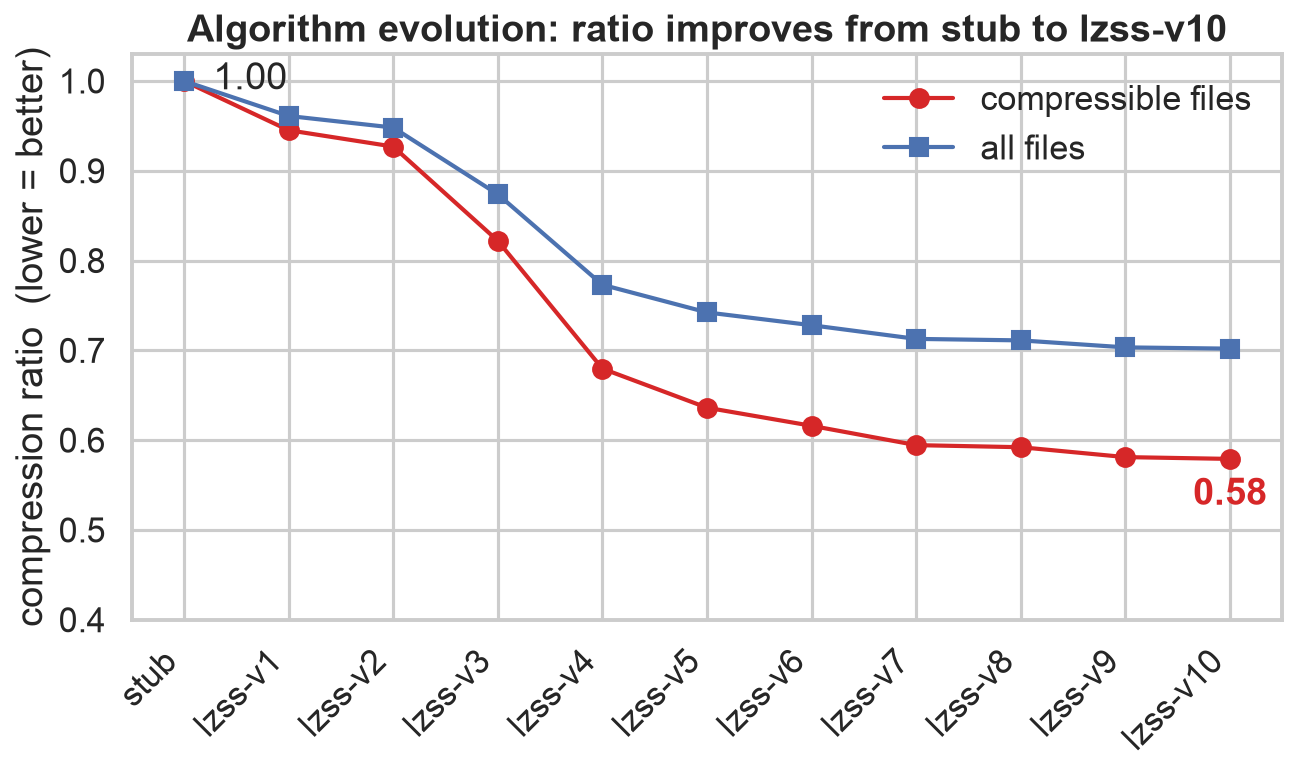
During the first iteration the agent produced a custom LZSS implementation, a fairly standard and well known method of compression. The next nine iterations were extensions to this method, adding new entropy checks and encoding techniques to try and remove entropy.
Each loop varied a lot in time taken and tokens used. On average, based on the `/usage` command in Claude Code, a single iteration cost about $4 USD. Again this was on the default settings so I am not reading too much into the price given how much that varies per model.
Interestingly the model never made more than one set of changes in a given iteration. It would form a hypothesis, add the code, run the benchmark and call itself 'complete'. This may come down to the prompting setup of not using the `/goal` command.
The results below show that the model was able to continue to make improvements to the compression factor. Looking in particular at the 'compressible' ratio the results were, in my opinion, pretty impressive given how loose the task was.
## Benchmarks
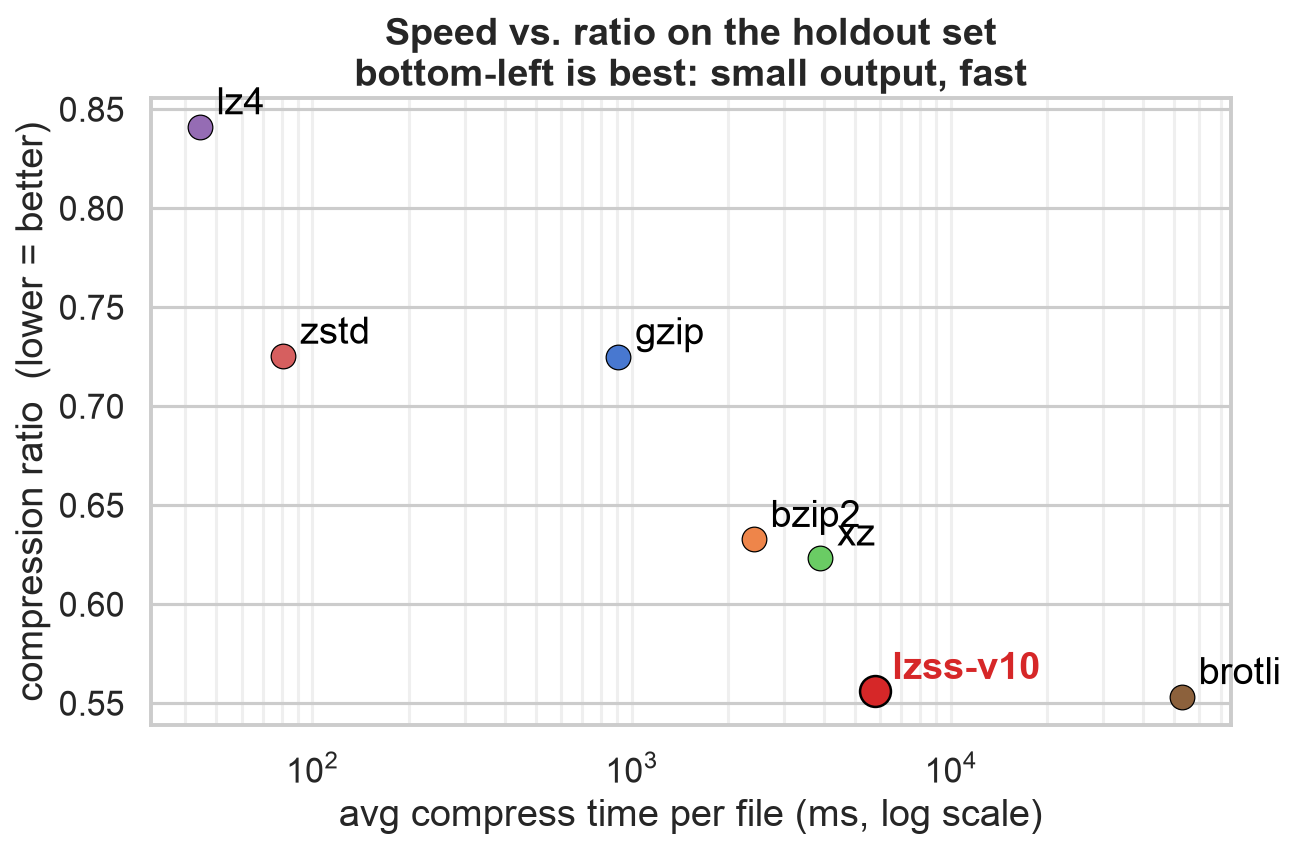
To assess the final results I ran several compression tools over the same dataset. These tools were chosen because they happened to already be installed. This is not the most robust method of choosing a benchmark but it does reflect a comparison to common tooling.
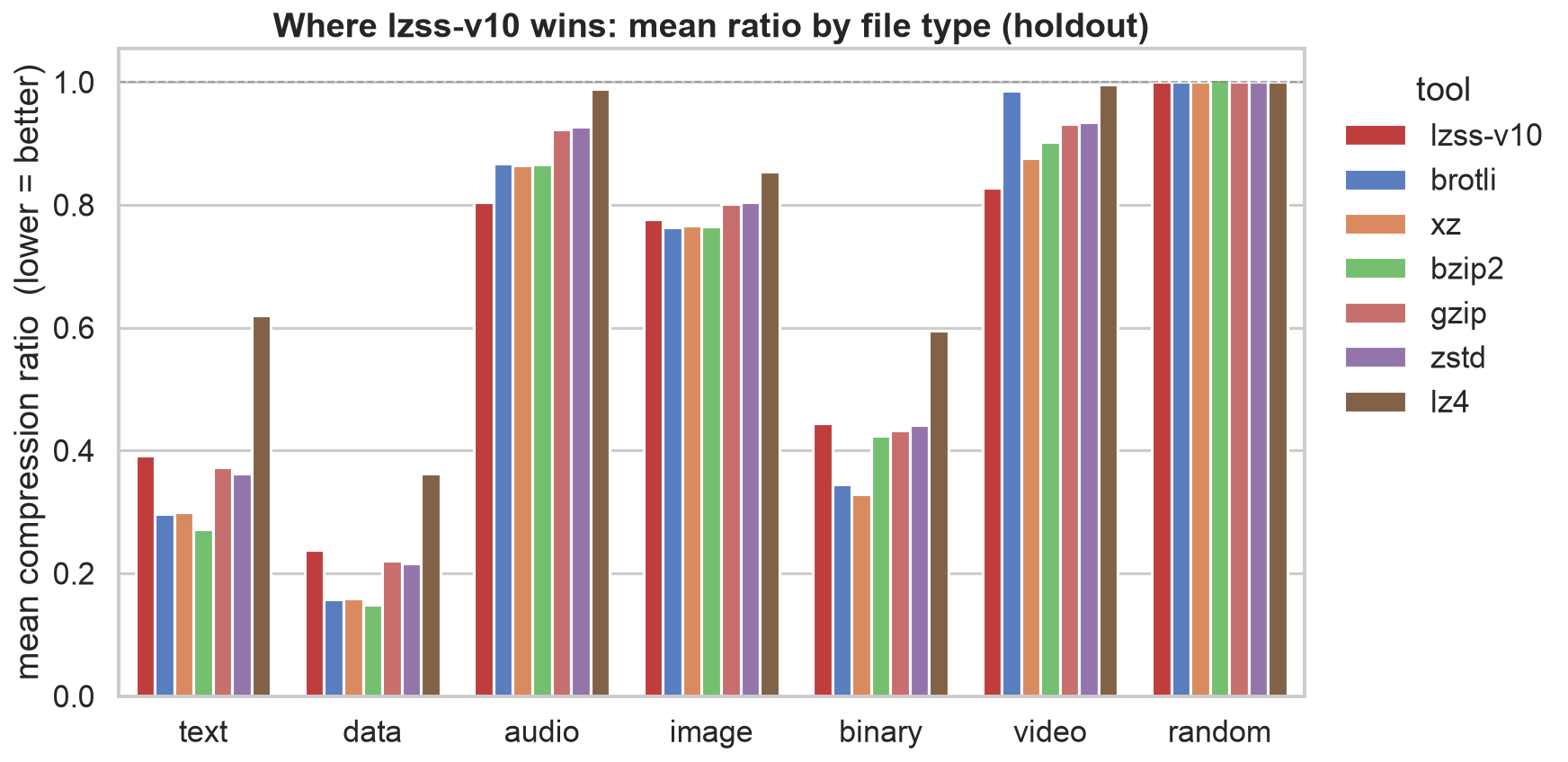
Overall the custom algorithm performed fairly well, it excelled at audio and video compression and was slightly worse or on par in other categories. The lower scores in audio and video aren't surprising given the metric used to optimise. These file types represented most of the bytes being compressed so the combined score was moved most by wins there.
Coming back to the goal of this project, this wasn't a quest to find a breakthrough compression algorithm but instead to develop some intuition about tasking an agent with optimizing software.
## Learnings
To wrap this up, and give folks something to skip to if this post is too long, here are some high level take-aways from this project. Overall, I think if you can find a robust, measurable and well constrained metric to optimise then this auto-research/loop style work makes sense. Finding one of those is often tricky.
### Models race to be 'done'
The overall feeling I had while watching/reviewing the setup was that it wanted to be 'done' as quickly as possible. Based on this I think having some explicit looping mechanism setup would be important for a real world version of this setup.
### The choice of objective function is key
Another observation I had was that the 300 second time parameter was likely far too loose a constraint. It was useful for capping the downside of a change but the model was only ever optimising for compression. A phenomenon recently captured by Mitchell Hashimoto in this X thread:
> I've got an agent in a loop optimizing a renderer with the goal to minimize frame times (and tests to measure). It got times down from 88ms to 2ms and allocations down from \~150K to 500\. Sounds good, right? Wrong. This is exactly why agent psychosis is a big fucking problem.
>
> As…
>
> — Mitchell Hashimoto (@mitchellh) [May 28, 2026](https://x.com/mitchellh/status/2060088112257372610?ref%5Fsrc=twsrc%5Etfw&ref=elliotcsmith.com)
A real world application of this method would either need a more complex 'score' to optimize or to later switch to an optimisation for speed. The same can be said for other secondary metrics like code length, memory usage etc.
This is by no means a new issue or one that is unique to agent based coding. Choosing measures of 'success' and 'done' has long been a challenge in engineering organisations. Realistically any metric or combination of metrics is going to come with trade offs. You probably just need to get comfortable with that fact and be willing to shift your focus over time as the needs change.
I saw recently that PostHog was doing some work in this space with their new PostHog Code product. Allowing users to bring product analytics into their coding agent context to better guide decisions. I'm yet to test it out but it feels like the right direction.
### Real world objectives are rarely as simple to measure
While discussing metrics it's worth considering how this technique might differ in the 'real world'. A compression tool has a very fast feedback loop. You can take a file, compress it, decompress it and compare the results. If this change was more broad, say "Improve the checkout conversion rate," you'd need a lot more time to gather samples and you'd be a lot more susceptible to noise in the data.
One solution here is to optimize a proxy metric with the hope/hypotheses that it will improve the conversion rate. That might be something like 'improve page load speed' or 'reduce the number of clicks needed to checkout'. This could certainly be more easily iterated on but you then run the risk of over-optimising on a proxy metric that only loosely correlates with your final goal. It is rate to find a proxy metric that is perfectly and linearly correlated with a more complex one.
## Limitations
Some very brief acknowlegements of limitations here:
- Model choice, how long are these results valid. Models change all the time (Sonnet 5 came out today), realistically the results of this same trial today will likely be quite different.
- Cost, is this sensible? Based on Claude's estimates each loop cost about $4 in tokens. You'd need an ROI to do this in a 'real' product. $40 (10 loops) isn't a high bar but running a loop like this for every change in a code base could be costly.
- Single machine, single thread results. Compression benchmarks vary wildly across CPUs, these were all done on an M2 Macbook Pro but I am sure the results would have differed in other scenarios.
- Choice of optimisation function. This is the biggest one, outlined several times above, had I chosen something like `average( compressed / raw)` or even `median` the path to better would have looked very different. I've written a lot about [choosing metrics](https://www.elliotcsmith.com/how-to-avoid-picking-terrible-metrics/) in the past and this applies to agents as much as it does to humans.
### Findings, May 2026
URL: https://www.elliotcsmith.com/findings-may-2026/
Last updated: 2026-06-02T23:30:20.000Z
# Assorted Links
- I finished book eight of [Dungeon Crawler Carl](https://mattdinniman.com/?ref=elliotcsmith.com). Loved it. I have recommended the series to a lot of different people now with a pretty good hit rate. If you haven't read it yet, you should.
- This was a fun read [https://tastecooking.com/i-want-to-live-like-costco-people/](https://tastecooking.com/i-want-to-live-like-costco-people/?ref=elliotcsmith.com)
- I've been in the mood for something casual to play so I picked up [Fields of Mistria](https://store.steampowered.com/app/2142790/Fields%5Fof%5FMistria/?ref=elliotcsmith.com). If you've played Stardew Valley it'll be familiar. It has enough differences to be interesting and a good way to unwind.
- I am very far from being an expert in K-Pop but I loved the way this story was put together: [https://pudding.cool/2026/05/kpop-generations/](https://pudding.cool/2026/05/kpop-generations/?ref=elliotcsmith.com) I'm generally a big fan of any examples where the web really shines as a medium for telling stories.
- Speaking of which, here's another one, this time with a more technical goal: [https://myzopotamia.dev/navier-stokes-fluid-simulation-explained-with-godot](https://myzopotamia.dev/navier-stokes-fluid-simulation-explained-with-godot?ref=elliotcsmith.com)
# Things I'm working on
- I've been working on a project applying the whole 'auto research' idea to compression (think zip files etc). I wanted to see how things went when the task had a less clear gradient signal and how well AI could iterate towards a solution. Write up coming soon.
- I've also been experimenting with using Claude as a coach for running and learning Japanese. I would say both are good but not great. They collate a lot of public info and communicate it well but I've called it out on a few mistakes in both cases which make me hesitant to use it for things where I have zero prior knowledge.
- I am in the middle of a week off at the moment between my previous job and a new one. Spending the time doing a lot of reading about how AI is (and isn't) having meaningful effects on engineering teams and product teams. There is a lot of noise in this space, that's for sure.
## In case you missed it (my posts)
[Momentum is the Safest MoatIf you are at all worried about AI disrupting your business, learn to build momentum. Your ability to execute more reps that your competition is, and always has been, the best moat. The trigger for this post was hearing that Claude Code was built in a weekend. It’s probably mildlyElliot C SmithElliot Smith](https://www.elliotcsmith.com/momentum-is-the-safest-moat/)
[Don’t sell the build effort.There’s a trend I have noticed when folks try sell software, their perception of how hard it was to build the software influences their comfort in setting a price. More difficult to build, more expensive. Easy to build, we can’t charge a premium for that! This is tangentially related toElliot C SmithElliot Smith](https://www.elliotcsmith.com/dont-sell-the-build-effort/)
[Build ‘Taste’ for the critics but ‘Care’ for the fans.There are a lot of folks out there tell you that what matters now is ‘taste’. Some loosely defined term that boils down to “know if the output is slop or not slop”. While it is probably a useful skill, I’d argue the thing that will ultimately determine if yourElliot C SmithElliot Smith](https://www.elliotcsmith.com/build-taste-for-the-critics-but-care-for-the-fans/)
### Momentum is the Safest Moat
URL: https://www.elliotcsmith.com/momentum-is-the-safest-moat/
Last updated: 2026-05-09T01:47:42.000Z
If you are at all worried about AI disrupting your business, learn to build momentum. Your ability to execute more reps that your competition is, and always has been, the best moat.
The trigger for this post was hearing that Claude Code was built in a weekend. It's probably mildly exaggerated but it led a lot of folks to claim that it's not worth much if its that quick to build.
That version, the one the shipped that weekend, probably not.
The fact that they kept shipping however, is very valuable.
This isn't something specific about Claude Code or the team at Anthropic. Teams that are able to move quickly will win in the long run, as long as they can meet two criteria.
That is assuming that they can keep up the speed as they scale, and that they're moving cohesively.
Most companies slow as they scale. Most slow down faster than they scale up. Taking the momentum metaphor literally, their momentum goes down. Moving fast as you get bigger is hard. It feels necessary to slow down as you get bigger, there's more to lose and more people involved in the process. This isn't building momentum.
More people means more process, more layers of communication and more chance of incoherence. You still ship quickly but what you ship is almost random. Features come out but top line metrics don't move. This isn't building momentum either.
Momentum is fighting the urge to add process and ensure you're shipping valuable features again and again.
It takes a lot of effort. Mostly saying no to things. Strip back the things that aren't "deliver more value" and then find out how to do that faster.
This is how you take on a giant. Arguably this even applies to things like Claude Code. The bigger it's gotten, the more that's been added and the more the team has been focused on other things, the less momentum they maintain.
They will have economies of scale, network effects, cornered resources and all the other things we typically associate with moats. Those haven't gone away. Your ability to move fast enough that they don't hold the same weight is what's new.
Get stuck in, keep your head down, do the reps.
### Don't sell the build effort.
URL: https://www.elliotcsmith.com/dont-sell-the-build-effort/
Last updated: 2026-05-07T09:47:34.000Z
There's a trend I have noticed when folks try sell software, their perception of how hard it was to build the software influences their comfort in setting a price. More difficult to build, more expensive. Easy to build, we can't charge a premium for that!
This is tangentially related to cost vs value based pricing but the 'cost' here is the one time build cost rather than the ongoing running cost. In recent conversations I've seen this phenomenon affect people in both sales and technology.
Lets think about a scenario here that might illustrate the point. Imagine a startup that's been building a product for two years and is now hiring their first sales person. They have some initial users but it's now time to price and sell the product outside of any 'early adopter' discounts.
First, imagine you're the technology lead. You've proven people want the thing you're building and now you need to recoup the time and effort you've put into the product. You know every feature inside and out and saw the five versions of that feature that came before. All of that time and attention has been tough, the reward needs to reflect that.
Sadly, the world doesn't work that way. Your new customers never saw versions one through four and nor should they. They want version five and they want it to solve their problem. That's it.
Now lets flip things and think about the perspective of a sales person who has only the context of the here and now. From their perspective the work is done. The thing is built and we all know the running costs are near zero. We don't need to earn back our R&D costs, those were the price to get here but are an artifact of the past. Let's pick a price point here that maximizes commissions and minimizes effort.
That is somewhat embellished I'll admit but I have seen similar arguments, especially when it comes to releasing new features. The new feature makes sales easier, if the price goes up then it'll be harder to sell. The work to make the feature becomes irrelevant, lets keep the price the same and sell them even more for the same price.
Both of these approaches are common. Neither of them means you wont get any sales but they're both disconnected from the optimal price point, one set through value based pricing.
As a brief aside, I see this 'effort high, price high' pattern a lot in university spin outs. These are by far some of the most extreme example of this, added here to paint the expensive end of the spectrum. In those cases the cost to develop the underlying technology can be astronomical and may be tied up in decades of research and effort. Oftentimes the businesses spun out from these research projects fail to find product market fit due to a strong bias of wanting to recover the research costs.
Value based pricing is old enough and well documented enough that I will cover only the high level here. You should discover how much value your product delivers to the customer, in terms they care about, and charge a mutually agreeable fraction of that value as your price. If you save a customer a million dollars you could charge half of that and both come out winners.
The reason I've been thinking about this lately is two fold. First, I have had some discussions recently about where pricing should live in the org-structure. Second, if the promise of AI based coding tools plays out then the effort to do things is going to decrease, potentially leading to a push for a lower price.
On the first point, where pricing should live, this is going to be very company dependent. My main comment here is that if pricing is determined by sales or engineering/product there is a high chance those biases above will come into effect.
As with most things relating to org-design you want individual incentives to align well with company incentives. This is going to be harder to achieve in a smaller team but having a dedicated 'pricing' person/team lets you set an independent success metric around finding a price as close to 'optimal' as resources allow.
If you're a founder or small team, how you handle this is going to depend a lot on how you're running your business. If you've raised money from venture capital you've banked on these costs and have raised to afford the luxury to recoup them over a longer time period. If you're bootstrapped or light on funding you've got to be even more aware of how setting the price plays into your long term cash flow.
On the second point, how AI will play a part here, I think there will be a reinforcement of the bias towards 'easy to make, should be cheap'.
To some extent that position is correct. If you have a competitive market you'll eventually find someone willing to charge less to capture more market share. This drives down the price of things in a way that's typically better for the end consumer.
This is fine in the theoretical market sense but for anyone building a startup or operating in a niche the dynamics don't play out the same way. You still have price pressure from competitors but you're ideally competing on maximum values rather than minimum price.
If you are competing on value the pressure to lower costs because 'AI makes it cheap to make this now' is something to be keenly aware of.
Generally, if you're getting this advice from people well outside your niche you should probably just ignore it. The zeitgeist of 'AI will kill SaaS' is likely very over exaggerated in the same way that we once heard stories of how everyone would have a 3D printer at home to print all their physical goods.
So what do you do?
You can't write these costs to zero and pretend they didn't exist. You spent the money on R&D and need to earn it back. You need to make sure your price point gives you an ROI on that spend in a reasonable time but it shouldn't be your primary driver. The specifics of estimating your value based price are a topic for another day.
Better yet you should be thinking about these things prior to the R&D effort. While R&D spend is hard to predict, if you can ball park your target price point you can put a budgeted cap on how much you're willing to spend getting there given the cash you have.
This has become a much longer post than I originally intended so to end with somewhat of a summary: When deciding your prices, the effort to get from zero to where you are should not be a deciding factor.
### Build 'Taste' for the critics but 'Care' for the fans.
URL: https://www.elliotcsmith.com/build-taste-for-the-critics-but-care-for-the-fans/
Last updated: 2026-05-05T08:52:22.000Z
There are a lot of folks out there tell you that what matters now is 'taste'. Some loosely defined term that boils down to "know if the output is slop or not slop". While it is probably a useful skill, I'd argue the thing that will ultimately determine if your AI assisted software is how much you care.
[Why taste is the most important thing in an age of AI, from Alex Komoroske | Lenny Rachitsky | 13 commentsWhy taste is the most important thing in an age of AI, from Alex Komoroske | 13 comments on LinkedInLinkedInLenny Rachitsky](https://www.linkedin.com/posts/lennyrachitsky%5Fwhy-taste-is-the-most-important-thing-in-ugcPost-7248041382622175235-Uiui/?ref=elliotcsmith.com)
When I think about the origins of the term 'taste' I think about that often quoted speech by Ira Glass:
He uses the word 'taste' within the video as a way to help encourage people to stick to things long before they can produce things to the quality they desire. I think in this form 'taste' means something pure.
More than a decade later I think the intention has been twisted in it's recent usage. Taste is no longer about you and your vision for something, it's about meeting a bar of 'quality' set out by someone else. If it wasn't you could never hire for or judge someone on their ability to have 'taste'.
Okay so why the two terms. Why don't we just say that's 'Taste'?

This is why. Loved by critics, hated by players.

Or this. Hated by critics, loved by viewers.
Or the countless others where the folks who pride themselves on 'knowing if things are good' differ wildly in opinion to the masses. They often live in bubbles, driven by incentives that are absent outside those bubbles.
This matters because your customer is probably in the second category. Those are the people who won't just use your thing once to write up a review, they're the folks that will use it every day.
The secret to impressing them is to care about them a lot. Not to care about what they might say in a review but to care about solving their problems in a way that matters to them.
They probably won't care about your tech stack. If your product works they're probably pretty forgiving with design. They certainly don't care if you used Claude or Codex.
This strange divide exists in all software, even B2B SaaS apps and strange niche software. So many of today's leading products seem odd and clunky to the unfamiliar but have cemented themselves because they work and work well.
I don't know if Ira Glass meant 'taste' for the 'taste makers' but when I listen to that talk I think he meant: continue to work at it because you care about realizing your vision, because sometimes you can venture paste done a little more towards perfect.
### Findings, April 2026
URL: https://www.elliotcsmith.com/findings-april-2026/
Last updated: 2026-05-03T01:44:59.000Z
# Products, games, books and links
- I watched [Company Retreat](https://www.imdb.com/title/tt22074164/?ref=elliotcsmith.com). The bits for the audience are a bit odd but they continue to find the all around nicest folks to star on this show. It felt like it happened a lot faster than the previous show but still overall a good watch.
- [https://www.aprilcools.club/](https://www.aprilcools.club/?ref=elliotcsmith.com) \- I like this idea of just writing about things you like that you're not typically writing about. There's a tech 'theme' to this blog for sure but it seems nice to write about other things from time to time. I missed the chance for the 'April' part of it but I'll keep it in mind.
- [https://stevehanov.ca/blog/how-i-run-multiple-10k-mrr-companies-on-a-20month-tech-stack](https://stevehanov.ca/blog/how-i-run-multiple-10k-mrr-companies-on-a-20month-tech-stack?ref=elliotcsmith.com) \- This reminds me of the many posts on boring technology. I think now that there are so many folks building apps for the first time it's worth spreading the message that you don't need a multi-region Kubernetes cluster to launch your product. Arguably, you probably never do.
[@smitec - areyougoingexponential.rhys.dev@smitec has 1,898 contributions on GitHub. Elliot Smith’s GitHub contributions are up 383% over the last 6 months.areyougoingexponential.rhys.dev](https://areyougoingexponential.rhys.dev/smitec?ref=elliotcsmith.com)
There's probably a little bit of missing data on this one as I spent a couple of years on Gitlab and Bitbucket but it certainly confirms that these last few months have had a lot of output.
- I read '[The Goal](https://en.wikipedia.org/wiki/The%5FGoal%5F%28novel%29?ref=elliotcsmith.com)' over a weekend this month on the back of a recommendation. I enjoyed it. I like the whole 'business novel' format over the traditional 'padded out blog post' setup. It reminds me of 'The Five Dysfunctions of Team'. I do think the ending was a little abrupt though.
# Things I'm working on
I have two projects (outside of my professional life) that I am currently working on. They're not ready for a link just yet but in short:
- Three close friends and I have been running a weekly goals / check-in group for about five years now, inspired by this post: [The Elephants](https://nickcrocker.substack.com/p/the-elephants-182870501589). We've been hosting it on a free WordPress instance but it has given us trouble lately so I figured it was a good project to tackle. It's a pretty simple app that's a combo of blog posts and tracking goals in a spreadsheet.
- I'm working on a headless ticketing system similar to zendesk but built to be embedded into your own application. I've found more and more businesses operate over email and there's plenty that can be done to make that smoother. This one has a healthy sprinkle of AI functionality in it as well. I hope to have an alpha version out this quarter.
# In case you missed it (my posts)
[Web Scale has changed.Writing an application that supports millions of users is much more difficult than writing one that supports hundreds. Historically, B2B SaaS apps aimed to grow big enough to need to worry about supporting that many users. Thousands of companies with thousands of employees. Having done that work gave you aElliot C SmithElliot Smith](https://www.elliotcsmith.com/web-scale-has-changed/)
[Spreadsheets and Disposable SoftwareA trend I am seeing, and experiencing, is an increase in disposable software. Software that does a little thing, for a little while and then gets deleted. No long term plan for maintenance or support. Like everything, there’s positives and negatives to the change. Overall I see more software goingElliot C SmithElliot Smith](https://www.elliotcsmith.com/spreadsheets-and-disposable-software/)
[I’m long on software engineeringSomebody asked me recently if I thought we would need more or less software engineers in the future. If it wasn’t obvious form the title my answer was ‘more’. They were asking in the context of AI code generation but my feelings on the matter apply fairly broadly to anyElliot C SmithElliot Smith](https://www.elliotcsmith.com/im-long-on-software-engineering/)
### I'm long on software engineering
URL: https://www.elliotcsmith.com/im-long-on-software-engineering/
Last updated: 2026-04-14T11:08:54.000Z
Somebody asked me recently if I thought we would need more or less software engineers in the future. If it wasn't obvious form the title my answer was 'more'. They were asking in the context of AI code generation but my feelings on the matter apply fairly broadly to any flavor of "If technology X does everything we can do today, are we done for?"
I am a strong believer that no matter what technology we invent there will always be people looking to push beyond it. Short of discovering a long lost cache of magic wands there will always be people looking to push beyond the best of what we have.
I find that exciting and optimistic. It's not without it's challenges but our desire to push the envelope is one of the best things about us. (Ensuring the direction is more 'good' than 'evil' is a topic for another post).
Let's take our current situation as the example. We have software we can use to write a good chunk of the code that humans wrote last year. It's not perfect, its not free but neither was last year's code. Looking at releases like Mythos we might be on the cusp of another big shift in capability (if the stories prove true and not just marketing).
Given all that I don't think we'll suddenly be happy with last year's code replicated a million times. We'll want an initial injection of that, maybe a few more layoffs, but sooner or later our expectations and ambitions will realign to this new normal and we'll start asking for more. More than these models can deliver, faster than they can be improved without smart people at the helm.
There will be plenty of companies that are perfectly fine with last year's code. They might need less engineers. This isn't new. Companies get big, transition from features to support and stop investing as much in R&D. This was the same '[innovators dilemma](https://en.wikipedia.org/wiki/The%5FInnovator's%5FDilemma?ref=elliotcsmith.com)' style cycle first published thirty years ago. AI hasn't fundamentally changed the pattern, even if it has made it faster.
What we will hopefully see more of is those big companies that were once startups hitting an exit scenario and releasing a new era of cashed up smart people back into the world. Mix those folks with other ambitious people and you've got a path to a new generation of companies.
Equip these future founders with tools to build bigger and bolder things and hopefully we'll see more humanity scale problems being solved (and maybe a little less B2B SaaS).
### Spreadsheets and Disposable Software
URL: https://www.elliotcsmith.com/spreadsheets-and-disposable-software/
Last updated: 2026-04-12T10:11:03.000Z
A trend I am seeing, and experiencing, is an increase in disposable software. Software that does a little thing, for a little while and then gets deleted. No long term plan for maintenance or support.
Like everything, there's positives and negatives to the change. Overall I see more software going the way of the spreadsheet: useful, accessible but ultimately disposable.
On the positive side of things I am a big supporter of any change that helps people make more things. That applies to helping new people make things they couldn't make before, and making it easier to make things you'd otherwise not have time to make. I've started to see a lot of projects that would otherwise never see the light of day. They're not all destined to be billion dollar SaaS apps but most of them aren't trying to.
People, like with spreadsheets, are building little things for themselves or for a small group of people.
I find amongst software people, those that were making things before, this shift has mixed feelings. The norm for a long time was to, whenever possible, avoid writing software over and over. We have millions of tiny little libraries and frameworks designed to ensure you're not reinventing things over and over.
There are arguments to be made that this had become a bit extreme and we were importing trees of dependencies to avoid writing basic functions but lets ignore that for now.
Where the negatives start to creep in are around the whole idea of disposal. The term itself is typically used in a negative light. Things created or destroyed without care or concern. This argument seems to be more popular amongst those who feel the power or water costs of AI don't provide an ROI.
Data centers certainly use their fair share of resources, both in training and in inference, but it's hard to think the right path here is shutting things down. There are endless other ways that folks could be spending their time but making things, for them or for others seems like a generally positive outlet.
There's no doubt going to be an initial burst of 'waste' as people try thing, make mistakes, build their 'fart apps' and then get bored. If we pay that price to give thousands or millions of people the tools to build things then maybe it's worth while. If nothing else I think more use will help more people understand these tools more, know their limits and dispel the hype.
After all, spreadsheets had their hype cycle too.
### Web Scale has changed.
URL: https://www.elliotcsmith.com/web-scale-has-changed/
Last updated: 2026-04-05T11:31:38.000Z
Writing an application that supports millions of users is much more difficult than writing one that supports hundreds. Historically, B2B SaaS apps aimed to grow big enough to need to worry about supporting that many users. Thousands of companies with thousands of employees. Having done that work gave you a moat, it was hard to replicate.
If that requirement is gone, the moat might be as well.
Let's think about some example apps here. JIRA and Slack, or their variants, are likely in the tech stack of most companies working with technology. These products have growth to support truly massive user bases and had the valuations to show it. Unless you're an enterprise user you get mostly the standard feature set, possibly customizable through extensions or add-ons.
Every team that purchased a JIRA or Slack subscription was adding users to the pool. Uptime got harder for Atlassian and Salesforce because most users means more potential for things to go wrong. Engineering teams grew. SRE becomes a major focus. Certifications like ISO27001 and SOC2 become essential because you're trusting a third party with key company data.
Of all the things AI can do, cloning a big app in a small way is high on it's capability list. Some apps, like Spotify or Netflix, [can't so easily be cloned](https://www.elliotcsmith.com/are-they-software-companies-or-do-they-just-have-software-problems/) because their value isn't in the software. Your ability to create a web app that plays audio or video isn't a threat to their business model.
For JIRA and Slack though, being able to replicate a mini-version might be an issue.
I'm not claiming here that you could rapidly spin up a JIRA competitor that could handle the same usage and growth. I am claiming you probably don't need to. If you're building a single-use JIRA just for your company, you probably have a tiny fraction of the user base. Building an app to that scale is a whole lot easier.
This has effects across the software supply chain. If we don't need heavily replicated data bases on every continent, AWS bills will go down. If the product lives only within the company VPN, the barrier for security gets an inherent boost. Not a free pass by any means but IT teams have become very good at keeping things within walled gardens.
Not every company is going to have the desire or the resources to build their own JIRA or Slack. Especially if they're happily being used right now. There's a long history of purchasing software that needs to be overcome.
This does mean there's likely an opportunity here for new smaller vendors. Especially for vendors willing to take a simple core version of a product and rapidly customize. Enterprise teams are very unlikely to shift in a hurry but there's thousands and thousands of smaller deals out there waiting to be won.
Personally, I find this exciting. I am hopeful we'll see a wave of new ideas, new business models and new remixes of old software in a way we hadn't before. I hope that some portion of that happens enough in public to encourage standing on the shoulders of others and making things that genuinely help people. The moat created from being the largest player in the space always seemed like the most satisfying to erode.
### Findings, March 2026
URL: https://www.elliotcsmith.com/findings-march-2026/
Last updated: 2026-04-03T08:04:26.000Z
# Products, Games, Books and Links
- Like many other folks I know, I spent a lot of time in March playing [Slay the Spire 2](https://store.steampowered.com/app/2868840/Slay%5Fthe%5FSpire%5F2/?ref=elliotcsmith.com). It's still in early access but already feels like it's improved on the original. A statement I don't make lightly.
- I also spent some time playing a bit of the new [Pokemon Pokopia](https://pokopia.pokemon.com/en-us/?ref=elliotcsmith.com). It was a fun Animal Crossing style game in the world of Pokemon. I got about 80% of the way through the main story line before getting a little distracted with other things.
- I finished the second and third book in the [Library Trilogy by Mark Lawrence](https://www.penguinrandomhouse.com/series/FQ7/the-library-trilogy/?ref=elliotcsmith.com). I enjoyed them both, particularly watching the story become more complex as the trilogy developed. If you're a fan of light fantasy novels I'd recommend this one.
- [https://sive.rs/socials](https://sive.rs/socials?ref=elliotcsmith.com) \- This got me thinking about my own writing and presence on social media. I spend a lot of time wondering whether I should post more thing or just ignore social platforms. I certainly don't have the following of Derek Sivers but there is something in his message about sharing things you've made.
- [https://astral.sh/blog/openai](https://astral.sh/blog/openai?ref=elliotcsmith.com) \- If you don't write a lot of Python you might not know who Astral are. If you do then you've likely switched over to `uv` as your package manager and may well use some of their other developer tooling as well. I saw this news and have mixed feelings somewhere between apprehensive and disappointed. I worry about major parts of any developer ecosystem being merged into a big company. Doubly so because OpenAI have gone out of their way to try and do less things, meaning they either want the people (likely, they're smart folks) and the tools will slow or they really want to own python tooling for some yet unknown reason. Either case lowers my bet that `uv` and it's siblings are around in three years.
- [https://www.terrygodier.com/the-last-quiet-thing](https://www.terrygodier.com/the-last-quiet-thing?ref=elliotcsmith.com) \- This piece is a great example of when web pages really hit their stride in storytelling. The effects, visuals an subtle things (like the watch showing your local time) help build an interesting and engaging piece. The topic itself, the endless torrent of connected devices, is also timely and was an interesting read in contrast to the next link.
- [https://nearzero.software/p/warranty-void-if-regenerated](https://nearzero.software/p/warranty-void-if-regenerated?ref=elliotcsmith.com) \- This piece is a rare combination of well written, fun and likely predictive. It's in a way that you see in really good Science Fiction. The story itself is simple, a guy lives in an AI heavy future and spends his time helping people with their myriad of AI generated products. Working, both personally and professionally, with a lot of folks using AI at the moment this one felt close to home.
# Things I'm Working on
- I've got a new Django project on the go. Not ready to share that one just yet but it's been a lot of fun. I write about it below as the project coded 95% with Claude.
- I'm also working on a number of news aggregating tools to help with some things at work. Being in Logistics right now is certainly interesting and having tools that can find and summarise useful updates is proving useful to our commercial team.
# In Case you missed it (my posts)
- \- The Django project mentioned above. I ran this one as an experiment of 'AI take the wheel'.
- \- The SVPG article came up recently and I was thinking about how the rise in AI equipped teams of Engineers and non-Engineers was changing the pressure and dynamics of teams.
- \- One thing I think AI has become very good at is the 'software that kind of pleases everyone'. It can get you to 60% very quickly. Previous generations of SaaS were all about maximal configuration to serve as many customers as possible. I think as time goes on, that kind of low hanging fruit will be less and less defensible and what customers will pay for is your strong opinions on best practice. Assuming your opinions are correct.
- \- If your team is 10x more effective and you choose cut resources, that's somewhat of an admission that you didn't have 10x within your grasp to begin with.
- \- Many of today's best tech companies are arguably only tech companies because they need to be. People aren't seeking the technology, they want a service delivered by technology. Those services and the resources behind them are the real moats in these companies. For this reason, many of the tech companies people say are one prompt away from death are a lot more stable than they appear.
### Some thoughts after shipping a project 95% written by Claude
URL: https://www.elliotcsmith.com/some-thoughts-after-shipping-a-project-95-written-by-claude/
Last updated: 2026-03-27T22:55:41.000Z
I ran this as an experiment. It was a side project I was probably never going to get around to building. I wanted to test the most extreme version of "Let Claude Do the Work" and see where it got to. I avoided plugins and just ran the out of the box Claude Code experience prompting it towards the end goal.
The project isn't 'done' per-say but it is live and online and usable in some sense. With that in mind I wanted to jot down some early experiences.
If you're curious, the 5% missing from the title was mostly me making small adjustments to text or config that would have been quicker to adjust than to ask for.
For some more context, this was a Django project with a focus on minimizing dependencies so no React or other frontend frameworks in the mix.
- Claude loves to write code. Even when it doesn't need to. It would often write migrations rather than use the `makemigrations` command. They were usually correct but it seems like a waste of tokens.
- Tech debt became spec debt. I wrote a fairly detailed PRD initially based on what I thought the product should do. It was great in getting V1 out but later it seemed to bias the model towards meeting that spec even when we'd deviated from the original ideas.
- UI design wasn't great. I avoided plugins or using any visual tools for this project. Layouts were passable but often crowded or lacking structure. A good chunk of my revisions revolved around this.
- I used the `/clear` command a lot. I was working things out as I went along with this project. I knew roughly what it should do but found that a clean slate helped back out of a lot of rabbit holes.
- I've worked on other projects where I leave things in one long conversation. Plan mode and the occasional context compression seem to be mostly okay. Despite that I've found that regularly clearing the context has the added benefit that the prompts need to be clear and self contained which helps my thinking if nothing else.
- It definitely hallucinated but very rarely. I was adding Posthog to the project for event tracking and it called functions with arguments the function didn't have. This seems odd to me given the docs were likely available but once corrected it didn't make the same mistake later.
- The initial back and forth was interesting. I asked Claude to read my spec and work through a plan together. I was strict on not adding external libraries without permission and the process of talking through the plan and refining it was fun. It helped my thinking on the project and, despite the comment on spec-debt above, led to a better implementation.
- It helped a lot that I knew the stack pretty well already. A lot of the choices were between two plausible solutions but there was often a better choice for each. If I hadn't built a lot of similar projects before it may have been a bit of a guessing game.
- I could have tried asking Claude to weight up the differences, something I might do next time it happens to see what the outcome it.
- I really like making things. This project was on the back burner because the actual code writing part of this project wasn't fun. It's a lot of boiler plate and repetition. Seeing the outcome here gave me joy.
- Other projects are the opposite. The process of working on the code and getting deep into the problem is the enjoyable part there. This is often more 'technical' projects where part of the outcome is me understanding things more.
- There's still a lot of things you need to consider. A couple of weeks after putting the project live I noticed a slowly increasing number of non-activated accounts. Some bot had caught wind of the sing up form and would sign up 20-50 new accounts every day. Without monitoring and knowing why this was bad this could easily have gone on for months, ruining my sender reputation in the process. There is still a lot of 'engineering' work left to do in the a world where a lot of the 'software' is now written by the computer.
- If its a side project, you aren't going to need multiple instances of an agent running in parallel. I am sure that is useful at scale when you have a backlog full of issues but in reality the first phases of any new project are pretty linear. I certainly wouldn't have seen major gains from running multiple agents at once.
As mentioned, the project is still a bit of a work in progress. I'll post a follow up in a few months to see how my experience changes and hopefully share a link for anyone curious.
### Product Teams vs Feature Teams in an AI world.
URL: https://www.elliotcsmith.com/product-teams-vs-feature-teams-in-an-ai-world/
Last updated: 2026-03-23T21:04:20.000Z
All the way back in 2019, Marty Cagan wrote an article titled "Product vs Feature Teams". If you're building things you should read it in full but right now I want to take a look at how these ideas land as more and more teams are being encouraged to use AI in their daily workflow.
[Product vs Feature Teams | Silicon Valley Product GroupA partnership dedicated to teaching best practices to product teams and product leadersSilicon Valley Product GroupMarty Cagan](https://www.svpg.com/product-vs-feature-teams/?ref=elliotcsmith.com)
The Silicon Valley Product Group (SVPG) have written [many very popular books](https://www.elliotcsmith.com/untitled/) on how to run successful product teams and [product focused companies](https://www.elliotcsmith.com/svpg-notes/). A common theme across all of their work is that Product, the capital-p function in a business, works best when it's role is to maximize problems-solved rather than product features delivered. This helps empower people and ultimately, so they claim, deliveries more value to end customers. As worthy a goal in 2026 as much as it was in 2019.
## The third type of team and how to avoid it.
Before the article gets into full swing, Cagan points out a third type of team:
> The most common in terms of sheer numbers are not really product teams at all, they are ***delivery teams***. Also referred to as “dev teams” or “scrum teams” or “engineering teams” and if your company is running something like SAFe, then unfortunately this is you.
Through working with and within many engineering teams, I still think this is the most common team type by absolute numbers. I also think this style of team correlates fairly well with an initial burst of growth followed by a long stagnation.
What's missing in these teams is the process of product itself. These teams, often under the direction of a non-technical leader, are asked to "just build what I tell you". Those leaders have a grand, but often blurry, vision for what they want and teams end up shipping the 60% version of that vision quite quickly.
Once the initial version is shipped it becomes harder and harder to articulate what's missing. As a result, output, judged on the number of new things shipped, shifts to shipping small inconsequential tickets as fast as possible to maximize a metric.
This is likely to happen even more frequently in a world where AI can get you to the 60% version very quickly. Assuming your "scrum team" remains in place, the output here is going to be an increased focus on tickets shipped per week. These teams will still end up stuck in the 60% solution because churning through a backlog of tiny ideas is rarely the path to unique and valuable product.
As much as it ever was, the path to avoiding becoming one of these teams is to champion the value of Product. Someone within the organization needs to believe that there is value in the product management function and that taking the time to discover and refine ideas is worth more than hitting the maximum of tickets shipped per sprint.
Assuming you have no budget for additional people and you're in one of these teams this change can be simulated with some minor changes in process. Many of the AI models available today do an okay job acting as a product manager. They're not going to go and talk to customers on your behalf but with careful prompting you can inject some product consideration into the process.
As it does with Product, this process will take extra effort and intention. All the AI coding assistants I have used are biased towards action and speed to code unless you put them in a mode that slows them down. They may ask the occasional question but by default these are implementation details rather than product consideration.
These changes however, will shift your team into the 'Feature Team' setup rather than the 'Product Team' described in the article. It's still an initial step worth taking as skipping from 'Delivery Team' to 'Product Team' in one change is nearly impossible.
## Product Teams, Feature Teams and the Four Risks
When comparing the two main types of Product team, Cagan calls out four specific risks:
> *Value* risk (will people buy it, or choose to use it?)
> *Usability* risk (can users figure out how to use it?)
> *Feasibility* risk (can we build it with the time, skills, and technology we have?)
> *Business Viability* risk (will this solution work for the various dimensions of our business?)
Cagan states that the product manager is most importantly in charge of Value and Viability risk. Usability sits with design and Feasibility sits with engineering. Ideally all working together to solve problems.
What I like about this framework is that it aligns well with the current capabilities, and gaps, in AI tooling.
Feasibility risk has been significantly lowered thanks to AI coding agents. You still need someone in the loop to help make correct decisions but the leverage a team has to maximize time, skill and technology has dramatically increased.
Usability risk is also on its way down thanks to AI. Tools like [Google Stitch](https://www.elliotcsmith.com/playing-around-with-google-stitch/) can increase the leverage of a competent designer dramatically. The path to a viable prototype is now much shorter and design can focus on the small but high impact changes that are so often lost in the time pressures of shipping product.
> In the vast majority of cases where you have feature teams, the designer (if there is one) is a graphic designer. It’s not that graphic or visual design is not important, but what’s relevant here is that now there’s a big gap – someone needs to figure out at least the interaction design and hopefully do some user research.
Value risk, and Viability risk still remain outside the remit of AI. That's not to say ChatGPT wouldn't have opinions on whether a feature will sell. There have always been teams that are willing to build on internal opinions and those willing to do the hard work of talking to and understanding their customers.
Similarly, Viability risk is often reduced by saying no to things, something AI is not typically setup to do. While we all have access to a lot more output-per-workday than we did in 2019, we're still limited by the precious resource of time.
If, as most companies are, you're in competition with others, then the value of building only what matters is doubled. If your competitor ships a higher ratio of features that are valuable to your customer then they will start to become the preferred product.
I can foresee a lot of teams landing in the "Feature Team" bucket with an increase in AI tooling. When your designers and developers now seem to have multiplied, product managers in feature teams end up "herding cats" more than ever before. You've suddenly introduced another layer of hierarchy in your teams by turning developers and designers into managers of agents.
> The job of the product manager on a feature team is most commonly described as a form of facilitator, “herding the cats” in order to get the feature designed and delivered, or some nebulous and weak form of cross-functional leader that’s not really responsible for anything specific. These feature teams will often think they are doing product discovery, but really it’s just design and maybe a little usability testing.
Looking at the opposite state now, the Empowered Product Leader, how can they thrive in a world full of AI tools?
Firstly, I think a focus on maximizing "problems solved" remains as important as ever. As we see more and more [AI related layoffs](https://www.elliotcsmith.com/what-do-ai-based-layoffs-say-about-tam/) there is a clear bias towards AI being a tool to maximize efficiency. Teams will end up measured on tokens used per day in much the same way that they were once measured on lines of code committed. If an organization has the foresight to focus on measuring and solving real problems those tokens are going to be far better spent.
I am not advocating by any means for a complete avoidance of efficiency maximization but the goal, and metrics, should be true efficiency gains rather than some loose leading metrics.
An AI equipped product leader should be spending as much of their time refining as they are executing. That means talking to customers, planning out how features should interact and fit into the product and how their success will be measured.
All of these steps can be assisted by AI tools but an Empowered Product team isn't going to assume that whatever training and prompts an off the shelf AI model comes with are a substitution for this work. Forgetting this will result in the sudden launch of thousands of indistinguishable products all generated by similar prompting.
This brings with it a focus on craft and quality over pure output. Customers are fast developing a distaste for rushed, sloppy features pushed out without care or attention. Even in 'boring B2B' there's value in care and attention. I'm yet to meet a company that managed to find product market fit through thousands of A/B tests or by shipping feature after feature until all users were happy.
Being 'Empowered' as Cagan describes it is all about having the ability to choose what you deliver knowing it's in service of solving problems. It takes a certain amount of trust in those teams because seeing results takes longer. These teams will be judged on the ultimate success or failure of their work rather than the speed of their output. This comes with both higher risk and higher reward.
When teams can say "well we shipped all the things quickly, don't blame us" then they decouple themselves from the success of whatever features were shipped. In large or inefficient organizations, this results in long lived zombie-teams that are immune to any scrutiny short of a major organizational restructure. This can be great for job security but is very likely to limit your potential for career growth.
As an AI driven push towards output at all costs lands more companies into the Feature team / Delivery team mindset I'll wrap this up with one last snippet from the original article. As you read it, imagine that 'true product manager' to be the kind that has access to, and mastery of the AI tooling to scale the term Empowered:
> It is sad to me that so many designers and engineers have never been exposed to a true product manager, and have never been able to work on a truly empowered team. This is why I argue that there is so much underutilized talent out there, and why I continue to try to persuade people to try working like the best companies do.
### Build SaaS with Strong Opinions
URL: https://www.elliotcsmith.com/build-saas-with-strong-opinions/
Last updated: 2026-03-19T19:40:48.000Z
There's no product more at risk of AI obsolescence than the 'everything for everyone, configure it yourself' SaaS product. These products exist in abundance, selling themselves on the fact that they don't constrain your process, you do the work your way and we'll meet you there. That used to be worth $99 a month per user, but its not any more.
If you are buying B2B software, you're looking to solve a problem. You want to swap some of your money (and time) in order to generate value or remove pain. Software was, and continues to be, a great tool to deliver that outcome. With the sudden rise in AI software development capability however, the bar has significantly lifted.
A handful of years ago, you would be applauded for configuration. Businesses work in many ways and if your best practice didn't gel with your customer then you were going to lose out on sales.
The solution to this was the rapid rise in configuration. Tools, especially systems of record like Salesforce and ERPs provided nearly endless customization so that you could encode your way of working within their system. They build lots of little tools that provide the framework for you to 'digitize' your best practice.
Today, you can likely employ a mid-level developer with a Codex or Claude Code license to do that same work. You swap a monthly fee for a salary but what you build is yours to own and shape how you like. If you already have mid-level developers with AI access on your team this becomes an even easier decision.
Before you suggest that it'll never get past IT without ISO and SOC2, remember that spreadsheets are likely still the biggest alternative solution for most of today's B2B SaaS tools.
So where does that leave SaaS founders? Well, in my opinion your best bet is to throw out the old 'configure it all' mentality and do the hard work of figuring out what works best then sell that as a strongly opinionated piece of software.
I think more and more, businesses will pay to shortcut their way to best practice rather than buy the tools to go on that journey themselves. This lets these businesses focus on their unique value and not waste time reinventing the same sales pipeline process used by every other company in their industry.
I am not suggesting this is an easy process. For many SaaS companies, they product they sell is abstract and their team is only tangentially tied in with the industries they sell to. With this in mind I think companies that[ combine services and software](https://www.elliotcsmith.com/thoughts-on-service-and-tech-startups/) are going to have a unique advantage.
Having team members living and breathing the work you are building tools for means you have the best test environment any product manager could ask for. You can work out what best practice looks like and then bundle that up and sell it to your peers.
It may sound a little crazy to sell best practice to your competitors but in many industries there's nearly no chance at a winner-takes-all end game. Trades and other people based services just don't roll up that way very often. You can become a very valuable company by playing a second game that those competitors aren't equipped to play.
Think of it like Amazon selling their Amazon Basics line. They're one of many in a crowded market and having those products there is probably not materially taking business from others making door handles or plain black t-shirts.
If you go down this path, the sell looks different. You need to now sell to peers and convince them that you have figured things out. This is going to take demonstrated proof and is again why the services and software combination is uniquely powerful here.
Trust me, from my early days trying to sell into the medical world, nothing came off worse than the image of some tech folks thinking they could come in and 'fix' things. We needed to become part of the industry before we could build the trust.
The same is true in my work today in logistics. We do the grunt work in freight and supply chain services to optimize technology that learns from our experience. That experience is the thing that is valuable,[ not the software itself](https://www.elliotcsmith.com/are-they-software-companies-or-do-they-just-have-software-problems/). Especially as that software becomes cheaper and cheaper to produce.
It's the strong opinions, backed by experience, on *what* software to be building that will drive the next generation of B2B companies.
### What do AI based layoffs say about their ability to scale?
URL: https://www.elliotcsmith.com/what-do-ai-based-layoffs-say-about-tam/
Last updated: 2026-03-16T11:12:50.000Z
It's been a rough couple of weeks to be in a tech company. There have been widespread layoffs across many large SaaS companies.
WiseTech, Block, Atlassian and more have let go thousands of staff claiming that AI is making them significantly more efficient. I don't totally believe it's true but if it is, it sends a pretty strong message about TAM and growth.
Walking through the logic these companies are using says that thanks to AI we are now all twice as efficient (lets round to 2x for now). As a result of this new found efficiency, we will remove half our staff. This cuts costs from our bottom line and makes us more profitable.
None of the above is flawed (assuming the 2x is true). Cutting your cost base, often the biggest set of expenses, is good leverage towards profitability.
What it does say however is that these companies are hamstrung trying to double in size.
Why? Because if you take the same 2x improvement, in theory these companies should be able to double their output. If doubling their output doesn't double their revenue then they're at some sort of a ceiling.
While it shouldn't be surprising that a company[ can't grow forever](https://www.elliotcsmith.com/infinite-avocados/), many of these companies are valued on the assumption that they have plenty of room left to grow.
If that assumption no longer holds true then there is a much more significant correction that needs to happen here. If Atlassian, or any of the others, is going to grow like a traditional business, its revenue multiples will need to adjust accordingly.
I think we're starting to see a little bit of this already with big downward swings in the market across technology but there still seems to be a positive market sentiment to AI layoffs. Short term, the numbers stack up, more profits today due to lower wage bills but we'll need to wait and see how those figures play out a year from now.
### Are they software companies or do they just have software problems?
URL: https://www.elliotcsmith.com/are-they-software-companies-or-do-they-just-have-software-problems/
Last updated: 2026-03-14T10:48:51.000Z
You don't need to go far online today to find rhetoric about software being doomed. The moats are gone and companies are in trouble. I'd argue that for a subset of companies, this is true. For others, there's an incorrect assumption at play.
The assumption that because you build technology you're a software company. Many of today's top 'software' companies just happen to *use* software rather than sell it. They become great at technology because it's their distribution mechanism. They solve hard software problems because they are big companies. If they could choose to do that another way they probably would.
I think the easiest example of this is Spotify. It seems to be brought up a lot, probably because folks are familiar with it. There are people saying that because they can 'clone' Spotify with AI in an afternoon that the company is doomed.
They prompt their way to a UI that looks pretty good, maybe even one that can play back some locally stored tracks. I don't want to discount that this is possible and quite amazing. The ten year old version of me using WinAmp on Windows XP would have thought this was magic.
The reality is however, that Spotify is not the Spotify app. Spotify has hundreds, if not thousands, of legal agreements that let them legally stream music in exchange for some fraction of user revenue. No amount of prompting is going to get you that.
The software that exists behind Spotify is impressive, delivering that much content at scale takes a lot of work. Despite that, you're not signing up because you want a globally distributed CDN for music. You sign up because you want to listen to music.
This is true for a lot of today's biggest software companies. They use software, it's critical to their business, but it's not what they sell. It's a platform to distribute their value. Be that services, content or anything else.
That isn't to say there are no software companies. Some companies like Google, Amazon and Open AI sell software in its pure form. Even then it's only a part of their business. The things they have that make them valuable aren't easily copied.
Now, this is easy to talk about with well established tech giants. What about the many many smaller companies in the broad category of "software"? There are plenty at risk. Whole swathes of[ Vertical SaaS](https://www.elliotcsmith.com/has-ai-removed-the-appeal-of-vertical-saas/) only existed because the experts in the field couldn't write software. That isn't the case any more. It probably shouldn't have ever been.
If you're a founder in 2026 and are relying on having some code as a way to win you should be worried. The dynamics of build vs buy have changed for a wide spectrum of software products. The bar is higher than ever for delivering real value.
In the most extreme cases, this is easy to point out. Spotify is obviously about music. A SaaS app that you can replicate with half an hour of Claude Code is obviously in trouble. The hard part of this new reality is that your reality is probably a lot more subtle.
It's unlikely that your whole business is that thin. There may be features on your roadmap however, that are. The thing that is still as true today is that time is your most valuable asset. Time spent on work that isn't related to your true, core, value is time wasted. It has always been wasted time, but now the gap closes a lot faster.
### Findings, Feb 2026
URL: https://www.elliotcsmith.com/findings-feb-2026/
Last updated: 2026-03-01T09:57:35.000Z
# Products, Games, Books and Links
## Books
I finished [Harrow the Ninth](https://en.wikipedia.org/wiki/Harrow%5Fthe%5FNinth?ref=elliotcsmith.com), book two of locked tomb. I'm enjoying the series so far, especially as the world building expands. A large part of this book was written in the second person which took some getting used to. It relates to the plot but it's certainly unique.
I also finished [Stoner](https://en.wikipedia.org/wiki/Stoner%5F%28novel%29?ref=elliotcsmith.com). It's received a lot of praise and while there were parts I liked I found it hard to connect with. Things were often kept quite surface level and the book skipped forward in time several times seemingly just to keep things moving. It's well written overall but I was less enamored than I had expected to be given the praise.
## Games
I played some [Ender Magnoila](https://store.steampowered.com/app/2725260/ENDER%5FMAGNOLIA%5FBloom%5Fin%5Fthe%5FMist/?ref=elliotcsmith.com), a metroidvania which is apparently a sequel. I never played the first game but have found this one fun so far. I haven't had a tonne of time for games lately but it's worth checking out if it goes on sale.
## Links
[ai;dr | Sid’s BlogSid's](https://www.0xsid.com/blog/aidr?ref=elliotcsmith.com)
I've been thinking about this topic a lot recently. The places where I will, and wont use AI. This blog is strongly in the 'will not' category. I'm not interested in outsourcing the work here. There are plenty of other places I will, and regularly do use AI. I might write a bit more of that soon.
[An AI Agent Published a Hit Piece on Me – More Things Have HappenedContext: An AI agent of unknown ownership autonomously wrote and published a personalized hit piece about me after I rejected its code, attempting to damage my reputation and shame me into acceptin…The ShamblogScott](https://theshamblog.com/an-ai-agent-published-a-hit-piece-on-me-part-2/?ref=elliotcsmith.com)
ClawdBot is a very strange blip in the recent AI zeitgeist. I not not convinced half of the stories about it are real, or are really all AI and fully autonomous. Regardless, this story is a wild one and worth digging into.
[Do MetaprojectsI’m learning to let go, but maybe letting go takes a lifetime.Taylor Troesh](https://taylor.town/wealth-001?ref=elliotcsmith.com)
As someone with more hobbies than time to do them, I can relate.
[HandyHandy is a cross platform, open-source, speech-to-text application for your computerHandyCJ Pais & Contributors](https://handy.computer/?ref=elliotcsmith.com)
[](https://www.fast.ai/posts/2026-01-28-dark-flow/?ref=elliotcsmith.com)
I like the idea of self hosting small AI models, I also use Linux on one of my computes at home which means a lot of the more polished speech-to-text tools are unavailable. I was recommended Handy by someone I know and it has been working quite well.
[How far back in time can you understand English?An experiment in language changeDead Language SocietyColin Gorrie](https://www.deadlanguagesociety.com/p/how-far-back-in-time-understand-english?ref=elliotcsmith.com)
This was just a fun read and an interesting exercise in language.
[How I built Timeframe, our family e-paper dashboard - Joel HawksleyOver the past decade, I’ve worked to build the perfect family dashboard system for our home, called Timeframe:hawksley.orgJoel Hawksley](https://hawksley.org/2026/02/17/timeframe.html?ref=elliotcsmith.com)
I've been thinking about getting an e-paper screen for a while now. Mostly just to tinker with. It is cool to see people making projects like these.
[The happiest I’ve ever beenIt was around January 2020\. I became the head coach of a youth basketball team.ben-miniBen Wallace](https://ben-mini.com/2026/the-happiest-ive-ever-been?ref=elliotcsmith.com)
This is just a nice story about someone finding joy out in the world from helping other people. A nice read to end the weekend.
# Little Ideas
- I've seen a lot of people say that it is the responsibilities of schools to accept that AI exists and change the way they assess people to allow AI. I'm on the fence. Performance enhancing drugs have existed in sports for a long time but we rarely see anyone say we should just accept them. I think the real problem is our detection mechanisms are kind of terrible and are unlikely to improve.
- When planning out the day I tend to optimise for 'fill all the time with things' rather than just 'do the things that need doing today'. I wonder what would change if I switched the two.
- Rather than 'SlopWare' or 'Vibecoding' I've started thinking of AI generated code as 'flat packed software', in the same vein as 'flat packed furniture'.
- Is it still software (or furniture)? Yes.
- Did you make it? Kind-of.
- Is the quality going to be as high as something made by hand by an expert? On average probably not.
- Are the pieces likely to be less durable? Probably.
- Is it cheaper? Most of the time yeah.
- Is it more accessible? Certainly.
- Is it faster to create? Undoubtedly.
# In Case you missed it (my posts)
[Reflection on revamping our sales processOver the last month or so I’ve been working on updating our sales process. The trigger for this was merging two different sales teams into a single unified team. In this merge I went over our process, our CRM setup and how we were measuring success. Some of that mightElliot C SmithElliot Smith](https://www.elliotcsmith.com/reflection-on-revamping-our-sales-process/)
[The unbound potential of open tabsI often go through a loop of visiting sites like hacker news or lobste.rs, opening half a dozen tabs in the background based on their name and then waiting days to read them. They sit in my list of open tabs and trigger a mild pang of guilt whenElliot C SmithElliot Smith](https://www.elliotcsmith.com/the-unbound-potential-of-open-tabs/)
### Reflection on revamping our sales process
URL: https://www.elliotcsmith.com/reflection-on-revamping-our-sales-process/
Last updated: 2026-02-23T00:39:48.000Z
Over the last month or so I've been working on updating our sales process. The trigger for this was merging two different sales teams into a single unified team. In this merge I went over our process, our CRM setup and how we were measuring success. Some of that might be useful to you if you're also working in, or adjacent to sales.
I've done my best here to abstract away any particulars related to our team or our tools. Both because I hope none of this is specific only to us and because some of the finer details are not really suitable to be distributed in a blog post. I have however, added a very high level overview of how we're setup if its useful for context. Additionally, nothing here is about "how to be a sales person," there are plenty of resources about that elsewhere.
## Observations
### Keep your pipelines as simple as you can
When I started this process we had six pipelines in our CRM, we now just have the one. We were using pipelines to segment customers which, while not an unreasonable plan, led to six different setups that were very hard to compare.
In reality we weren't selling in six different ways. Our from from lead through to meeting, trial and close were similar for each. Some took longer and they had different close rates but that isn't a good reason to split them up.
If you have more than one process to track it can make sense to have more than one pipeline. For example, if you have a team looking to book meetings you might have a pipeline where 'won' means a meeting has been booked and another for the 'sale'. In that case you don't want to combine your win rate across closing a deal and booking a meeting.
Similarly I've seen (and created) pipelines with far too many stages. As a rule of thumb I'd say you want to add a stage when some meaningful action has happened or a new person needs to get involved. That might be 'first meeting completed' signalling that the customer is interested or 'on-boarding ready' which might help customer success manage their workload.
### An empty CRM is a useless CRM
You should aim to capture a lot of raw, unstructured data associated with deals if you can. This can be transcripts, activity on your product or anything else you can find. AI has become quite good at going through large amounts of (text) data and summarizing things. Having that data available for a deal and across multiple deals can help with closing deals and team training.
On the flip side of that, be cautious about adding too many structured fields to your deals. It can be tempting to want to store every little bit of information in a custom field but you'll quickly find that unless its automatic it will likely be a pain to maintain.
Other than the basics around contact information the most important structured fields you can capture are estimated deal size and estimated close date. Consider making these mandatory pretty early in the life of your deal. It is going to be hard to project revenue without them and without a revenue projection it's impossible to know if what you are working on right now is enough to hit your targets.
Deal probability is another useful field but in most cases I'd recommend tying that to the deal stage rather than trying to guess deal by deal how likely it is to close.
Remember that all the fields and automation in the world aren't going to offset nobody using the CRM. While you can certainly try and enforce use, you should also be working to make that as easy as possible.
The easier it is for sales people to keep their deals up to date the more likely it will be to happen. Use enforced fields where it matters but be willing to justify it. For example, an enforced 'Lost Reason' from a list is probably helpful and simple, on the other hand getting people to look for trends across their lost deals is better left to automation than people.
### Your tools are not your process
It is easy to spend a lot of time refining how your tools are setup. This is true for big complicated tech stacks and people running sales out of a spreadsheet. Remember that the tools are there to be a snapshot of your process, not the process itself. All the hard work happens outside the CRM.
In the same vein, remember that the rituals around your process are just as important as the tools you have setup. For us that's a weekly "Pipe Review" and a monthly "Win Loss" meeting. Neither are complicated but they set the cadence for the team.
### Your revenue forecasts are always going to be estimates
Even if you get all your deals up to date with size and close date, your figures are likely still just forecasts. When the dollars hit your bank account depends on many factors beyond the 'sales' process. Don't try and account for this, accept that your figures are estimates.
Here are a bunch of ways your actual revenue might differ from what you had in your CRM:
- You estimated some usage based figures, real world usage differed.
- You bill in different currencies, the rate of exchange changes.
- Customers renegotiate payment terms changing when the revenue arrives.
- The customer churns so you don't earn all the money you were set to earn.
If you're managing a team and many deals try and manage the cohort and the forecast as a whole rather than getting too specific on any given deal. Refine as well as you can but always build in some buffers in case your estimates are wrong.
### Process is not a one shot activity
Treat all of your processes like a garden. You need to tend them to keep them useful. If you keep on top of this you will largely remove the need for a big refresh but those may still happen if there's a structural change to your process or team.
## Our Setup
This is the current tool and team setup at Explorate as at Feb 2026\. It is really only here to give context around our size and complexity as it related to the lessons above.
### The Team Structure
- Growth Marketing + Lifecycle Marketing
- Responsible for finding and nurturing leads. Our leads come from a roughly equal split of inbound, outbound and account based marketing. That's equal in lead count, the effort split is probably highest in ABM.
- Account Executives
- We have several dedicated sales people at various levels of seniority. We also have two founders and a small handful of other commercial folk who spend a portion of their time on sales.
- Customer Success
- For us CS is responsible for the first three months with us. We picked that range based on retention numbers, knowing that customers who had a good first quarter tended to stick around.
- Tried SDR, wasn't a fit for us.
- I think if we double our AE numbers this will make sense again but we found that early qualification and booking meetings wasn't our bottleneck.
- Tried PLG, wasn't a fit for us.
- We offer a SaaS tool and logistics services. One of those is suitable for PLG (SaaS) but we found that our ideal customers needed sales conversations early. This one will depend heavily on your average contract size.
### The "Stack"
⚠️
The rules and regulations about recording calls and meetings will differ a lot based on where you and your meeting participants are. Do your homework here.
- Pipedrive
- Pipedrive is simple. That works for and against it. We were using Salesforce at one stage but not to an extent that justified the price. As far as CRMs go it's fine.
- Aircall
- Used for some outbound and inbound calls as a way to capture transcripts. Mixed feelings about the quality but it gets the job done.
- Gemini + ChatGPT + Make
- We use a whole bunch of AI workflows to do things like enrichment, ICP fit checks, recent new summary etc. We tried a couple off the shelf tools too but found that self built worked well for what we need right now. The specifics here change a lot.
- Firmable
- We use Firmable for finding contact details. It works fairly well. We've tried others in the past and they all seem pretty similar with their own quirks.
- Posthog
- Our product is wired up to posthog for analytics. Certain events in app trigger changes in the CRM. Nothing too fancy here. We're working on more detailed product based lead scoring but it is very much a work in progress.
- Zapier
- We use Zapier to glue things together. Nothing unexpected or fancy here except to say that lots of tools work well with Zapier and it can do a lot of the heavy lifting if your tools don't "officially" integrate.
- Google Meet + Transcripts
- If we are booking online calls we use meet with Gemini turned on by default. This lets us capture transcripts which we use both internally for training and to generate meeting summaries for clients.
### The unbound potential of open tabs
URL: https://www.elliotcsmith.com/the-unbound-potential-of-open-tabs/
Last updated: 2026-02-18T08:25:16.000Z
I often go through a loop of visiting sites like hacker news or lobste.rs, opening half a dozen tabs in the background based on their name and then waiting days to read them.
They sit in my list of open tabs and trigger a mild pang of guilt when I glance at them. Sometimes I save them to a 'read later list' but that just ends up moving where and when I see them.
The odd thing is that when I do finally end up reading them, they often end up being very different from what I'd imagined.
Despite all of this the pattern continues. I know they'll sit for a while before being read. I know most of them will be mediocre but it's a habit that I can't quite break.
If I get mildly introspective there are three reasons I keep it up.
1. Sometimes, they meet expectations. This is probably just a slot machine effect but given how quickly you can close a tab, the risk is low.
2. Sometimes, what I thought the post would be about ends up being more interesting and triggers me to look into things myself.
3. Sometimes, the least frequent case, the topic isn't what I expected but there's some meta value in the style of writing that I end up enjoying.
I think there's also some value in random discovery. If I was slightly more cynical I could probably filter out most of the posts assuming I knew better. That would certainly free up a little time and likely a little RAM but I think the chance at finding something new and interesting is worth the cost.
### Findings, Jan 2026
URL: https://www.elliotcsmith.com/findings-jan-2026/
Last updated: 2026-02-06T08:36:47.000Z
💡
Bringing back something I tried a while ago. A once a month round up of little things too small for their own post.
# Products, Games, Books and Music
[pynb — Python Notebooks Without the FussPython notebooks without the fuss. Fast, local notebooks for data science and machine learning. Privacy-first.pynb](https://pynb.dev/?ref=elliotcsmith.com)
This looks quite cool. I do like notebooks. I'm hopeful it gets both a linux release and the ability to run against local models. I'll keep an eye on it for now.
[Stripe Press — MaintenanceAn in-depth exploration of maintenance, and a powerful argument for its civilizational importance.Twitter](https://press.stripe.com/maintenance-part-one?ref=elliotcsmith.com)
This looks amazing. I am sure the content is great and there's that old advice not to judge a book by its cover but surely whoever said that hasn't seen this one.
[INTVLINTVL Website](https://www.intvl.com.au/?ref=elliotcsmith.com)
Tried an app called INTVL. Figured it'd be good because I run a lot. I like the concept but the incentives don't really align with the way I run so I can't really see myself getting too into it. Primarily it encourages running big wide loops but not the same loops. Doesn't really align with how I run.
[The Strength of the Few (Hierarchy, #2)This highly anticipated follow-up to The Will of the Ma…GoodreadsJames Islington](https://www.goodreads.com/book/show/169485073-the-strength-of-the-few?ref=elliotcsmith.com)
Finished book 2 in the hierarchy series. I read James Islington's previous books and enjoyed them a lot and I am glad to see the work has gotten even better. There's also a small bit of pride to see an Australian author do so well.
[PolarsDataFrames for the new eraOptiver](https://pola.rs/?ref=elliotcsmith.com)
This one is niche, I'll admit, but Polars feels like a breath of fresh air compared to years of working with Pandas. I do a tonne of data work and have always found pandas mildly annoying in the way it works.
[Return of the Obra Dinn on SteamLost at sea 1803 \~ The good ship Obra Dinn.STEAM](https://store.steampowered.com/app/653530/Return%5Fof%5Fthe%5FObra%5FDinn/?ref=elliotcsmith.com)
After a long hiatus I finished Return of the Obra Dinn. It's a great detective puzzle game and the visuals are one of a kind. If you're into graphics or game dev there are also a bunch of posts form the developers on how they achieved it's signature feel.
# Link Collection
[A Social Filesystem — overreactedFormats over apps.](https://overreacted.io/a-social-filesystem/?ref=elliotcsmith.com)
This post blew up a little across Bluesky (naturally) and sites like Hacker News. The topic itself is quite interesting but I loved the writing style here. It breaks a fairly complex topic down into something easy to understand.
[Mostly GrowthMostly Growth is a podcast from Mostly Media where go-to-market strategist Kyle Poyar and CFO CJ Gustafson break down how modern companies make money. Each episode focuses on pricing, monetization, and benchmarks—translated into clear tactics and playbooks you can actually use. Built for finance, product, and sales operators who want to think like owners and be the CEO of their role.YouTube](https://www.youtube.com/@MostlyGrowth?ref=elliotcsmith.com)
This podcast should have a lot more views. Kyle and CJ do a great job and have interviewed some very interesting people. If you are at all adjacent to growth or sales I recommend checking it out.
[Some notes on starting to use DjangoSome notes on starting to use DjangoJulia EvansJulia Evans](https://jvns.ca/blog/2026/01/27/some-notes-on-starting-to-use-django/?ref=elliotcsmith.com)
I've tried a lot of different web app packages over the years but consistently finding myself back using Django. Reading about Julia's experience as a beginner reminded me of all the things that make Django great. I know the web world is mostly javascript these days but Django remains a great way to build web apps.
# Little Ideas
- Putting a long sleeve shirt over a t-shirt is an unreasonably effective way to look less casually dressed.
- I've been playing the first Ni No Kuni game in Japanese trying to aid my learning a little. It is amazing how quickly you can feel like you know nothing.
# In Case you missed it (my posts)
[How to, mostly, guarantee success in your careerOver my career so far I have done a lot of different things. I’ve written code, designed PCBs and MRI machines, run Google ads, been out on the road doing sales and managed teams doing all of the above. Overall, regardless of the job at hand, I think I’ve foundElliot C SmithElliot Smith](https://www.elliotcsmith.com/how-to-mostly-guarantee-success-in-your-career/)
[Things I changed my mind about in 2025It’s still the tail end of January so I am going to use this time as an excuse to sneak in a ’2025 reflection’ type post. This could easily be just about things I’ve changed my mind on recently but I figure I’ll use the new year as a framework.Elliot C SmithElliot Smith](https://www.elliotcsmith.com/things-i-changed-my-mind-about-in-2025/)
[Has AI removed the appeal of vertical SaaS?Let’s put aside for a moment the question of ‘is AI bad for humanity’ and accept that it is a thing that exists in the world. Particularly in the world of ‘tool that writes code’. Right now, for circa $200 a month you can buy a tool that can writeElliot C SmithElliot Smith](https://www.elliotcsmith.com/has-ai-removed-the-appeal-of-vertical-saas/)
[Playing around with Google StitchThis week I spent some time using Google Stitch, an AI chat interface for product mock ups. There are a lot of these kind of products, Figma has one, so does Canva. Stitch is the first one I’ve used that is filling a real need for me. That need? ProducingElliot C SmithElliot Smith](https://www.elliotcsmith.com/playing-around-with-google-stitch/)
### How to, mostly, guarantee success in your career
URL: https://www.elliotcsmith.com/how-to-mostly-guarantee-success-in-your-career/
Last updated: 2026-01-29T08:22:03.000Z
Over my career so far I have done a lot of different things. I've written code, designed PCBs and MRI machines, run Google ads, been out on the road doing sales and managed teams doing all of the above. Overall, regardless of the job at hand, I think I've found a few ways to ensure I do fairly well.
I've mostly worked for or started 'technology' companies of some description but in a wide range of fields. I've spent time on everything from hardware to software and marketing to sales. I've worked in academia and for other people. Regardless of setting or size, two things seem to be as close to universally true as things come.
First, become very good at learning new things quickly. Second, learn how to find problems and get comfortable leaning in to fix them.
If you can work out how to do these two things you're career is likely to be both successful and interesting. Both of these things are hard to learn well. Both of these things can be uncomfortable. That's the trade off here.
## Learning how to learn
In 2012 I started a [PhD in design and optimization of MRI gradient coils](https://www.elliotcsmith.com/things-phd/). I started this PhD right after finishing my undergraduate degree in engineering. I knew very little about MRIs, numerical simulation or computational electromagnetics when I signed up. Almost five years later, I became 'Dr Smith' and knew a lot about all of those things.
Lots of people ask me if I feel my PhD was 'worth it'. Sometimes this is because they're considering doing one themselves, other times it's because they look at what I do now and how different it is.
The thing I learned, more than anything specific about MRIs, was a set of skills on how to jump into a field I knew nothing about and become confident in it. More than that, I learned how to do that on my own with very little guidance or structure.
For that alone I think a PhD was worth doing. I also happened to love the work I did but that I see as a nice bonus.
That's not to say I couldn't learn things before then. I have always had a drive to understand how things work and just enough confidence to think I can understand them. What five years of independent research taught me was that with enough focus and time you can learn just about all that humanity knows about a given topic. Yes, that band gets very narrow the more you dig but being able to go from zero to one on a new skill is immensely valuable no matter what you're working on.
Perhaps its useful to think about what the opposite of this skill looks like. I have met a lot of people over the years that go through a 'learning phase' and then stop developing from that point. People find a niche they are comfortable in and stay there. They may find ways to become more efficient in that niche but they plateau. These folks tend to get stuck.
You might read all of this so far and think "well I am not really in a position to go and do a PhD Elliot, this is not very useful advice." That's very fair and honestly I wouldn't suggest that you do. While a PhD was the way I learned these things it's not the only path.
Broadly speaking you need the following things:
- The ability to work on things for a long time without giving up
- The ability to hold your work against some objective standard and iterate on it
- The ability to seek out the current best practices and enough skepticism to question why
- Either enough self confidence, discipline or naivety to stick with it during the time you know you are bad but haven't yet become good
- An acceptance that you are about to start a thing that you are going to be bad at
Books like Cal Newport's Deep Work can provide some structure here but there are plenty of roads to success. Depending on your situation this is likely going to mean that time in your day is going to be reserved for practicing something new.
Not everyone has that luxury but again, that's the trade off. I won't pretend you can read one blog post a day on a new topic and become an expert in a year. You need to put in the reps to get good at things. You also need to be realistic with yourself about what you are going to trade off in order to find the time. It might be sleep, time with hobbies, your lunch break or something else but nothing here comes for free.
The last thing I will say on this particular topic is that you do not learn from just reading things. You need to do the thing. You could read a thousand cook books and still be a terrible cook. You could read every blog post on hacker news about the latest and greatest way to build single page apps in React and still make terrible websites. Learning comes from burning toast and shipping crappy things knowing you're dedicated enough to making them better.
## Finding and fixing problems
Learning things is all well and good but you need to learn the right things. Generally, you're going to take a few big bets in your career about what to be good at. That can be a pretty wide set of things but it can't be everything. You are going to be hired for a specific thing, that's step one and largely something you can find advice about elsewhere. What I think is often overlooked is what you can do once you're on the inside.
It should be obvious from the title of this section but people who know how to find and solve problems that are impactful to the business tend to do well. They also tend to be great people to work with. Importantly, you need to do this strategically.
In any given business there are going to be a lot of problems. They range from the very small (some link on our internal docs is broken) to the very large (we're selling to a market that is disappearing). Your job, if you want to do well, is to find problems that are big enough to be meaningful and problems you're willing to commit to solving.
Working out what is meaningful to the business is a skill. Rarely are problems that well signposted. Luckily we already covered 'being good at learning things'. The first thing you should be learning is how the company you work for runs. Top to bottom, inside out. Even if you only do the things on your initial position description I promise you'll do better if you spend the time learning how your business runs.
The process of learning about the business tends to involve a lot of reading and a lot of talking to people. You should start with the people closest to you. Your manager's problems or your colleague's problems are great ones to solve.
I am not advocating for doing other people's work for them. You should be looking for problems that are sitting there being somewhat ignored. They might be ignored because they are mildly hidden or they may be ignored because they are annoying to solve. I have seen a lot of problems fall into the latter category. One afternoon of sitting down and manually adding data to a spreadsheet might be enough to fix a problem that's been slowing teams down for years.
If you spend the time looking for problems you're going to find them. Probably more than you have time to solve. Given that, you're going to need to be selective. In doing so I would personally suggest you preference problems that help people you already work with, ideally ones with about sixty percent overlap with your current skills. This gives you a chance to help your immediate colleagues and an opportunity to apply you learning skills to fill in the last forty percent.
Importantly, you need to find and fix problems for this to work. If you are known as the person that points out problems all the time that will pretty quickly start to work against you. If you spot a problem you feel ill-equipped to solve on your own, the best thing to do is try and find out who in the business might be able to help.
Presenting a plan can be as good as presenting a solution if it really is something you don't know how to fix and can't see yourself learning fast enough.
In amongst all of this you also do need to do your day job. It is pretty rare to be hired as a 'just fix stuff' role so I certainly wouldn't suggest trading off your core responsibilities in order to focus on fixing issues. This is part of the reason why its often good to start close to home, time spent making your team more efficient is less likely to be seen as a 'distraction' than time spent fixing problems for another department.
You should also be prepared that if you get good at this then your job will likely change. If you are known for fixing things, you will probably be asked to fix more of those things. Do make sure you pick things you're happy to keep fixing. Also be prepared to have your position change to 'person in charge of keeping this thing fixed'. Be aware that in making that change you may be leaving your old team behind. Make sure that's something you want to do and that you're not leaving them with a mess to clean up. That's no way to make friends.
## Bonus: Remember sometimes things will still fail
This last point, perhaps too important to just be a bonus is one that is maybe hardest to learn. Sometimes you can do everything right and for reasons outside your control [things will not go well.](https://www.elliotcsmith.com/maxwell-plus-lessons-learned/)
You might work somewhere that hates people working outside their JD and solving a problem makes you look bad. You might fix problems but your company goes out of business. You might learn things but still make mistakes.
There's a reason this post has the word 'mostly' in the title. There's only so much in your control. You need to play the long game. If you do the above two things for a long time you'll likely do well in the long run. You may well have a bunch of negative outcomes along the way.
Remember, even if you spend a lot of time working, even if the company is one you started, it isn't you. You can only do so much to stack odds in your favor. There's still a lot left up to chance.
I've had plenty of set backs over the years but being willing to learn and happy to find and solve problems has meant that those years have been well spent. I've got (hopefully) another 35 years of career ahead of me and here's hoping the trend continues.
### Things I changed my mind about in 2025
URL: https://www.elliotcsmith.com/things-i-changed-my-mind-about-in-2025/
Last updated: 2026-01-25T10:59:37.000Z
It's still the tail end of January so I am going to use this time as an excuse to sneak in a '2025 reflection' type post. This could easily be just about things I've changed my mind on recently but I figure I'll use the new year as a framework.
## LLMs are all hype.
My position on this, especially recently with things like [Google Stitch](https://www.elliotcsmith.com/playing-around-with-google-stitch/) and some experiments with coding agents is that they're only mostly hype. I still think there are a lot more people talking about 'game changing' results than people showing said results which is always [cause for skepticism](https://www.elliotcsmith.com/red-bubble-green-bubble/) but I can attest to them being useful for a few specific small things.
My plan is to continue experimenting here with a strong bias towards avoiding LLM driven laziness.
## iOS is a good operating system.
There's enough said online on this already but the latest iOS and all this "liquid glass" has really left me wishing there was more competition in the mobile operating system space. The constant need to do new things to continue a brand of 'new' seems to be wearing a little thin. I've considered switching to an Android phone but for now I'll keep my current iPhone until it gives up the ghost.
## In person sales is only for early sales and big accounts.
The more that sales get flooded with AI SDRs and email after email I feel like in person matters now more than ever. I've always been a fan of in person meetings and spending face time with customers but I'd previously reserved that for either the 'early days' or big accounts.
My advice now would be that if your CAC can sustain it (and most of the time it can) try spend as much time with your customers as you can. If you're not involved in sales the same advice applies to product and dev, knowing your customers as people is well worth the effort. There a lot you'll miss if all you do is sit on zoom with them.
## Second brains.
I've tried a lot of these tools with a grand vision of building some vast repository of knowledge to call on. The reality is I almost never reopen notes that I took on a whim.
What works for me is having a note to a day/week/planning period that I add dot points to and one note per recurring meeting like 1:1s. I also keep notes about things I am very deliberately doing research on. The daily/weekly notes could probably be deleted at the end of the week without losing much. They exist to help in the moment but aren't anything profound.
I still think there is a lot of value in writing, but I don't need notes on every blog post I've read or podcast I've listened to. Keep the ones that really make an impact. Being deliberate makes a big difference.
## Steam Deck.
I've had a gaming PC for a long time as well as whatever the latest Sony and Nintendo consoles were. When the Steam Deck came out I thought it was neat but mainly there for people who didn't have a gaming PC.
After a recommendation from someone at work I decided to get one. I took some long flights overseas in the middle of the year and many somewhat long train trips and I can confidently say I was wrong. It's a great form factor even if I have a PC at home.
For almost anything that isn't pushing the limits of a GPU I probably spend more time playing on the Steam Deck. It's quick to boot and shut down and the battery life generally exceeds the time I have available.
I'll be interested to see what Valve's other new hardware releases are like. I am somewhat interested in the controller and the other devices are interesting but I don't think I'll make the jump to owning a VR device just yet.
---
That's about all that comes to mind without being too much of a stretch. No doubt there were plenty of small things in the mix as well.
### Doing more things just for the hell of it.
URL: https://www.elliotcsmith.com/doing-more-things-just-for-the-hell-of-it/
Last updated: 2026-01-20T11:49:09.000Z
One of my 'not written down' goals for this year is to try to do more things just for the hell of it.
I have historically fallen into the trap of trying to optimise, maximise or commercialise just about everything I do. It eventually managed to make a lot of things I enjoy feel like a chore.
As a concrete example, some time in the last couple of years I started a second blog about video games. I enjoy playing video games and initially I wanted a way to let other people know about games that I liked. (I've now moved those posts to this blog if you're interested)
Eventually I dreaded it. I felt guilty spending time on a hobby I enjoyed if I couldn't see a path to writing more posts. I felt I needed to find some deep and insightful thing about every game I played. The reality was, many of them just fall into a bucket of 'yeah they're fine'.
So to me, and you dear reader, remember you're allow to just do things. You can spend time on things that are just for you. You don't need to sell your free time. You don't need to find a way to package all the things you do into content (irony is not lost on me). Pick your battles, be okay with doing things just for the hell of it. Or don't, I'm not your dad.
### Has AI removed the appeal of vertical SaaS?
URL: https://www.elliotcsmith.com/has-ai-removed-the-appeal-of-vertical-saas/
Last updated: 2026-01-17T22:38:51.000Z
Let's put aside for a moment the question of 'is AI bad for humanity' and accept that it is a thing that exists in the world. Particularly in the world of 'tool that writes code'. Right now, for circa $200 a month you can buy a tool that can write you some code. It wont be perfect, but if what you're doing has been done before , you'll probably be fine.
The reality for almost all the vertical B2B apps in the market today is that most of what they do has been done before. What was once a moat, building a very specific product for a narrow ICP, may have started to dry out. Is Vertical SaaS dead? Maybe not, but it's not as healthy as it used to be.
Talking this week with some tech VCs, there's less and less desire to invest in Vertical SaaS that doesn't have some other form of unique IP. The risk of competition is too high.
Those feeling this the most are the mature vertical SaaS companies which may struggle to raise their next round and may not have the runway to develop something unique. We probably wont see the fallout of this for 12 to 18 months but the early signs are there.
Once upon a time (early last year), if you knew plumbing and how to code you could build a SaaS for plumbers and be confident that you'd do okay. You'd embed plumbing specific workflows and sell to plumbers because you spoke their language. You could rest easy knowing that there are plenty of trades and the chances that you'd be flooded with competitors in 'plumbing' was low. If you became the go-to product you'd get good market share and build a healthy business.
As of today, some of those assumptions are no longer valid. Unless you have a reason beyond 'we customised things to a niche' you may not have a moat any more. Anyone with a tiny AI budget can likely spin up a generic competitor to your plumbing SaaS pretty quickly. The current set of AI tools is very good at 'do things that are done a lot.' Most B2B SaaS code falls directly into the bucket of 'things that are done a lot'.
This isn't uniquely an AI thing. If we had ten times as many startups the competition would probably naturally arise anyway. What's new is that becoming a viable competitor has become much, much faster.
Is vertical SaaS doomed? Probably not in general, there's a need to find a moat that is deeper than 'nobody else will put the effort in to doing this.' The market is about to be flooded with products that get most of the way there. If that was all you had to go on then yeah, you're probably in a tough spot. On the other hand, if you have a real moat you'll likely do better than ever.
AI has made the bottom 80% more accessible than it's ever been. The top 20% is still there for the taking. If you're slogging through the work to get to the 80% mark or you have a large existing code base serving that 80% functionality, you might be falling behind. The top 20% however, will still be won by people willing to put in the work.
If you spend a lot of time with today's AI tools you'll find they start to fall over when they get too far from the median. All the work that's pushing the envelope, the deep-tech, the regulatory compliance, it's all still there. Investing time in those things will still help you build a winning product. Spending that time instead on building the 'easy' 80% when your competitors are automating the boring bits is a trade off that makes less and less sense.
This is not at all a post suggesting we no longer need developers. The delta between AI code created by devs and non-devs is big. All those 'one prompt, one product' tools are great for a demo but you'll still need devs. Those devs seeking the fastest path to an MVP that isn't built on sand can get a product in front of users significantly faster than ever before. Even if you end up with a rats nest of code and never make it past the 80% mark, having more competition at that level is going to drive down what consumers are willing to pay. Features become become a commodity.
The drop in 'effort' needed to get an okay product into the market also changes the weight of factors like marketing, distribution. All the non-code reasons that people buy a product. The battle for market share will be won with a combination of one or two key technical insights plus a whole lot of sales and marketing effort. This is the way that the battles for market share have been won in less niche products for a long, long time.
None of this is to say that if you know plumbing and how to code that you should give up on building a Vertical SaaS. You're just going to face a lot more competition than before. You need to find your unique, hard to copy, edge to make sure you're not a few prompts away from being replicated.
### Playing around with Google Stitch
URL: https://www.elliotcsmith.com/playing-around-with-google-stitch/
Last updated: 2026-01-11T08:09:52.000Z
This week I spent some time using [Google Stitch](https://stitch.withgoogle.com/?ref=elliotcsmith.com), an AI chat interface for product mock ups. There are a lot of these kind of products, Figma has one, so does Canva. Stitch is the first one I've used that is filling a real need for me. That need? Producing something I can copy paste into a requirements doc. Something that's better than a hand drawing as an alternative to paragraphs of text.
As I said, there are plenty of tools that promise to take your prompt and give you everything up to a working MVP. I have never wanted that functionality, especially in the context of a mature product. I don't need a react app, I need a somewhat useful UI mockup that I can add as a visual aid to some user requirements. I tried to do the same task in the Figma AI tool and got a complete React app out the other side. While that's impressive it is also pretty useless. It isn't enough on it's own and doesn't integrate with the existing product so all that code goes in the bin. All I wanted was the visuals.
I can understand why other providers built these tools, it is cool to make little demo apps from prompts. 'Little demo app' is usually where it ends though. You'll get a shell of your idea that you can click around a bit but your youtube clone isn't going to serve 4k video. Anyway, I am not here to bad mouth other products. They seem to be doing very will with their niche it's just not for me.
What I like about Stitch is that it spits out visuals. There's HTML, but most of my work with it has been extracting screenshots and pasting them into docs.

One of the initial images, ultimately rejected. Not at all what I wanted but helped reveal where my description was overly vague. The note about fuel surcharges was interesting as it was never mentioned in the prompt.
I've been careful to set expectations with the people on the receiving end of these images. They are there to replace what was previously a photo of a whiteboard. They're rough, indicative and high level. They'll go through a proper round of design if the project kicks off but they're not to be taken as detailed designs.
A few things I have found particularly neat:
It took my prompts and generated 3-4 images displaying a somewhat sensible workflow. I asked it to merge some of the steps into one unified UI and it managed to do that quite well.
I work in a logistics software company and it added terminology and concepts without them being in the prompt. There were mistakes but nothing unacceptable at a 'whiteboard sketch' level of detail.
You can select any image it has spit out so far and ask for refinements. I did this several times adding more features and removing ones I didn't need.
The images revealed how even a thought out description leaves a lot of room for ambiguity. The follow up prompts produced better images and made the written specifications clearer.
I uploaded a screenshot of our existing product and asked it to match the style. It wasn't perfect but it did a fairly good job.
Right now, it's free (with some monthly limits).
### Ball x Pit is pretty good.
URL: https://www.elliotcsmith.com/ball-x-pit-is-pretty-good/
Last updated: 2026-01-19T20:41:18.000Z
There's a formula that seems to work pretty well, combine a simple and familiar game mechanic with rouge like/lite elements and you've got a good chance at a winner. Balatro was poker, Rent is a Landlord was slots, [Ball x Pit](https://store.steampowered.com/app/2062430/BALL%5Fx%5FPIT/?ref=elliotcsmith.com) is Breakout.
As is the trend, these games are simple to pick up and win based on how well they can stack systems and unlocks. Ball x Pit does this pretty well. I played through to the credits and enjoyed my time with it but overall it's a mild recommend. Now that I am done with the levels my desire to keep playing has gone but it was good while it lasted.
At the start you have one player and some initial items unlocked. Enemies fall in from the top of the screen and you damage them by hitting them with balls. If they get too close for too long or reach the bottom of the screen you take damage. Your goal is to reach the end of the level, beat the mini-bosses and final boss and repeat.
To get the job done you'll pick up experience and level up. You can add multiple special balls to your inventory, each of which has different effects. You can also add items which unlock some passive and active side effects.
There's also items called 'reactors' that drop and either give you some free levels or let you combine items. Some items 'evolve' unlocking new skills, others can just be fused together to add their effects and free up room for more items.
As you play through more you'll unlock more characters, each with their own quirks. One shoots balls from the back of the field rather than the front, another changes the game to be turn based. There are a couple of duds but overall they're each interesting and keep the game feeling fresh.
Characters themselves level up as you use them, increasing their stats and unlocking some side effects for the 'town' that you manage in between levels. The town lets you place buildings that collect resources and provide some general meta progression across characters. I didn't really like this part of the game. I can see what they were going for with it but I found the placement of buildings and the interaction with them more frustrating than interesting.
If you beat a level for the first time with a character, you unlock 'gears' which are used to open up future levels. Beat them all and you unlock a new game plus. For the most part, new levels are a ramp up in difficulty and not much else. Some have unique mechanics but for the most part the same strategies work across the board.
This is where I think the game falls down a little. Once you've found a combo that works you can replicate it fairly easily with all the characters. There's very little randomness at play so most runs looks fairly similar. It may have been the way I was playing but playing run after run got a little stale. I pushed through to the credits and to hit about 65% of the achievements on Steam. At the time of writing about 9% of players have hit the credits so either I am particularly quick to play through or I'm not the only one feeling the repetitiveness of the game.
All this being said, the game is pretty cheap, pretty easy to pick up and fun enough that I was happy I gave it a go. It didn't quite live up to the level I was hoping but there's plenty of praise around the web for it so it's worth giving a shot for yourself.
### Some games are a guilty pleasure
URL: https://www.elliotcsmith.com/some-games-are-a-guilty-pleasure/
Last updated: 2025-10-19T06:28:53.000Z
Somehow, without quite meaning to, I have managed to spend around forty hours playing Megabonk. There's a little part of me that's ashamed to admit that. It's full of flashy lights, terrible humor and a fair share of mindless grind. Ultimately though, if its fun, does any of that matter?
[Megabonk on SteamSmash your way through endless waves of enemies and grow absurdly powerful! Grab loot, level up, unlock characters and upgrade to create unique and crazy builds as you fend off hordes of creatures!STEAM](https://store.steampowered.com/app/3405340/Megabonk/?ref=elliotcsmith.com)
I played and liked Vampire Survivors and a little bit of Risk of Rain 2, this game describes itself a combination of the two. That means a lot of levels, items, enemies and failing a lot.
Alongside the gameplay there's a clear effort put into the regular dosage of dopamine. Shiny lights, flashy sounds and enough randomization to keep me coming back for more. I saw somewhere online that the game was akin to Coco Melon for adults and in some ways that feels about right. At least on the surface.
Initially I was quite bad at playing. I never quite got the hang of Risk of Rain 2 and in a similar way I struggled to get past the first stage. I'd misjudge timing, pick the wrong combination of upgrades and become overwhelmed. At this point I kept playing out of a desire to get better.
Eventually I started to get the hang of things. I unlocked a few items and weapons and started to learn about the game's many stats and systems. It was at this point that the first hints started to show that while there were flashy lights all over the place there had been effort and attention to making the game good.
A few more hours and I could regularly make it from zone one to zone two. I knew what I needed to do in order to stay ahead of the difficulty scaling. I started to unlock more weapons and tomes and spent time testing different combinations.
At some point I'd hit around 80% of the steam achievements. I am not one to hunt for 100% completion but there were a few left that I could see a path towards. I setup runs with very specific builds and learned more about the game through these constraints. The lights kept flashing but underneath it all there was challenge.
In amongst all of this grinding I found myself at the final boss. I was once again promptly killed. I quickly learned that what gets you through the hoards of enemies doesn't always work for defeating the final boss. Each round became a new balancing act. I had to pick upgrades that would both get me to the boss but also help me win.
I first saw the game on YouTube on Haelian's channel. Much like the game it's a channel I feel a little odd saying I watch. There's nothing odd about the content but watching someone else play games falls into the same odd space as Megabonk. I enjoy it but feel a little silly saying it out loud.
[HaelianHello friends, I go by Haelian and mostly play rogue-type games right now. I have a set streaming schedule on twitch, so come by to say hi some time http://twitch.tv/haelianYouTube](https://www.youtube.com/@Haelian?ref=elliotcsmith.com)
Eventually I managed to make it through the final boss. Getting there was a struggle. Plenty of runs, plenty of failed attempts. I'd achieved something at that point. Sure you could say that was time wasted. Maybe I should have been watching art house films or playing the latest AAA release but I am okay leaving that to others.
After beating the boss and unlocking a few more in game items and characters I reached a point where I felt the fun was waning. There was more to do but I could see the amount of time I would need to get there. At this point I'd had my fun and was happy to move onto something new.
Looking through my Steam library there are plenty of games like Megabonk in there. I'll call them guilty pleasures but the amount of guilt I feel isn't really very high. They're not pushing the boundaries of the genre but for the most part I won't play something for that long if it's lacking in depth.
On the surface Megabonk looks like a low effort slot machine of fun. Underneath there's clearly been care an attention put into getting it to where it is. It's authentic to itself and that should warrant giving it a chance.
Some of this you can feel if you watch the short form content on the developer's youtube channel. It has the same level of slightly cringe humor but there's evidence there of consistent effort, attention and an understanding of how to build interest over time.
[Vedinadyo! i am a gamedev working on a game called Megabonk. it’s a 3rd person roguelike with a bunch of upgrades, characters, randomly generated maps & more! It’s inspired by games like Vampire Survivors and Risk of Rain 2, so if you like those, you will probably (maybe) like my game Megabonk! also make sure to wishlist it on Steam. or else mr. bones will be sad. you don’t wanna make mr. bones sad. im hugely inspired by other creators on Youtube Dani (rip in piece dani my beloved), Blargis, Barji, and more!YouTube](https://www.youtube.com/@Vedinad?ref=elliotcsmith.com)
I say all of this knowing I'm not alone. With over 30k reviews on steam and a 92% positive rating this seems to be the guilty pleasure of a lot of people.
### Get Good - Is Silksong too hard?
URL: https://www.elliotcsmith.com/get-good-is-silksong-too-hard/
Last updated: 2025-09-14T09:02:32.000Z
I'll admit, I never finished Hollow Knight. It wasn't because it was hard but I reached a point where the fun waned. Despite that I enjoyed it. Enough that I was always destined to play Silksong all these years later. I'm about fourteen hours into Silksong now and I've reached the early parts of Act 2\. It is not an easy game, that's a given. The question though is whether the game is good hard or bad hard.
Like the first game, Silksong is about exploration, hard bosses and dying a lot. There are some crazy people finishing the game without dying but for me its just part of the process. I find a new enemy, misjudge its move set and I'm dead. I try run past too many enemies, mess up a platforming section and once again, I'm dead.
Most games these days have some sort of failure state but one area where Silksong does feel a little punishing is the benches. Benches provide a pit stop, sit at one and you recover health and set a respawn point. Not an uncommon mechanic but Silksong does two things that are a little rough. Benches are miles from bosses and often cost rosaries, an in game currency, to access.
The low frequency of benches and their distance from bosses means that I've spent a lot of time running between a bench and boss fight. On it's own, running back to a boss isn't the worst thing in the world. Combine it with platforming and plenty of enemies and I'm often entering a boss room with most of my health missing.
I've seen plenty of complains about this online. The general sentiment seems to be that the world has moved on from run backs and Team Cherry should have as well. Personally I like the challenge. Running back through the levels and enemies in them is a good way to get in some much needed practice and helps to provide a little bit of a break between getting my ass handed to me by the same boss.
One thing I would change is putting more benches right after boss fights. I've had a couple of instances where I finally beat a boss only to die to a basic enemy in the next room. That run back is one I could do without.
The other mildly annoying thing is having to pay to access many of the benches. I've found myself on one health with just a few missing rosaries too many times, combine that with the fact that the nearest previous bench was probably a while ago and I often end up miles away now with zero rosaries unless I make it back.
I still feel like I am pretty bad at Silksong, not as bad as I was at the start but still not great. Some of the bossess have taken dozens of attempts and for a couple I felt more lucky than skilled. I find that those moments are part of the fun. I swing and dash around the fights and sometimes string together the right set of moves to win the day. Other times I don't and that's fine. The more I play the more I do feel like I am getting better, that progression is rewarding. More rewarding than any in game score or hitting the end credits. It takes work to get good and you can feel when it slowly starts to happen.
I knew the game would be hard going in, I've spent enough time playing punishing games that I can happily play until it stops being fun and still be happy with the purchase.
### OKR Hierarchy - Detail not Distance
URL: https://www.elliotcsmith.com/okr-hierarchy-detail-not-distance/
Last updated: 2025-09-01T00:33:00.000Z
OKRs are a very popular goal setting technique in startups. Despite this, they seem to either be loved or hated. In theory, they help to ensure every person, team and department is spending their time on things that help move the company towards its goals. In practice, I've seen many companies roll out layer upon layer of OKRs without ultimately making any useful progress towards their top level goals. There are plenty of reasons this can happen but the one I want to talk about here is around how goals cascade. Companies that layer OKRs well create lower level goals that are smaller and smaller pieces of the work. Companies that layer them poorly tend to use each new layer as a level of abstraction.
Firstly, its worth questioning whether cascading goals are a good idea at all. I'd argue that they are. They help to provide people in the business a more tangible link to how they can help the company achieve its goals. If your company has a goal to grow revenue to 100M ARR and you're an IC in a development team, it can be hard to understand how anything you do directly can make that happen. When goals are cascaded well your day to day work has a direct line back up to that revenue number.
It's easy to look at that example and think of the 'Draw the Owl' meme. Getting to a point where an IC can feel connected to top line revenue isn't an easy process. Despite that, it's an exercise worth doing. It can be time consuming and will likely end up feeling like you're going in circles but the work of ensuring goals cascade well is half the value. You'll learn a lot about how your teams interact and sense check minute details of your plan and its assumptions. If you get to well laid out OKRs that's a great outcome, if you don't you'll likely still be in a better place.
A question that often comes up in the process is how many levels are right. I've heard arguments that team or department level is best, others argue that you should cascade all the way down to the individual. I think the answer depends on the size of the company and your confidence in running OKRs.
If you're working in a startup things move around quickly. Setting OKRs down to the individual level for a quarter can be counter-productive. Chances are you don't have a quarter's worth of foresight about what's important other than at a very abstract level. Where I've seen this go poorly is when these OKRs are set, become irrelevant and then have no mechanism for adjustment. This slows teams down in a frustrating and bureaucratic way.
If you're working in a very large company then stopping at a department or team level can result in the same disconnect that happens when you only have top level goals. If your team or department is big you can still feel that your day to day doesn't have a connection back up to the goals.
Practically, I'd suggest you keep moving down until you feel uncomfortable committing to the goal for the quarter. You need to put trust in your managers for this to work but when you reach the point that managers feel uncomfortable committing then it's time to either workshop or stop. If you end up at a higher level than you'd like then aim to go deeper next OKR refresh.
Now lets assume you're committed to cascading goals down at least one level. How do you do that well? The best version of a cascade is breaking the goals into smaller pieces. If you look at the goals and can easily recombine them back into the higher level goal then you've done well. Each lower level goal should be a single piece of the higher level goal. Additionally, when you sum all the parts there should be no gaps. If you can't combine your lower level goals back up to your higher level goal then there's still work to be done.
If you do end up finding a gap in your lower level goals that's a good signal. You've found something important that doesn't have a natural home. Without deliberate change that portion of the goal is unlikely to happen. That also means your top level goal is now unlikely to happen. This is another reason that it's important that lower level goals are pieces of the higher level goal. If your process is more indirect these gaps can be difficult to spot.
Cementing this, the key thing to avoid is lower level goals that feel like a level of abstraction. This is easy to do by mistake. It most often happens when the goal above is naturally disconnected. You can't find a way to link your team's work to the higher level goal so you opt for something tangential. You think "well, if we do this then things are better for everyone so that connects."
In some sense, this is true. If your teams or staff get better then its likely that things will improve. On the other hand, its a lack of focus that most often plagues startups. Having people, or even a whole team, focused on work that isn't in line with the company's goals should raise some questions. Either you have picked the wrong company level goals or the team in question needs to align more with the current objectives of the company.
A question that often comes up here is whether it is relevant for all teams or staff to be involved with the OKRs. Some teams may be more 'business as usual' compared to the more aspirational feeling of the OKRs. I've got mixed views on this.
On the one hand, there is a very real need for business as usual, especially as companies grow. You can't have everyone in the business focused only on new initiatives. Someone has to process payroll and fix bugs. Given this, it can be tempting to designate that certain teams or people live outside the world of OKRs.
Personally I'm not convinced this is the right approach. You run the risk of disenfranchising teams or individuals if they feel like they're not part of the company goals. An alternative to this approach is to realise that OKRs don't encompass 100% of your requirements.
OKRs are the 'objectives' that relate to new initiatives. Things that push the envelope of last year's results to move the business forward. There should always be an assumption that there is work that happens that isn't part of an OKR. You'll need to carefully control the balance between BAU and pushing the envelope but if you structure things this way you can work to ensure everyone feels connected to the company's top level goals.
Admittedly, getting this right is very difficult. There are plenty of very reasonable sounding reasons why OKRs end up deviating from being proximal to the goals above them. Often goals are presented that are good, reasonable and worth doing but are ultimately somewhat a distraction. Time spent on those goals seems good on the surface but if you're in a startup you're more likely to fail from a lack of focus than from choosing to work on things that are objectively bad.
Teams, often driven by pain they are acutely feeling pain, will put forward goals that if completed will make their day to day better. This in general is not a bad way to pick what to work on. In the case where you have limited time or resources however – AKA all startups – it can be a fatal distraction. If you start with low level goals like this you'll end up with a mix of positive sounding goals that may not necessarily solve the top level objectives.
Saying no to these goals can be difficult because they are genuine. Teams put them forward because they are feeling the pain or can see the value. If you're a founder or in senior leadership and don't set the agenda of focus you're going to have to tell people that their good ideas aren't going to be worked on. If instead you set the expectation from the start that goals need to be optimised for proximity to parent goals you can avoid some of the heartache.
Instead, as leaders, you need to set the example and the expectation that lower level goals are proximal to ones above. Each goal should sum up to the goals above, covering them completely and ideally not covering anything more. The first few rounds of this may feel like a chore but eventually people will be in the rhythm.
Sadly, you're never quite off the hook when it comes to reminding and reinforcing this. It's easy to fall back into setting goals that seem good but are multiple steps away. This is especially true as you add more layers. While you can enforce this fairly well at the top, if you expect goals to continue to be set all the way down to individuals you will need to check in and make sure the trend continues.
To that end, it can be useful to limit how far down you go. Each additional layer is more work to review, monitor and update these goals. As a rough rule of thumb you can probably get away with one layer per order of magnitude of staff you have. The first ten people don't need more than the top level goals, the first one hundred can deal with two layers and so on.
There's an additional benefit to breaking goals down this way in that reporting becomes simpler. When each sub-level goal is a clear part of the goal above you limit the number of things you need to report on. People reporting at lower levels naturally add to the reporting of the layers above. From experience, reporting on OKRs is an area that often leads to their failure.
The work in reporting means that they only get looked at right before the next reporting interval, meaning they're not really being used. If they're not really being used then they're probably more effort than they're worth.
Overall, I still think OKRs can be a great mechanism to align teams. If done well they let teams run on their own while ensuring everyone is running in the same direction. There are, however, plenty of ways to 'do OKRs' that don't really provide the value they promised.
### Sword of the Sea Review
URL: https://www.elliotcsmith.com/sword-of-the-sea-review/
Last updated: 2026-01-19T20:41:48.000Z
Sword of the Sea is a short, well crafted game following in the footsteps of its creator's previous wins. Playing casually you'll probably reach the credits in a few hours but there's enough fun and hidden extras that there's plenty more to do once you've finished your first play through.
Similar to games like Journey that laid the path, there's little in the way of formal story here. You're in a world that's vast but mostly empty and you learn about it through exploration. There are the occasional text boxes found throughout the world but the majority of storytelling happens through gameplay.
Sword of the Sea is a game about movement. Your sword, rather than being swung as a weapon, becomes a surfboard. You move about the world riding on your sword. Levels start as mostly sand, undulating like waves. Later you'll find water, stone, snow and lava. Each typically captured in one zone within the game.
As you move around you can perform a small number of tricks or special abilities. Each of these unlock naturally as you progress and by the end you'll be stringing together tricks and floating through the environments.
Environment design, both the sound a visuals are a clear strong point. Each area feels unique but part of the same world. You can feel that it's a world that was once lived in but has long been left silent. There's a blend of built structures and natural features blended together. As you move through the world, as the bearer of the titular 'Sword of the Sea' you transform those environments by brining back the sea and the life within it.
If you've played Journey or any of the other games created by the studio's previous team you'll have a good idea of what to expect. The game is unique but you can feel the continuity from previous titles in its design.
If you have a higher tier PS Plus subscription, Sword of the Sea is currently free so it should be mostly a no-brainer. If not I'd still recommend picking it up when you can.
### Sunny Days Are Warm: Why LinkedIn Rewards Mediocrity
URL: https://www.elliotcsmith.com/linkedin-toxic-mediocrity/
Last updated: 2025-08-17T20:07:37.000Z
I, like many people, find LinkedIn particularly annoying. I like the premise of it, don’t get me wrong, a resume you don’t need to update all that often seems cool. Unfortunately though, its turned into the worst possible version of itself. It’s a place where people post half baked nonsense all for the sake of building a personal brand that nobody really cares about.
I log in and see constant posting that I can only describe as toxic mediocrity. A seemingly endless stream of posts that are over fluffed, over produced and ultimately say nothing.
(I considered posting a screenshot here but will save the folks in my 'network' from potential doxxing. The LinkedIn Lunatics subreddit has no shortage of curated examples.)
I like writing on the internet, probably more than most. That doesn’t mean that I think its useful to post vapid nonsense on a regular schedule just for the sake of posting.
You’ve probably seen the posts, both the reality and the memes. Generic advice disguised as a story. What my divorce taught me about B2B sales kind of stuff. It seems to be encouraged in much the same way that SEO content is encouraged. Yeah, it probably increases some metric around views or whatever but honestly, what for?
The vast majority of it falls into Toxic Mediocrity. It’s soft, warm and hard to publicly call out but if you’re not deep in the bubble it reads like nonsense. Unlike it’s cousins ‘Toxic Positivity’ and ‘Toxic Masculinity’ it isn’t as immediately obvious. It’s content that spins itself as meaningful and insightful while providing very little of either. Underneath the one hundred and fifty words is, well, nothing. It’s a post that lets you know that sunny days are warm or its better not to be a total psychopath. What is anyone supposed to learn from that.
What frustrates me the most about it is that the underlying premise of LinkedIn is still good. There’s some decent stuff on there in amongst all the noise. But, for whatever reason, that good stuff gets lost amongst a million posts of washed out nonsense.
Worse still is that those same lessons about ‘how to grow on LinkedIn’ encourage users to engage with this kind of content. Leave a pointless congratulatory comment and both you an the author will earn more professional network points.
As a result, the mysterious algorithm sees that same content as content that boosts time on site and the cycle continues. LinkedIn wants you on LinkedIn. Comments, likes and other engagement is a sign that you’re still online. It likely correlated well with clicks on ads and conversion to premium.
It annoys me in particular because I think people post this kind of stuff from a genuine place. They care about their careers and want to do better. I don’t want to shut that down. What is frustrating though is that unless you’re being hired by someone else who posts this way I am strongly convinced this behavior doesn’t work in your favor.
So what should someone do? Honestly, the best approach is to remember that LinkedIn is a website owned by Microsoft, trying to make money for Microsoft, based on time spent on the site. Nothing you post there is going to change your career. Doing work that matters might. Drawing attention to that might. Go for depth over frequency.
If writing online matters to you, you’re probably better off starting a blog and building things there. You’ll get less views and less engagement but there’s less temptation to post nonsense just for likes. You’re going to have a harder time getting people to stick around and read what you’re writing but that additional pressure raises the bar. Yeah, there are plenty of blogs that mostly go unread but even knowing that people will click away when they get bored should help distill your posts into content that matters.
Lots of people who write good content don’t live on LinkedIn, they might repurpose things for the platform but they exist elsewhere. If you’re more of a consumer than a producer and you want to help make things better the best thing you can do is reward the real stuff. Find those people who aren’t playing the game and promote that instead.
Or, failing all that, as with most nonsense on the internet, you can always close your laptop for the day and go outside.
### Donkey Kong Bananza Review
URL: https://www.elliotcsmith.com/donkey-kong-bananza-review/
Last updated: 2026-01-19T20:42:05.000Z
Donkey Kong Bananza is the best Donkey Kong in a very long time and a strong contender to be one of the best games Nintendo has ever made. The game has been built to provide a pathway to a fun experience for just about anyone. It’s approachable for younger or more casual players while being packed with challenges and collectables to keep just about anyone happy. While Mario Kart made sense as a launch title, Donkey Kong Bananza is good enough on its own to justify the console purchase.
At its core (pun intended) Donkey Kong Bananza is a 3D platformer. Players move through levels to collect bananas, beat enemies and make your way to the next level. What sets the game apart is that unlike a traditional platformer, the vast majority of the level is destructible.
Walls, floors and platforms can be broken through, picked up, thrown and rearranged. Every piece of terrain you’ve punched, thrown or moved around stays that way while remaining on that stage. Players can reset the environment from the menu or by revisiting the stage later.
This destruction gives the game a new canvas to work with. Platformers traditionally have very intentionally placed and spaced environments designed to challenge players with their traversal. When you can punch your way through a mountain, hiding an entrance to a cave loses its meaning.
While the game does have some non-destructible terrain it is only a small fraction. This means that the designers of DK Bananza had to build a platforming experience that accounted for the ability to smash your way through the floor. The game knows players can destroy things and has built platforming around that in a way that truly compliments the destruction system.
In some cases there are bananas hidden behind indestructible terrain, forcing you to find the right way to get to them. Similarly, there are a few bananas that you’ll stumble upon while smashing through mountains that were clearly designed to be found some other way. Those are the minority. Across the nearly 800 bananas waiting to be collected, most are hidden behind just enough of a challenge that heading “Oooh, Banana” for the hundredth time feel like an achievement.
Some bananas are in the overworld, leaning on its terrain or unique gimmicks to make accessing them a challenge. Others are found in small isolated scenarios accessed via the main level. These might be a timed room full of enemies or a unique use of the current layer’s terrain in the form of a puzzle. As you move further through the game, more of the bananas become harder to find and access, ramping up the challenge for those looking for more while keeping enough bananas close to the golden path that you never feel like you need to grind to progress through the main story.
Stages in DK Bananza are called layers. To keep the summary of the story spoiler free I’ll keep it simple. Your goal is to move through each of the layers towards the core of the planet. Each layer is its own, isolated design full of unique systems and NPCs. Players can move back to any layers they’ve previously visited quite easily allowing them to move on with the story without worrying about leaving each layer 100% completed.
Early layers help introduce the player to the terrain system and basic controls of the game. The design of those layers is simple and more linear which helps when getting used to moving through walls and the floor rather than along a preset pathway.
Later layers start to introduce their own unique mechanics. This might be icy terrain that causes you to slide as you run on it or rainbow colored rocks that jet you into the sky when picked up. Challenges in a layer do a great job of utilizing these mechanics and teaching you about them without feeling like you’re stuck in a tutorial.
Across the layers there are NPCs. Some provide a shop interface or similar but most are there to bring a little life to the layer. Not a whole lot of the game happens via dialog other than the occasional cut scene. DK Bananza is about exploration and leaning into the fun of breaking the world apart and the lack of forced dialog helps to keep that experience running.
While players can skip most of the bananas in the game, they do provide skill points used to unlock and improve DKs abilities. Some of these are nice-to-have upgrades like holding more consumables while others provide things like doing more damage to terrain which would be difficult to skip at deeper layers when terrain becomes more difficult to break apart.
The skill points also add new moves and perks to DK’s various Bananza states. These are unlocked as you progress through the story and let DK turn into one of five different animals, each with their own skills and powers.
Both of the skill point system and the bananza modes bring some extra flavor to the game. Some challenges, especially when you’re on a layer with a bananza unlock, require you to be in a certain bananza mode but for the most part you’re free to switch between them as you see fit.
While these modes unlock things like flying, none of them feel overpowered enough to take away from the fun. Each transformation, as well as the skills they have are limited just enough to keep things in check. Again, the game feels like it has been very delicately balanced to provide something fun in amongst a set of systems that could easily turn a less polished game into a boring mess.
These days, well balanced games are few and far between. So much so that during the first half of my playthrough I’d convinced myself that I had to sweep each level for all the bananas and fossils before moving forward.
Somewhere around half way I gave up playing that way. I realised that this wasn’t a game I needed to blast through and put away forever. If I wanted to come back and collect things I could. That process might happen over month of casually playing for half an hours, it might happen in a second pass of all the levels.
Ultimately though Bananza is a game that is there to maximise fun. There’s no grind unless you want one. You can blast through levels as fast as possible or run around and find all the secrets. Either way there’s a path there that is engaging and fun.
Donkey Kong Bananza was made by some subset of the team that made Super Mario Odyssey for the switch. You can somewhat feel that as you play and I think the time they spent building Odyssey helped shape Bananza in a positive way.
That’s not to say that the games feel similar but the same careful planning of environments, challenges and balance are present here as well.
Looking back it’s been a long time since we’ve had a proper 3D Donkey Kong game. Tropical freeze was a good game but it was side scrolling Donkey Kong for a modern system. The last 3D platforming Donkey Kong was Donkey Kong 64 almost 25 years ago. It’s nice to have a DK game back in this format and lets hope it’s not another 25 years before the next one.
### Duck Detective The Ghost of Glamping Review
URL: https://www.elliotcsmith.com/duck-detective-the-ghost-of-glamping-review/
Last updated: 2026-01-19T20:42:16.000Z
Duck Detective : The Ghost of Glamping is one of the best examples that games don’t have to be long to be great. This is a game you can complete, with all achievements, in under two hours without much effort. It’s length feels right for the game, it packs in enough fun for what it’s offering and doesn’t push beyond that. In a catalog filled with games claiming the largest worlds and longest play time it’s nice to remember that games are made for fun and that fun comes in different sizes.
As the name suggest, Ghost of Glamping is a detective game about a duck. You move through the story collecting clues and piecing together the next part of the story. Clues come from people or objects in the environment. This isn’t the kind of game where you need a notebook to keep track. Click around, talk to people and slowly gather the bits you need. Along the way you’ll meet a cast of interesting little characters and one duck’s dry sense of humor.
The game’s simplicity is mirrored in the controls. You point and click on things and then occasionally fill out some short sentences based on what you’ve learned. You can review any conversations or clue gathering at any point so there’s very little need for back tracking. If you get stuck, there are hints to help you along the way.
It’s clear that this game has been built so that a wide audience can enjoy it. It’s probably not suitable for small kids but it would work well for someone who doesn’t often play many games. The guard rails are there to ensure you can’t really mess things up. There are a few choices you can make near the end but overall the story is linear. While that might be unappealing to some, it means that the game is free from frustration and regrets. It’s knows its audience and the experience it wants them to have and does that very well.
Overall, this is a good game. It’s short and to the point but is a well polished and enjoyable experience. It’s not really a game you replay in a hurry but that’s not the point. If you’re looking for an afternoon of fun, its one to pick up.
### He is Coming Early Access Review
URL: https://www.elliotcsmith.com/he-is-coming-early-access-review/
Last updated: 2026-01-19T20:42:34.000Z
The last month of my video game playing time has been a lot of small indie games on the steamdeck. He is Coming is the most recent addition to that roster. The game is a rougelike where you move around a map picking up items and fighting enemies. You’ve got a limited number of item spots and after a set amount of time you’re fighting a boss. Each boss you defeat opens up a couple more inventory slots and you eventually fight a big boss for the area.
Each round is fairly simple, most of your success or loss depends on which items you pair together and if that works well against the next boss. You can preview the boss and its gimmick at any time, giving you the chance to setup a suitable build. There are vendors and other NPCs that can boost your items or give you access to rare higher tier items. Some items for sets, giving you a unique bonus if you have all the set items equipped.
This loop of trying out various combinations of items is unquestionably fun. There are plenty of items unlocked in the beginning and hitting certain milestones unlocks more. Some are simple like defeating the next boss while others might take a bit more planning to unlock. The items you do unlock add to the pool of items in an interesting way without any of them being a sure fire way to breeze through the level.
Right now in early access there are a couple of single player zones and an asynchronous multiplayer mode that I really like. In multiplayer you proceed through the map as normal but fight other player’s builds instead of bosses. If you manage to defeat enough of them you win a crown which can be used to unlock some cosmetics.
Each of the different areas you can unlock have their own unique set of weapons and status effects. The first zone is simple and introduces the game mechanics well while the second has a much wider collection of status effects and battle mechanics to choose from. I enjoyed the new area being almost a fresh start, it kept things challenging and avoided the new area feeling like a reskin with damage values turned up slightly.
The game has plenty of nice quality of life additions despite being so new. For example, after a few games you’ll probably get sick of watching the fights against small enemies play out. The game then nudges you to turn on instant resolution mode which skips the fight animations and keeps the game moving quickly. You cant instantly resolve boss fights but that feels like a good choice.
The game is very well setup for the steam deck, controls are simple and map well. I also think the game is simple enough that it would do fairly well on mobile, we’ll see if it goes down that path but I can see it being something you’d play on a bus ride or some other short stint requiring some distraction.
Judging by the current set of achievements I’ve almost finished the current set of game content. Given it’s in early access they will no doubt add more in the future. What’s there is fun and brings a lot of variety but I can imagine the core experience may get a little stale after a while. The multiplayer is a good feature but I feel like the game may need some more variants to keep things interesting and challenging. That being said, there’s noting wrong with a game that does things well and then is done.
Overall He is Coming is a nice little game that seems well polished already. I look forward to seeing how it evolves over early access and hope that it doubles down on the things it is already doing well.
### 9 Kings Early Access Review
URL: https://www.elliotcsmith.com/9-kings-early-access-review/
Last updated: 2026-01-19T20:43:02.000Z
9 Kings is a deck building, city building, synergy building combo that manages to find a sweet spot in a mix of genres. I played hours of the game while traveling in June and while it remains in early access there’s already a lot to like. If you’re looking for a game that leans into synergies and has enough difficulty settings to keep everyone happy then 9 kings is worth checking out.
While I did call 9 kings a deck builder, its not really about decks in the same way as many others in the genre. You, the king, are given a choice each turn from a few cards which can create, or augment your city. These cards can be buildings, armies or power ups. You build your city and it’s defenses and each turn you face an army from a random challenger king. As turns progress the armies you face become more difficult, culminating with a boss fight at turn 33 which lets you play on into endless mode if you win.
As of writing this seven of the nine planned kings are playable, all with a unique set of cards, gimmicks and strategies. You’re not locked into just your own king, defeating an enemy army will give you a choice of cards from that king’s deck, allowing you to mix and match the best from each of the kings. There are other mechanics like a perk system, blessings and royal decrees, all of which tweak the rules slightly to help you build a kingdom set to output higher and higher damage numbers.
The perk system, especially in it’s latest iteration is quite good. Each king has a unique set of perks and you can unlock some shared meta-perks which do things like double the effect of other perks. The other systems in the game, blessings and royal decrees feel a little bit underbaked at this point.
Royal decrees happen regularly as you progress and are similar to the relic system in games like Slay the Spire. Each king has a few unique decrees and there is a shared set of generic ones like increasing army hp by a fixed percentage. What’s lacking here for me is a good set of synergies between choices. They’re all okay on their own but it often feels like the best option is to get as many copies of the one decree as you can.
The blessing mechanic feels almost entirely pointless. It happens once per play through and causes one of a few fixed events to happen several turns later. This could be doubling the army size or leveling up any building on one of a few currently empty spaces in your city. Completing these blessings successfully rarely feels like it makes a difference and when they happen only once in a long game they’re quickly forgotten.
Each of the seven current kings feels different enough that they’re all worth playing. Strategies that work well with one will fall over with another. I’ve found that as I unlocked higher and higher difficulty levels each of the kings came in and out of fashion. Sometimes those higher difficulty scenarios pushed me to try something different with a king, opening my eyes to a fun new way to combine their strengths.
The game’s difficulty levels are fairly simple at this stage. Each time you complete turn 33 on a difficulty setting it unlocks the next one. Typically this means that enemy armies scale in size and strength faster. Combining this with endless mode means that you’re unlikely to ever truly break through and win every battle. You might have a setup that breezes through battles for a while but eventually enemies become too string even for the best combinations.
While this ramp in difficulty helps keep things challenging it can feels a little simple after a while, especially once you unlock the King difficulties which then become King 2, King 3 and so on. I’d love to see something akin to the heat system in Hades as a replacement for these higher settings, allowing players to tweak how the difficulty scales in a more interesting way.
The game has menu items for challenge mode and ranked mode, both of which are still a work in progress. I can see a challenge mode working well by giving the player a limited subset of cards, perks and decrees. I imagine this will be a good way to keep the game interesting long after people have maxed out their kings and difficulty settings.
I’ll wait and see what ranked mode looks like but I think it could be an interesting option if it was anything like the asynchronous multiplayer in He is Coming \[LINK ME\]. Letting players face each other’s armies at set turn numbers, interspersed with regular battles could make for interesting game play.
I mostly played 9 Kings on my steam deck while traveling around Europe. It’s a great game to pick up and put down because each round is fairly short and you can leave a game mid way through without much hassle. The controls are definitely optimized for a mouse and keyboard but the developers mention they’re looking to add more controller support in the future.
The studio, Sad Socket, looks to have been making games for a while now. While none of the other titles are games I recognize they seem to have had success over the years. It’s always great to see small studios hit their stride and I look forward to seeing what they do in the future.
### Common modes of communication failure
URL: https://www.elliotcsmith.com/common-modes-of-communication-failure/
Last updated: 2025-05-26T01:34:10.000Z
For almost everyone, a big part of your professional life will be communicating ideas to others. Your ability to communicate those ideas to others will be directly correlated with your success. I’ve noticed, over many years of trying to communicate ideas, that there are several common failure modes in communication. These failure mores are easy to spot, easy to call out and easy to avoid. At least once you know about them. They wont fix everything but they’ve saved me enough times that I figure they’re worth sharing.
Here they are, in no particular order.
## Having different names for the same thing.
The first mode of failure is calling the same thing by different names. In my world, this often comes up when discussing product features that we should either build or promote. I’ll have a name for it in my head, whoever I’m talking to will mean the same thing but call it something else.
When we talk, we end up arguing over which of the two features is more important. This is the classic Tomato-Tomato situation. I’ll leave your inner monologue to pronounce those two words differently.
To combat this, be very deliberate when you give things a name. If you call the system “quotes management” and I call it “bookings management” we might assume we’re at odds with one another. If we take a quick moment to align on what we’re referring to we’ll no longer be combatants.
This can also show up as differing definitions on the size or scope of something. You might describe this one as the opposite, having the same name for different things.
Lets assume for the moment that you’ve aligned on names, you’ll now need to determine what is and isn’t included into the category. If its a product feature, to build on the previous example, failure happens when there is a misalignment on what is include in the scope.
In this case, you might have differing ideas on what is and isn’t going to be included in your sales playbook, even though you both refer to it as such. I see this one most often when things have broad names ‘sales playbook’, ‘onboarding’ etc can all encompass a wide variety of things and in this case it is important to be clear on what is and isn’t part of the named thing.
Overall, the fix here is to spend time on clear definitions and shared documents outlining scope. It can feel like a waste of time putting together all these definition documents but they pay off in the long run.
## Differing opinions about timelines.
The next common failure mode relates to timelines. This shows up just as often as the others but can be more subtle. It often ties back to [what kind of ‘mode’](https://www.elliotcsmith.com/drafters-editors-and-critics/) you’re in and how you’re thinking about an idea.
As with the other failure modes, this one causes the most issues when discussions are about priorities. Usually in the form of what we should do now or next.
Lets say you have a feature you want to build that will be high impact but may take years to come to fruition. It’s important, no doubt, but it isn’t something you’re able to devote resources to right now. In this scenario you’re internal idea of timelines is ‘now’.
In this theoretical example, imagine you’re talking to your boss or your investors. They’ve been thinking about five or ten year plans. Their mind isn’t in the day to day, they assume you have that covered. They want to talk about longer term vision and where things are headed.
Now imagine the conversation. Your investor is insisting that this new feature is the highest priority for the company. You counter that other things, perhaps it’s prerequisites, are more important.
To your investor, you’re prioritising smaller things, you seem less ambitious. In your mind, your investor doesn’t understand your product, they have pipe dream ideas of what it can and can’t do.
In reality, you’re misaligned on timelines. This one takes some practice to spot but when you spot it then its an easy fix. Just ask ‘What time frame are we talking about here?’ and you’ll quickly align. Yes, on a five year time scale this is priority number one, and yes, right now we need to solve a few prerequisite issues before we can get started in earnest.
## Speaking in riddles.
This one I sometimes call the ‘Downton Abbey’ effect. Named that way because it reminds me of the dressed up language you’d see in the show. Lots of words being used to communicate very little.
I find this one happens the most when there’s a power difference between the two people talking. You’re the one here that’s lower on the ladder.
For whatever reason you start to lose confidence and comfort. The things you say go from plan and clear to overly formal. You talk around things, try and covey things with wit and metaphor rather than just saying the thing.
This one is hard to see if you’re on the lower rung of the ladder. You’re probably already somewhat flustered and there’s likely not much that’ll help other than practice. There’s plenty you can do on the other side though.
If you notice someone behaving this way, do what you can to make them feel comfortable. Avoid dwelling on how strange they might seem talking in convoluted circles and see if you can get to the core of what they’re trying to say.
The big risk in this scenario is not cutting through the dressing and getting to the core of what is being said. If you don’t you may end up agreeing (or disagreeing) to something completely different to what the other person is trying to communicate.
There’s a lot of overlap between these failure modes, they often blend together in some way. You won’t fix them all and might find you see some more often with certain people. Being aware of them however, can help minimise or correct for them.
### Clair Obscur: Expedition 33 Review
URL: https://www.elliotcsmith.com/clair-obscur-expedition-33-review/
Last updated: 2025-05-24T07:50:05.000Z
Clair Obscur: Expedition 33 feels like the game I have been waiting for since Final Fantasy X. Maybe since FF12 but in either case, for a long time. It’s takes the turn based formula and makes it feel fresh. Doing so while avoiding all of the strange semi-action turn based changes that so many JRPGs have adopted in recent years. It’s packed with interesting characters, a beautifully designed world and plenty of systems and side quests to keep even the deepest RPG nerds engaged.
Expedition 33 seemed to appear from nowhere. I had heard about it once or twice in passing but until the week it was due to release I hadn’t looked into it at all. I browsed through the various videos on their steam page and was impressed by the line up of voice actors they’d assembled. There’s plenty of familiar voices and a couple I was less familiar with. Watching them work behind the scenes made it clear that they enjoyed being there, a good sign that the brand new studio was doing something interesting.
I then watched the trailer and was hooked. The world that had been built was clearly beautiful but it was also intriguing. A broken world filled that felt familiar peppered with magic and mystery. This same feeling is pervasive even in the first minuets of playing.
Something bad has happened, people are broken but its clearly not fresh. If you’ve watched the trailer, which I’ll count as ‘not as spoiler’, then you’ll know that whatever has been happening has been happening for around 70 years at this point. The world didn’t just break apart, people have come to terms with their reality.
I love this. The people accept their reality and unlike so many other games, every conversation isn’t just an excuse to tell one tiny extra step of background lore. There’s a big evil across the world, everyone knows that. There’s magic and pieces of islands floating in the sky, that’s not new. Everyone clearly lives in this world and just because you’re the protagonist doesn’t mean you need everything explained to you as if you’re an alien.
This way of telling the game’s story helps to build a deep sense of immersion that I feel is missing from many games. The storytelling here is some of the best I’ve seen in a long, long time.
This continues throughout the games three acts as we learn more about the world and why things are the way they are. Each act has it’s own narrative arc which opens up more and more of the world as you move through the story. A story that is full of interesting twists and turns, many of which I would never have seen coming.
Coupled with the narrative progressing, Expedition 33 does a good job slowly introducing new systems. You start in the prologue area as just a single character. You battle a couple of tutorial enemies and learn the basics of the combat system. A traditional turn based system with quick time events.
Beyond the classic attacks and skills there’s a dodge and parry system that forms the core of any battle. Enemies are relentless in their damage and so the parry and dodge system help keep damage away in the first place. Normal difficulty has a parry window that’s short but doesn’t feel overly gimmicky.
I tried a couple of battles in the other difficulty levels which gave a good spectrum of difficulty around the timing which gives people options if they’re not looking for a punishing experience.
As you progress through the story you’ll find that each character in your party has unique skills and their own unique battle system. You can take three party members into battle allowing you to pair party members together in fun and interesting ways. Combining this with a wide array of skills, weapons and passive skills and there’s plenty of build engineering waiting to happen.
More than anything, its obvious that there has been a lot of care put into the game. The studio is new but its made up of developers from larger studios who grew fed up with the way AAA games were being built. Expedition 33 focuses on being a great game more than anything else. Next to so many other games focused on larger maps and endless rounds of collectables and paid cosmetics, Expedition 33 feels like a reminder. A reminder that games don’t need to be run by giant studios to be wonderful.
I strongly recommend you pick up this game. It’s the best game I’ve played this year by a long margin. It really deserves every bit of praise its received to date and I hope this new studio goes on to make many more games.
### Spinning up SaaS in an service business : Lessons Learned
URL: https://www.elliotcsmith.com/spinning-up-saas-in-an-service-business-lessons-learned/
Last updated: 2025-05-18T23:19:40.000Z
Over the last twelve or so months I’ve been working to spin up a new line of revenue at Explorate. The company has, for most of its history, been focused around growing a freight forwarding services business. Rather than use off the shelf software, we developed our own. Fit for purpose but also as a differentiator.
I joined the business about three years ago, originally as head of product and now as director of growth. My role has been, since the beginning, focused around how to do more with our software. Around a year ago we decided to take a bet on spinning out our in house platform as a stand alone supply chain management tool. We’re still early in the process but there’s been interesting milestones over the last year of setting up a new line of revenue in a seven year old business.
For some further context, the business did start as a technology business. As with most changes, it’s shift into services came due to good timing. The pandemic led to some truly unheard of freight prices and offering freight services was too good an opportunity to pass up. We’ve built a very good freight services business over that time but we see the somewhat tantalising allure of a revenue line that we can scale more independently from global freight prices and headcount.
## Side Projects and Ownership
About six weeks into joining the company, I put together a presentation with the main point being ‘we should monetise our software’. I’ve spent a long time building software, with a fair chunk of that combining software an services. This wasn’t news to the founders either, they were keen to diversify revenue and had started the company wanting to build technology.
Despite that, it took a while for things to take off with any real force. A lot of that was because while we were all keen to see it happen, it was fairly low on the priority list. Specifically, nobody was really on the line for making it happen. We had meetings, working groups but no strong ownership.
Furthermore, services were continuing to grow. It wasn’t that we had hit a ceiling or had run out of steam, we just had enough SaaS veterans in the business to know we were leaving opportunity on the table.
Eventually we made that call to put someone, me in this case, in charge of the initiative. My role moved from product to growth with a broad remit of ‘find ways to expand new revenue, starting with SaaS’. I still led product but now had marketing and sales resources in my team as well.
This is not an excuse to toot my own horn but with someone on the line, things started moving. It was far from an instant success but we now had an organisation structure that meant decisions were made. Not every decision I made has been perfect, growth is never that simple, but having the goal of launching SaaS tied to a person, things moved forward.
My advice here is that if you’re serious about a new initiative, give it to someone. With a clear ownership of an initiative, things will move faster. If they don’t there’s someone you can point to rather than a vague sense of ‘we should really do something about this’.
## Knowing when to double down
Whenever you start something new you need to size up your bets. This goes double for new revenue lines in an existing business. It’s rare that it makes sense to hard pivot into a new idea and devote all your resource to it. You need to find ways to validate the next reasonable assumption before doubling down. Timing that process is tricky but critical.
If you end up doubling down to early you risk both an internal and an external mess. There’s a lot of work to do in extending a business’s product line. Things need to fit together well or you may end up confusing your team , your investors, and your customers.
You also run the risk of investing too heavily into something that’s half baked. New projects are, by their very definition, new. For most companies you’ll want to experiment with plenty of ideas and GTM motions before settling on something new. You need to find the right time to take your experiments and shift them into definite new products.
There is also the very real possibility of taking things too slowly. Experiments run on experimental budgets. Most new initiatives are intentionally light on resources in order to match the risk with the expenditure. When you’ve decided on measures of success and subsequently seen then, you need to make the call to double down. If you don’t, you’re new idea will remain an experiment.
If that’s all you have the appetite for, its fine to keep things experimental. What I have seen however, both in companies I’ve worked with and others I’ve talked to, is that expectations can move faster than resources. If this happens, your team, investors and customers might end up expecting your experiment to perform like a fully rolled out new product. That is a risky situation to be in.
Keep your resourcing in lock step with your progress and you’ll do okay. The timing is always a little rough around the edges but you’ll feel it in your gut if its way too early or too late. It can help to write down a list of results or metrics you’d need to hit to double down and reinvest. That way you’ll have a preset and objective way to judge if its time to add more resources without being biased to the emotions of the moment.
## Finding Overlap
A particular challenge in spinning up a new product in an existing business is ensuring there’s overlap with the existing customer book. Sometimes this can be a new product intentionally aimed at new customers but the key thing here is to be intentional.
In our case, we built out a set of new tools for our existing customer base. We didn’t make it a strict criteria that you were a services customer but by focusing on the same customer demographic we had an advantage in marketing and targeting.
Similarly, we were very intentional in making sure that our services customers were not worse off with the introduction of new product. This was a slow and carful process to make sure we found the right split of features to keep customers old and new happy.
You can go the other way and use new product lines as a way to target customers outside your existing customer base. In a way we did this too by offering software to customers who weren’t ever going to be a services customer of ours.
The overall message is to be intentional. Treat your new thing, as a new thing. Go back to the drawing board on who to target and you’ll be okay. Expect things to happen on their own and you’ll be in a bind.
## Navigating the Innovator’s Dilemma
If you have more than one product you need to ask yourself if one will cannibalise the other. It isn’t a sure thing, but if there’s a chance that it will, you need to be prepared. The Innovator’s Dilemma is a book on this topic, its worth reading in its entirety but the sort of it is that if you hang on too tight to the old then the new will put you out of business. Usually because someone else took all your customers.
The hard thing about navigating this situation, the reason its called a dilemma, is that the two forces at play are both very strong. On the one hand, you have existing revenue and customers, if you’re going to whittle that down you need to be sure that what you’re replacing it with is going to have more upside.
On the other hand, if you cling to tight to what you’re doing there’s a risk someone else will beat you to what’s new. If you play that game and lose then all the revenue still disappears but it now goes to someone else rather than to your own new initiative. As the book outlines, the mindset of hanging onto what you have often wins out so you need to be intentional with this one.
Where you can avoid directly cannibalising your own revenue, stick to it. If you can’t avoid it, be intentional and careful with the process. Chances are you have entire reporting lines tied to what you’re already doing and it’s in nobody’s interest to sabotage internal support structures.
## Positioning is difficult
One you’ve worked out what you’re building, how it aligns with your current offering and how to pair things up, you’ll probably soon realise that launching new product is tough. In our cause, we had to work out how to communicate to the market that we were now both a software company and a services company. We’d always been focused on technology but it made our market positioning difficult.
While you’re in the early experiment phase its largely irrelevant. At that point you probably don’t have the resources to push to hard on brand or marketing and you should mostly be reaching out to potential customers directly. Once you graduate into wanting to seriously test product market fit it starts to become important to put out a consistent message.
You can achieve this in a lot of ways. You can launch whatever you’re doing next as a new brand with a new name. You can work to make the company position grow to encompass the new product or you can shift your position to encompass your new thing.
In our case, we had always tried to position ourselves as a technology company first and foremost. We provide an excellent service but, while the company wasn’t selling traditional SaaS, we were a technology company.
With this position in mind our new SaaS offering was only a minor course correction in our overall brand position. We went from a services company that sold software to a software company that provided services. This one is still very much a work in progress for us. Positioning a company takes time.
## Company Metrics and Fitting in a Box
When reporting, especially to shareholders and the board you’ve usually got a limited opportunity to present a condensed view of how the business is going. When you start running two different business models this becomes tricky. Picking the right combo of metrics and then clearly communicating them is essential to ensure you don’t end up causing confusion or a misinterpretation of what you do as a business.
SaaS metrics are pretty well established and for the most part I’d recommend sticking to a standard set in line with your progression. When your new product line is in its infancy, report it as an R&D project, then once you’ve got some repeatability in sales you can start to drift towards metrics like CAC and NRR.
One thing I strongly recommend is not blending metrics together. New customers in your existing product and new customers in your new product likely have very different behaviours, unit economics and relevance. The same goes for things like CAC, ATV and any other SaaS metric. If you are spinning up a second SaaS product then this advice is slightly less applicable but there’s are plenty of differences between SaaS and service KPIs.
If you do start offering services and SaaS you’ll probably quickly be asked “so what kind of business are you? Technology or services?” This can be a very annoying question to answer. For the right kind of business, the answer should be ‘both’ but many people are looking to pattern match you against something they’ve seen before. When that happens, whoever you are talking to will likely see the other portion of your business as either unimportant or a distraction. You’ll need to be ready for this and have a clear picture in your mind as to why you’re doing it. Your best bet may be to keep your new SaaS offering in stealth until you have enough traction to show that its more than a pet project for someone internally.
In our case at Explorate we had positioned the company from day one to be a technology company. Services ended up coming later during the mania that was COVID supply chains. Because of that there were expectations around us being a technology company from the very beginning. As our services arm grew we certainly shifted to reporting more as a traditional services business but positioning our new offering was easier because we had our origins in technology.
### Things I've Done: Maxwell Plus
URL: https://www.elliotcsmith.com/things-ive-done-maxwell-plus/
Last updated: 2025-05-05T08:06:58.000Z
It’s taken a long time to write this. Not because it was a secret but it has taken me about that long to decide what I wanted to say. The short version is that Maxwell Plus was an AI startup in health that we ran for six years, ending July 2022\. We shipped product, helped find 35 cancers and learned a lot along the way. There are plenty of ways to tell any startup story and no matter what I put down some pieces will be left out. I’m glad I did it, there’s stuff I’d do differently but nothing I regret.
I’ll caveat the below that most of the dates and timeline are based on emails and photos on my phone. I may have mixed up a couple specifics but the story remains the same. There will be details missing both intentionally and not.
Now for the long version.
## 2016 - Genesis
Things started in March of 2016\. At the time I'd submitted my [PhD thesis](https://www.elliotcsmith.com/things-phd/) and had spent a few months doing odds and ends in software consulting. I was ready for whatever came next but wasn't sure what that would be. I knew a lot about medical imaging and enjoyed making software. I'd run a startup a couple of years before the local startup scene had evolved enough that taking another run at something was more plausible than ever.
One afternoon I was at River City Labs, a local co-working space, enjoying a beer or two after an event. I got to talking with Steve Baxter about the work I had done during my PhD. During that conversation at some point Steve commented that he wished he could get a head-to-toe MRI scan every so often just in case there was something wrong that was too early to be picked up via symptoms. With two beer gusto I proclaimed that I could definitely build something like that before moving onto whatever we talked about next.
A couple of days went by and I hadn't given the conversation much thought. Steve on the other hand, had been thinking about it. He called me and asked if I had meant what I said. After remembering exactly what that was I said I would ask a few questions and see what made sense. I knew the analysis part was probably technically possible but getting a whole body MRI was pretty uncommon and likely for good reason.
The revisions for my thesis came back so by coincidence I booked a meeting with my supervisor.
I asked him what he thought of the idea. His reaction was blunt. It was possible but good luck finding a doctor who would agree to read a full body MRI. If they read it, it's on them not to miss things. Plus booking time to get a well aligned MRI from head to toe would have been tough, even in an academic context. I left thinking it sounded hard but might be worth a little more digging before calling the whole thing off.
Just in case it helps, remember this was 2016\. ResNet came out in 2015, AI was very early in its current hype cycle.
I spent some spare time between consulting projects testing ideas. I found the Cancer Imaging Archive and downloaded a dataset or two to see what I could make work. The results were alright. I had a single GPU so progress was slow. I also had no idea about the clinical context of what I was doing at this stage. I knew how medical imaging worked as an engineer but I'm not a clinician.
Matt, a friend who I'd been working with on consulting projects became my co-founder and we continued to tinker around with data and basic models in between paid gigs.
Before long there was enough in what we'd built to get comfortable, but to take things to the next stage we'd need to grow. Neither Matt or I were doctors. We weren't bold (or stupid) enough to pretend we were either. Not knowing many radiologists at the time was a little bit of a vote against taking it further. Despite that, we continued.
Part of that continuation came from a bet. A friend of mine was heading overseas and made an informal bet that we'd not be underway by the time he got back. It was in jest but certainly set a little bit of a fire under me. I figured if it was going to happen I needed to make it happen. Now or never.
I took the plunge shortly after that, post a quick sanity check from the important people in my life. The timing was ideal as the next cohort of an accelerator program I'd wanted to attend was open for applications. Before that though, we needed to bring one or two more people on board. One of the things I knew from the start was that work like this needed more expertise than two founders could provide. Medicine is complex, political and not an environment primed for messing things up. To do that, we'd need a way to pay people.
## 2016 - Angel Funding and Accelerator Programs
To solve that we decided to pitch Steve on the idea. He’d said in the follow up call that if the idea had legs he’d be interested in supporting it. We put together a pitch deck representing what we’d learned so far and where we thought we could take the idea. The pitch deck was heavy on the theoretical and lots of the product was described in Google Slides clip art.
The idea, as we saw it at the time, was to take regularly spaced full body MRIs. We’d have each one looked at by an expert but importantly, build a view of how your body was changing over time. With enough samples we hoped to distinguish between the kind of changes that were part of normal life and those that were early signs of something more serious.
We knew even then that the ‘whole body diff’ would need a tonne of data so we set ourselves up to also focus on a couple of key and common cancers as a starting point. We looked at breast, prostate, lung and brain cancers as early candidates. All four are common and have fairly distinctive patterns of change on imaging.
The pitch went well. I try, when there’s ambiguity, to lean towards reality rather than over-selling something. In my mind, while there’s a definite place for sales and hype, medicine is not the industry to flex that muscle too hard. This applies doubly so in terms of investors. Medical startups take a long time to grow and you’re going to be working with your investors for a long time. They need to know what is really going on if they’re going to help.
We secured a small round, enough to ensure we weren’t working side jobs to pay the bills and to bring on our first engineers. In today’s world, and in the context of your typical US fundraising round you’d probably call it pre-seed, maybe something smaller. We didn’t have a product, we had an MVP of an MVP and a plan to make things happen. I’ll always be grateful to Steve for taking the punt on us.
With a little bit of cash in the bank we started working on fleshing out our product. We started scouring the web for accessible, free and appropriate data to use. There’s a lot out there if you know where to look and our initial use case was broad enough that we could pull in just about any MRI data we could find. We managed to amass around 1,000,000 scans of various types from lots of different data sets. It’s a credit to the research community that so much data is available for other people to use.
We leveraged our new bigger data set and some first-pass AI models as our path into the accelerator program. The program was a joint program between a local co-working space (River City Labs) and the Australian telco Testra, run under the name Muru-D.
From memory Muru was a word meaning ‘coming together’ and the D was for ‘Digital’. I don’t know if many people knew that though. This was December 2016 and we were the second cohort through the program and had heard good things form those that came before.
For anyone more familiar with the international accelerator scene, the Muru-D program was good but not great. There were some excellent people across both the teams and those running the show but the reality was (and still is) that Australia is small and startups are still a little obscure here. Compared to something like Y Combinator or Techstars, the program was pretty basic. Nevertheless, it gave us a cohort to be part of and the accountability we needed to keep moving forward.

One of the earliest photos I can find with something Maxwell Plus in it. We were Maxwell MRI at the time, we later changed to name as we were looking at more than just MRI data.
Two early milestones we set for ourselves were to position ourselves for another round of funding and to find ourselves a chief medical officer. We knew that to be taken seriously in the medical space we couldn’t rely on just hiring good engineers or salespeople. We needed someone with deep expertise in the clinical application of what we were doing.
Over the first six weeks of the program we talked to dozens of potential candidates, eventually narrowing it down to a small handful. After a few more rounds of discussion we brought on Dr Peter Swindle as our CMO. He was a urologist who ran a private urology clinic full time and had a particular interest in medical imaging. He joined in a part time advisory capacity but brought with him some much needed medical credibility.
Looking back, there’s part of me that thinks we probably should have looked for someone wanting to join full time. Dr Swindle wasn’t in a position to give up his clinical work and provided us with plenty of guidance but there is something different about having someone part time and full time. A full time position, especially that early in a startup, shows a certain level of commitment that’s hard to match. As I mentioned at the start, this isn’t something I regret, but if you’re looking to hire a CMO yourself, I strongly recommend finding one who’ll join full time.
At the time we were a team of six. Me and my co-founder, three engineers and our CMO. We were making slow and steady progress on the technology front, building a collection of segmentation and classification models based on the data we had. We were starting to see the edges of our current dataset and the need for a focused, high quality dataset.

Four of our six team members. New shirts and all. We made a lot of different shirts over the years.
In January of 2017 the accelerator took a trip to SF and NYC as a part of the program. We’d meet with investors, other startups and expose ourselves to a much more thriving start scene. Our goal was to meet with some US investors and potential collaborators.
The trip overall was fun and interesting but two things in particular stand out in my memory. One was a very odd meeting with a team at SAP and another was a pitch competition we won.
Starting with the meeting with the guy at SAP. We hired a car and drove out to their campus. I can’t remember how we setup the meeting in the first place but it was with their newly formed AI team. AI was early in that hype cycle and companies were starting to pay attention. They weren’t a company we were specifically thinking about in terms of partnerships but they took the meeting so we went out to see them.
We arrived and spent the first twenty minutes or so talking about what we were doing and he talked about SAP's ambitions in the space. Then we broached the subject of working together. That’s when the meeting turned strange. Very quickly it was clear that unless we could help them in their very exact idea of where AI could help, we weren’t worth talking to.
They, for whatever reason, cared a lot about insurance. Specifically car insurance. They wanted an AI model to look at photos from accidents and predict what claims could be made. Miles away from medical diagnosis. He want as far as to try and convince us that there was no future for AI in medicine and unless you were directly involved in finance you were screwed.
We were polite and left but I still think about it sometimes. I don’t see the meeting as a reflection on SAP as a whole but it was the theme of the moment. Everyone had their idea about how AI was going to make them rich and the tunnel vision of not looking beyond it. It would be a year or so until people started to realise that being collaborative was better than aiming for a made up winner takes all.

Pete (left) a mentor in the accelerator and long time friend, and Matt (right) somewhere overlooking the bay in SF.
The other thing that’s stuck with me was a pitch competition we won. It was an event we found on meetup run by a local startup group. It was mostly something to do on an otherwise empty evening. What stuck with me wasn’t that we ended up winning but how hollow that felt.
It’s easy to get caught up in the rose coloured tint of early startups. Everything seems cool and exciting and if you’re not careful you can lose sight of the fact that you’re not there to be in a startup, you’re there to build a real business that solves a real problem.
Winning that competition didn’t really mean anything, other than we were pretty good at telling a story. I am glad I saw that for what it was. It helped reinforce the need to focus on what mattered. That isn’t to say those things are pointless, they can be fun, but they’re not an indication of success, despite what the even description might tell you.
## 2017 - Our Seed Round
Back from the trip we had another month or so of the program. We made the call to focus specifically on prostate cancer as a first product. It aligned well with our new CMO and meant we could use our fairly limited resources more effectively. Our goal was to build an MRI specific tool to help find and classify potential cancers.

Presenting our work at Startcon in 2017 in yet another new shirt design.
We merged together the various data processing scripts and AI models we had into the first version of our platform. Our tech stack was a Django backend, a React front end and a work queue that pulled data and ran it through our in house Tensorflow models. We kept a very similar stack for the remainder of the company. We eventually looked at other front end setups as we shifted to mobile but all things behind the scenes continued to grow from that initial stack.
Without going too much into the pathology of prostate cancer, its a disease that typically effects older men and there is a very high rate of low risk and slow growing cancer. There’s a lot of controversy in the clinical world around whether we should test for prostate cancer at all. Our thesis was that technology could help find the high risk cases and rule out the low risk ones, making the clinical statistics more favourable to widespread testing.
After making this decision we applied to join the Reimagine consortium. This was an international study looking to find new ways to diagnose prostate cancer. They had a particular focus on MRI which aligned well with what we were doing.
It was an interesting group to be a part of but ultimately ended up being very slow. By the time things wrapped up in 2022 they still hadn’t released the first batch of data to participants. This isn’t unusual in the world of large scale clinical trials but it does highlight that research and startups can often move at very different speeds.
From there we set our sights on raising our seed round. We were going to need more cash to get a product built, validated and through the regulatory hurdles needed to go to market. We started pitching Australian VCs hoping the find the right match.
In my experience, all fundraising is a numbers game. No matter how good things are you need to talk to a lot of people to find the right match. There’s a need to refine your story but its also important to find the right partners. You might find someone keen to be involved that doesn’t align. It’s hard to list all the ways that investors might not be the right fit but its one of those things where you’ll know when you’ve found the right ones.
For us, that match came with Main Sequence Ventures. They were brand new when we met them. They hadn’t finalised their fund yet but they were a spin out fund from Australia’s peak science body the CSIRO. They were focused on deep tech startup, especially where there is collaboration between startups and public research.
Because they were so early in their fund the conversations continued while we talked to others in the market. We had mixed interest overall, part of it came form the timeline needed to bring medical technology to market and other parts came from just being early in our development.
Along the way we met other interested parties but ultimately it was MSV that led our round. They partnered with the Queensland Business Development Fund which was a state based fund aimed at brining more startups to Queensland.
With the round closed we started to shift from a small group of people to a fully fledged company. We leased an office, grew our team and set to work on product.
We grew headcount fairly quickly, mostly in our engineering function. We were working on our core product and the associated AI models and in parallel tried to test some ideas around potential business models.

A team dinner. A mix of staff and plus ones. Soon after we would have had too many to fit even on a table this large.
We knew that there was a path to being a tool used by clinicians, specifically radiologists, as part of the diagnostic process but we set our sights on something bigger. Within prostate cancer, and many other clinical pathways, there are many doctors and a whole lot of data involved in getting to a definitive diagnosis.
We wanted to find a way to assist in the entire diagnostic flow. If we just sold to radiologists we’d only have the MRI on hand but we felt that if we had access to other data we could better predict risk. This ultimately ended up working well for us but at this stage it was still very much untested.
To test this idea we ran a small test in a less clinical setting. We worked with a small group of people to get some basic blood tests, a DEXA scan and some other general tests. We processed the results, reviewed them with a doctor and gave them some high level advice on improving their health. It wasn’t aimed at being diagnostic but we wanted to test if people would engage with healthcare delivered this way.

Some of the team holding their imaging results. Things were and are still very much physical in the world of medical imaging, printed copies and CDs everywhere.
It was fun, it gave us some interesting feedback on how to delivery B2C healthcare but we left it alone after that. Ultimately it was an experiment to test and idea and we weren’t looking to shift away from diagnosis into the more light tough ‘wellness’ space.
## 2018 - Change
By this time we were in 2018\. That was a packed year for the business. While we continued to work on our product and company a lot happened that shifted who we were.
The first of these was a trip to China. We signed up for a trip run by the government for Australian companies looking to expand into China. For us, we were at a stage where it was clear we were going to need a lot of data. There are hospitals in Shanghai that do more prostate cancer surgeries in a year than the whole of Australia so we figured it was worth exploring to see if we could work together.
China also had (and may still have) special economic zones specifically aimed at medical innovation. Within those areas, companies could apply for accelerated regulatory approval just in that one geographic area. We thought this would be an interesting way to test launch our product if all things aligned.
We met with a number of hospitals and groups in China but ultimately the realities of working in China without being a Chinese company proved too much of a barrier for the return we expected.

People we met in China really loved taking photos together and sharing them on WeChat.
Then, later in the year, my co-founder left. His partner was moving to the UK and while we went back and forth on being long distance founders, ultimately he decided he wanted to step back and start fresh in the UK.
It was a strange time. I won’t pretend it was simple or easy or free from complicated feelings but ultimately I think it was for the best. He’s been doing interesting things since then with a number of different companies in the UK.
A few months later, my good friend Tom joined the company. Without putting too much pressure on it in the beginning I was looking for someone to step into the gap Matt left when he moved on.
Tom did his due diligence before joining. We chatted a lot over several months about my plans for the company and how we were going to get there. At the time he was working at a top tier consulting firm so leaving to join a startup was no small ask.
Tom eventually did join the company and was there from 2018 until the end of the company. I wouldn’t have been able to do it without him and the next business I start I hope he’ll be there on day one this time.

We had this photo taken for a news article of some description. It even features our office dog.
Later in the year we went back to the US. This time it was to meet with potential clinical collaborators. I started the trip with a conference in Nashville and then spend time in California and New York talking to doctors.
We built a strong network of collaborators but it was becoming clear that within the world of US medicine, if you’re not in the US you may as well not exist. Being in Australia was equivalent to being on a tiny island like Fiji.
I’ve given this advice before but one thing I would recommend to anyone building a health company in Australia is to think long and hard about moving to the US on day one. Things move faster there and it is a lot easier to move from the US to the rest of the world than to start elsewhere and pick the US as geography number two.
At around the same time that year we also started work on a joint research partnership. This was in the form of a ‘Cooperative Research Centre Partnership’ or CRC-P grant. The purpose of these projects was to link public research to commercial companies with a focus on brining research to market.
We partnered with i-med radiology group and a team at the CSIRO to start commercialising an algorithm to quantify amyloid plaque on PET scans. The goal was to take a previously subjective review process and normalise it with a quantitative measure. This would help both in diagnosis and in monitoring of treatment effectiveness.
There’s a lot of controversy in the Alzheimer’s world around the link between amyloid plaque and Alzheimer’s. We weren’t there to weigh in on the argument one way or another, amyloid plaque is unquestionably a real phenomenon and tools like this could assist in proving, or disproving, its link to Alzheimer's.
The project spanned the next three years and while the company ultimately wound down before we could bring the tool to market, we were able to advance the technology along the way. Funding for the project covered two post doctoral positions and two PhD positions at the Queensland University of Technology.
Working with the Post Docs and PhD Students was my favourite part of the project. It gave me a chance to reconnect to academia in an arms length way without it becoming a major distraction to growing a startup. It also gave me a chance to be on the other side of the PhD supervisor table, this time as an industry advisor.
Looking back I probably wasn’t the greatest advisor. Running a startup is a busy job and I don’t think I made myself as available as I should have. In the grand scheme of things, that probably didn’t matter as I was only a minor part of their supervisory team but I do look back and think I should have allocated a little more time. Both students have now graduated with interesting PhDs focused around AI and its applications in medical imaging.
It was around this time that we also started working towards publishing our own research work. As a medical device you need peer reviewed results to both be taken seriously and to achieve regulatory approval. Whenever we published a paper we were working with external collaborators to minimise any bias in our work, and to help build our clinical network.
We published at conferences and in journals. In both cases we made the call to focus on clinical publications rather than technical ones, our goal was clinical impact and not clever engineering and we wanted our output to reflect that.
## 2018 - Regulatory Approval
Towards the tail end of 2018 we also had our first regulatory audit. We’d chosen to pursue CE certification as a first step. In Australia if you have a CE marked device you can put it onto the ARTG, our register of medical goods, without needing an additional Audit in Australia. This would give us access to two markets, Europe and Australia, fairly quickly.
The scope of our audit covered two separate products. One was a Class I device which patients used to receive results and communicate with clinicians. The other was a Class IIA device which processed the data and provided diagnostic assistance. By that stage we had incorporated data from blood tests, MRI and patient reported demographic information to create a series of diagnostic risk scores at different stages of the diagnostic process.
The audit itself was a monotonous process. Most of all, an audit is a review of process and ensuring that you have met the requirements of the various clinical standards like ISO13485\. Auditors aren’t there to run independent tests on your product or functionality, they’re there to ensure you have the right systems in place to build consistent products that meet whatever standard of efficacy you claim. Any verification of efficacy, in our case the accuracy of our models, is done independently in clinical validation studies, the output of which form a part of your Quality Management System (QMS).
What baffled me the most was how little the auditing team understood about software. I am sure they do audits back to back all year long so you can’t expect them to know every kind of product but a lot of the process felt extremely disconnected to a non-physical product. The most direct example I can give of this is their insistence that we review our process around toxicity.
If you’re building a physical product you need to ensure it’s use isn’t going to cause issues if it comes into contact with someone or they eat it. That is not something that makes sense in the world of software. Software may well be eating the world but I promise you can’t get sick from eating software. It took numerous back and forth discussions around this before they were happy to accept that this section was ‘not applicable’ in the context of our QMS.
Tangentially keeping up with medical device regulation since then I can say that it has certainly matured. Even in our later audits there was an increased focus on software specific content like privacy and security which weren’t present at the start. AI itself also now has country specific guidelines and regulation which govern its use in a medical context.
Looking globally we were probably one of the first ten AI products to receive a CE mark so it’s not surprising that regulation hadn’t yet caught up.
The audit took about two days and was a full time process for Tom and I. We worked through the many documents in our QMS. Talked them over and showed evidence that we followed the processes within.
At the end of the audit we received a list of minor issues that we had to resolve and respond to in order to be issued our certificates. I doubt anyone passes an audit with zero minor issues so we touched up our process documents and send back the evidence required and then two months later we were certified. We received certification of our internal quality management system as well as a product specific certification for our Class IIA device.
One then I worried about as we went through the formation and certification of our QMS was its impact on our product velocity. When you’re building an unregulated product you can change direction quickly and ship new features as you need to. When you have a QMS its there for a reason, you need to ensure that what you’re building is compliant and maintains a level of quality in line with the potential impact of shipping a broken product.
To balance this we invested heavily in automation around compliance documentation. We wanted to ensure we could ship as fast as we could while maintaining quality. This became a series of automated tests and reports that would generate prior to every release. We could then review the outputs and be confident we’d maintained correct documentation.
Some processes like risk assessments on new features had to continue to be manual but we worked on large new functionality covered by an initial project level assessment.
I think overall there’s still a huge gap in the market for a tool and process around blending agile software development and medical approval. If someone managed to nail that and productise it I am sure it’d be both lucrative and a path to faster medical innovation. After years of doing audits however, I’ll leave that idea to someone else.
## 2019 - First Revenue
Once we had our CE certificates the process to list on the ARTG was fairly quick. We submitted our documentation and then we were approved to put our device into the hands of real people.
Our plan, built into the setup of our two approved devices, was to link patients to doctors remotely for analysis of medical data. Our clinical portal serviced multiple clinical specialties but was mostly focused around initial testing and then MRI and potential biopsy.
To make this work well we had a two-sided gap to fill. We needed patients to test and doctors to test them. We felt that without the patient cohort, and some real world experience, we'd have a hard time selling directly to clinicians.
Clinicians are naturally quite skeptical of change and we wanted to first prove that what we were doing would have the impact we claimed it would. Leaning on our experience with our early B2C testing we decided to setup our own clinic.
We hired a GP who would work within Maxwell Plus as the interface between our technology and men who came to be tested. If the patient was high risk, they'd be referred onto one of our specialists.
On day one we just had the one specialist, our CMO. We quickly grew out that network however as we needed more geographic coverage. We leaned on Dr Swindle's connections across Australia to build out a list of around 20 urologists who were familiar with the platform and willing to assist patients who needed further testing.
In the early days we kept our footprint fairly small. We focused on friends and family in the right demographic and worked to make sure the service arm of our business was as high quality as our product.
Part of that meant building a lot of integrations. We needed to be able to gather prior data on patients who signed up. We were able to do so as a service provider by requesting data from a patients pathology or imaging provider but they initially wanted to just send us paper and CDs.
We accepted these initially but it didn't scale particularly well. In parallel we started building integrations into the major providers in Australia. Along the way we learned that despite there being numerous standards around medical data, the actual application of these standards was varied.
Data would come to us in a mix of structured and unstructured formats and we had dozens of parsers to extract useful information and normalise it into something we could feed into our models.
Beyond the basics of data extraction we also had to develop a keen understanding of the many different assays and imaging hardware being used. Each different machine would have slightly different calibration characteristics and we needed to account for those to ensure we were comparing like for like.
I said it a lot then, and I still believe it to be true now, you get a lot more bang-for-your-buck working on cleaning and normalising data than you do building bigger and more complicated models. This probably doesn't apply if you're building a large general model, but application specific models most often suffer from a lack of well formed data.
Once we had data coming into our platform and the clinical team to run it we needed to work out how to sell it.
In Australia, for the most part, general medical expenses are either heavily subsidised or free. This made asking the public for a fee difficult. There was a general expectation that Medicare should be paying for this and patients shouldn't have to get out their wallet.
Being eligible for a Medicare billing code is a very long, complicated and political process. It wasn't something we could let be a blocker to us entering the market.
Instead we tried to anchor ourselves to existing payments in the diagnostic process. In order to assess a patient they had to get one or more tests. We charged a small margin on tests to cover our analysis.
This worked okay, and got us our first paying customers, but it didn't align well with our larger goals. For this model to scale well, we needed to do more tests. Prostate cancer already had a reputation of over testing and I didn't want to align our incentives that way.
We shifted to an annual fee that covered any interactions with our clinical team for a whole year. Tests would be billed externally and outside of our remit. This meant that we were primarily incentivized to see more patients, not to run more tests.
Landing on a price point for this subscription was tricky. For patients who ended up being diagnosed, the value the received was massive. For those that got an all clear, it was harder to justify a fee. We experimented with prices a lot over our time and eventually landed on something that was palatable across the board.
There were plenty of ways we could have maximised revenue across the diagnostic process but longer term we didn't want to only serve prostate cancer patients and we didn't want to setup a business model that didn't scale into a broader medical play.
This is another case where I think we would have had an easier time in another market. I know that some of this is that the grass looks greener in the US but more and more examples of B2C healthcare exist there that justify a higher tolerance for out of pocket prices on healthcare.
We continued to grow and test throughout the year. At the same time we gathered and annotated more data readying our next generation of models. We were seeing moderate early success with our B2C model and wanted to test if we had options in the world of B2B.
In our case we targeted companies with largely male work forces looking to invest into actionable health plans. Industries like construction, mining, engineering and policing tended to have a large at risk male workforce. We reached out and refined our pitch for the corporate environment.
By the end of the year we'd locked in our first B2B sale. A local city council with about 250 men in our target demographic. They'd pay for a year of coverage if we came in and ran some education programs to support the testing.

Tom and I helping guys sign up to our platform. We worked with some councils and companies where half the men either didn't have an email address.
The program ran well, we say real impact and helped some men who previously hadn't engaged in testing services.
## 2020 - More Growth and Getting Stuck
We spent a lot of 2020 doubling down on early wins. We'd seen some growth in a number of different areas of the business but none had hit a repeatable process.
During the early months of the year we started reaching out to investors to better understand where we stood in the market and milestones we'd need to hit to raise a Series A.
We found ourselves in an odd position. By entering the market at all we were no long in the world of pre-revenue. Our business was now thought about in multiples of our revenue and projecting our growth.
In some ways, we probably launched too early. We initially went to market in part to prove it was possible and in part because it felt like the right time. Because it was very experimental I chronically under invested in the growth team in the business. We should have invested much more in GTM or made the call to focus on technology expansion more along the path of a traditional deep tech company. Having one foot in both worlds made things tough.
We learned a lot and quite quickly found small pockets of marketing, sales and positioning success that we could double down on. Tom and I set ourselves a goal to do whatever it took to work out how to make growth happen.
I remember weeks where Tom and I would sit and make fifty calls each a day and then spend the afternoons tweaking ads, emails and our on-boarding flow. It was a baptism by fire but during the years we spent in growth we went from nothing to proficient in sales and marketing.
We should have grown out that team and pushed harder but some part of me had started to worry about running out of capital and it caused us to be a little more risk averse than we should have been. Overall though, we managed to get a founder led growth engine up and running. By the end of the year we'd grown from less than one hundred patients to around one thousand.
For us, growth came from good ads and PR. We focused a lot on search ads in the early days, looking to capture men already searching for testing. We spent some time on awareness via social channels and then used PR as a boost to our credibility.
Advertising health services is a carefully regulated process in which we had to ensure we never crossed the line of being overly pushy and encouraging services that people didn't need.
The more men we tested the more evidence we had that the AI powered clinic we were running could potentially make widespread testing for prostate cancer a net positive activity. We ended that year cautious but hopeful that if we could keep things growing just a little longer the clinical results and growth metrics would start to back up the vision we had for the company.
## 2021 - COVID
If there was ever a tough time to scale an in person service it was 2021.
In many ways COVID awareness and lock downs made people hyper aware of their health. Unfortunately, but understandably, that didn't extend to budding services in an area traditionally considered 'optional'.
We quickly moved our company to be fully remote. It timed well for us with an office renewal and we decided to let the renewal lapse and see how things went. It took some getting used to, as it did for everyone, but we made it work.
Once the initial period of closed clinics and widespread lock downs ended we adapted as best we could to the new state of the medical industry. B2B sales were the most difficult in this period because most of our success there relied on in person events and centralized testing on site. We closed one or two companies over the year but focused more on B2C as it continued to grow.
As the year continued we hit a major clinical milestone. We had enough early diagnoses that we could show our clinic performed better than current clinical guidelines. We were finding cancer that others had missed and better separating low risk cancer and high risk cancer.
We'd need larger numbers to change population level process but we were incredibly proud that the idea we had so long ago had proven itself.
We saw these results after testing around 3,500 patients. In the end around three quarters of them were B2C customers with the rest coming in via our corporate programs. We had enough data at that point to measure churn and saw annual churn rates of less than 7%.
Our tech team had also been hard at work on releasing native apps. Our clinician portal remained desktop focused but most of our users accessed our services on their phones. We'd made the choice to use Flutter for our app development and we released our first test flight version in the second half of the year.
We had built something special here but we needed to raise capital to continue to grow. We'd raised a small extension round early in the year to keep things going during the uncertainty but the last quarter of the year Tom and I focused our efforts on fundraising.
## 2022 - Winding Down
If you read from the beginning the ending here will come as no surprise. Ultimately we weren't able to raise another round. We were in a no man's land between early growth and repeatable growth and many of the investors we talked to didn't know where to place us in their mandate.
We had some interested parties, went through some round of DD but ultimately couldn't secure the funding we needed to grow. We still had ambitions to expand beyond prostate cancer and work to commercialise technology from projects like the CRC-P and we needed enough capital to continue on that path.
We made the tough call to cut down staff in March or April of that year. We shifted to a small skeleton crew to keep services running and push our remaining cash further. While we had revenue coming in, we were far from profitable at that stage.
As we reached the middle of the year we made the call to end our services and let the rest of the team go. We spent our last couple of months creating a new PDF version of our risk report and generated one for every patient on our platform. This way they'd leave us with a record of all their data and one final assessment they could take to their GP and hopefully continue testing.
We were overwhelmed with the feedback we received when we announced our shut down. Patients sent dozens of heart felt messages about how we'd helped them and their families. Those with diagnosed cancer were expected but many of them came from men who valued the peace of mind knowing they were okay for now.
Middle aged men weren't the easiest cohort of customers to market and sell to but once we convinced them of the benefits they were great users to work with. We spent time with a lot of them over the years as we worked to build out case studies and test new ideas around the product. There's something important about finding customers that you enjoy working with. That's certainly something that's easier when you know you're helping them.

One of the last Maxwell Plus photos I could find. Tom and I having a final beer with our clinical team after things wound up.
After we wound down, Tom and I approached several parties with an offer to purchase the remaining IP in the company. Those talks were positive but ultimately weren't fruitful. We made the call then to return the capital we had left and de-register the company.
I won't bore you with the long and paperwork filled process that is involved in winding down a company. It took another eighteen months to have it all wrapped up. Not due to anything malicious, these things just have a way of taking their time.
## 2022 - After
I'd say overall, everyone at Maxwell Plus parted amicably. People were sad, some were annoyed but only because we all felt there was untapped potential left on the table.
One thing that has been a real positive for me in the years since Maxwell Plus is seeing the careers of everyone who worked with us continue to grow. At our peak we were around 25 people and in the years since I've seen people go and do wonderful things. I'm proud of whatever part we played there in being a springboard into the amazing things they have done since.
Personally, it took me a while post shutdown to decide what to do next. Going from full time founder to nothing was a shock to the system. A lot of my identity had been tied up in the business and it was a tough transition. There were days when I felt pretty down about it all and it took a while to come out of that.
Its been almost three years since then and today I look back on everything fondly. There are plenty of war stories. Many of them left out of this retelling but with the benefit of time there's plenty of positive to lock back on as well.

A blurry photo from the early days of Maxwell Plus sent to me long after things wound down. The giant quote was already on the wall when we leased the place.
If you happened to read all the way here, thanks. I wanted to write this all down somewhere for my own benefit and figured it might make for an interesting post.
I am fairly confident that this wasn't my final stint at being a founder. Whatever comes next, I hope there's a much longer blog post waiting with a slightly different ending.
### Color TV and Chat GPT
URL: https://www.elliotcsmith.com/color-tv-and-chat-gpt/
Last updated: 2025-04-25T03:39:04.000Z
Sometimes I think technology has hit a bit of a wall. There are lots of every day things that I feel should be solved by now. For some vague definition of solved. The logical part of me, the part that has been building technology products for the last dozen years, knows that there’s a lot of complexity that’s hard to see on the surface. That complexity makes things that seem simple a lot harder to achieve. There’s another part of me that thinks there’s some kind of hedonic treadmill at play. The more we have, the [higher our expectations become](https://www.elliotcsmith.com/estimators/). It’s made me reflect on a timeline of technology. One spanning longer than my life so far, but not so long that nobody alive remembers it.
Today, roughly twenty percent of the global population is over sixty. Those that are were born in a time before color television. The idea of television had been in the works for almost one hundred years by 1960 but color images beamed into your home weren’t readily available until around 1960 here in Australia. That’s a time well within living memory.
Fast forward to 2022 and the world saw the release of ChatGPT. A widely available AI model, trained well enough to engage with in an interesting and meaningful way. Much like television, AI wasn’t brand new in 2022, it was decades of work coming together. Crystalised into a product that, for the first time, captured the public attention.
Twenty percent of the people alive today experienced both those changes in technology. That’s a big leap in what technology could do in a relatively short span of time. Both of those changes likely felt substantial in the moment. Much like color TV today, both will likely be commonplace before long.
Looking back on my own life I remember similar zero to one shifts in technology. I missed the release of the NES and SNES but the Nintendo 64 released in my childhood. Before that, video games, especially those in 3D just didn’t exist.
I remember getting the internet for the first time. We were probably late to the party on a global scale but this was still in the days where you could either browse the web of make phone calls, not both. Having the internet at home opened up a world of technology that I previously just never had access to. Today, I’d be hard pressed to go somewhere without immediate internet access at speeds that ten year old me would find hard to believe.
I remember getting a giant brick of a mobile phone in my teenage years. Each year phones would get more features, shed weight and become a bigger part of our lives. My first phone had no camera, a tiny black and white screen and just enough functionality to text and call. Within five years we had cameras, color screens and access to the web. Another few years and everyone had a smart phone, packed with data and access to anything you could ask for.
All these little marvels so quickly go from new to normal. All this technology right in front of us. Technology that if sent back in time would give you near super powers compared to the average person.
I’ve been lucky enough in my career so far to work on some fairly interesting applications of technology. Areas that are less commonplace but have seen equal levels of progress in a relatively short period of time. [My PhD](https://www.elliotcsmith.com/things-phd/) work brought together medical imaging and radiation therapy. My work at [Maxwell Plus](https://www.elliotcsmith.com/maxwell-plus-lessons-learned/) introduced me to people on the cutting edge of genetics and immunotherapy.
It’s easy to feel like more should be solved by now. That technology might be doing more hard than good. That the people in charge of these companies don’t have our best interests at heart. Some of that might be true. But there’s also reason to be hopeful.
Technology continues to march forward and we’re living, on average, better lives because of it. There’s room to improve. There always is. Despite that, I remain optimistic. Optimistic that another sixty odd years from now, if I’m lucky enough to be around, I’ll be able to look back on the technology of today and see a rich history. One on par with the jump from color TV through to Chat GPT.
### Infinite Avocados
URL: https://www.elliotcsmith.com/infinite-avocados/
Last updated: 2025-04-23T00:15:29.000Z
I saw an article recently about the continued growth in the Avocado market. I don’t know why it showed up but something about it tempted me enough to read it. Most of the article was updates on weather conditions and a surge in production in some part of the world. The part that stuck with me was the way the author talked about the future. They spoke as if there was an infinite market demand for avocados and that the only issue the world had was we couldn’t product enough. Avocados are great but its insane to think there’s no ceiling on demand. A trap we seem to fall into again and again with technology.
Imagine for a moment that you have some sort of secret fast growing avocado. You can grow one hundred for every one that others produce. You’re no longer bound by supply and have more avocados than you can sell. The marginal cost has dropped as supply has grown. You need money to buy up farm land and invest in marketing, but seeing your super avocados investors are impressed.
For a while, you’ll naturally do well. People love their avocado toast. Eventually though, you’re going to hit a limit. Even if that limit is eight billion people having avocado toast for three meals a day. As you see that saturation point approach you have a choice. You can remain happy knowing you’ll have sold an immense number of avocados, or you can try and invent more demand.
You can start to tell people that avocados aren’t just great for food, they also make great building materials. Also if you rub them into your skin you’ll slowly age backwards. Is that true? Who knows, but given you’re well financed from your food empire you can probably get away with it for a while. Likely long enough to convince some new avocado investors to buy you some more farmland. Maybe long enough to retire and let others worry about Avocado Homes Inc.
I feel like this is what’s happening right now with AI. It’s happened before with other new hype cycles but AI is the one we’re in. Just like avocado as an ingredient, there’s plenty of real and legitimate demand for AI. Demand that AI is a good fit to fill. There’s also a limit to that demand.
If you pull back the hype the AI of today has constraints and limits. There are tasks that we’re still decades away from mastering. AI has problems we don’t fully know how to solve and don’t seem to be solved with more GPUs. Despite that, there are plenty of people pushing an agenda of infinite growth.
Spend any time on LinkedIn or reading startup news and there are dozens of new companies claiming they’re on a path to make whole industries redundant. First it was artists, now its developers with AI allegedly writing more and more of the worlds code.
We are probably still in the early stages of growth. AI certainly hasn’t saturated the equivalent of the world’s breakfast market but its not likely to either. Worlds like slop and hallucination are becoming more prevalent in discussions. I think people are starting to realise that narrative that we’re only bound by the number of GPUs we can produce is starting to appear as fiction.
No market has infinite growth. You can invent great stories to make the market seem bigger than it is but at the end of the day there’s always a limit. That limit might be high, reaching it might be valuable, but pretending its not there is either ignorant or deceptive.
### I Very Much Recommend Dungeon Crawler Carl
URL: https://www.elliotcsmith.com/i-very-much-recommend-dungeon-crawler-carl/
Last updated: 2025-04-21T01:52:10.000Z
I am about twenty percent into book seven of the Dungeon Crawler Carl books and it has been a blast. In particular the Audiobook versions read by Jeff Hayes. It’s funny, full of interesting twists and turns and often quite heartwarming. All while remaining very light hearted. If you like fantasy, listen to DND podcasts, or play a bunch of video games you’ll probably enjoy it too.
The mostly-non-spoiler summary of the series is that some aliens have taken over and turned the earth into a giant intergalactic game show run by a somewhat deranged AI. Surviving humans enter a dungeon, get fantasy RPG like skills and try and survive as many floors as they can. Carl, and his cat Doughnut enter the dungeon together and battle through enemies, quests and try and slowly unravel what’s going on outside the dungeon they’re now stuck in.
With the exception of a couple of the book, each cover roughly one floor of the dungeon. Each floor has it’s own theme and quirks and the duo meet up with a growing cast of friends and allies as they progress. Everyone they meet along the way is dealing with their own issues, some from before the apocalypse, some dealing with its effects. Each additional character brings their own story as they intertwine with Carl and Doughnut across the various dungeon floors.
As the books progress, more is revealed about the world outside the dungeon. The various intergalactic races, their politics and the long history of The Crawl. The world opens up and deepens the story, raising the stakes on Carl and Doughnut’s journey through the dungeon.
The book describes itself as a literary RPG. Broadly that means it plays out like a narrated video game. The book talks about skills, stats and spells. People level up and find gear. It’s all blended nicely into the narrative of the story. Most of it only exists within the gameshow being played out by the characters.
If you’re not into this sort of thing, I’d give it a chance anyway. It’s not really that pervasive and things like the constant earned achievements are fairly comedic. Warning though that some of them are a little strange. The gameplay mechanics boil down to being similar to any fantasy book and its magic system. There’s not a whole lot of deep research into how it all works, characters just work out the rules and use it to make the story more interesting.
As I mentioned I’ve been making my way through the audiobook version of the series. Jeff Hayes does an amazing job narrating the series. He voices all of the characters other than the very rare guest star. Each of the characters feels unique and interesting. The additional work around sound design takes the whole thing to the next level.
For the first few books I mostly listened to them back to back. Later books I’ve been rationing a bit as I caught up to the latest published entry in the series. I’ve been worried about reaching the end and not having any more to listen to until the next book is released.
Without going into details that would spoil the story I’m not sure how much else I can add here. The series is great, you should give it a try. It’s light, easy listening that manages to be fun and captivating at the same time. It’s not ever going to land in the book store’s literary fiction section and its not trying to. It knows when to be serious and when to poke fun at books taking themselves too seriously.
### Experiments are Bricks
URL: https://www.elliotcsmith.com/experiments-are-bricks/
Last updated: 2025-04-20T04:56:06.000Z
I was listening to an episode of Lenny’s Podcast with the Head of [Growth at Shopify](https://www.lennysnewsletter.com/p/shopifys-growth-archie-abrams?ref=elliotcsmith.com). In it, they talked about how 30% - 40% of all experiments fail to show long term impact. I’m not doubting the numbers, but I think this misses the point. Experiments around growth aren’t meant to last forever. They’re bricks, there to provide the support for the experiment that comes next. If you’re experiment count is low enough that you’re still thinking about the change you make to the CTA text, you probably aren’t thinking about growth experiments the right way.
Given enough time, almost any A/B test style growth experiment you run will probably look meaningless. Even if you measure statistical significance, over a long time horizon that significance tends to fade. You shouldn’t expect every little change in copy and colors to continue to deliver uplift forever.
Experiments, especially the ‘test a small change’ kind, aren’t meant supposed to be tasks to complete and then forget about. They’re bricks. Each one placed down so that the next one can sit on top. No single experiment is ever going be the key to unlocking growth, but lay down enough of them, each building on the last and you have a good shot at getting there.
This is partly why these experiments lose their significance over time. The controlled conditions you had at the time aren’t there any more after you’ve made another two dozen changes. Especially when you have worked to optimise each change to push key numbers higher.
That isn’t to say that none of these changes really were just statistical noise, there are plenty of ways to [mess up experimentation](https://www.elliotcsmith.com/cautions-on-being-experiment-driven/). Unless you’re confidence threshold is absurdly high you’ll let a few of those slip through. The reality is though that once all is said and done you’ll have a hard time telling them apart. Dwelling too much on trying to identify if an experiment you ran last year really made a difference is almost always a waste of time.
I think this also speaks to the temptation to wipe the board clean and start again from zero. Treated the wrong way, small changes can feel like a waste of time and you can trick yourself into thinking that a clean slate is the answer. This might be a brand new marketing website or a rewrite of your product. Both of these, more often than not, are not going to be the solve.
After the little steps we took have faded into insignificance it can be easy to forget about them. Once forgotten the prospect of starting from zero seems appealing. It can’t be that hard can it?
Before long, any rebuild we attempt is going to reach an impasse. Those bricks we laid over months and years of small experiments add up to a lot in their totality. Each brick built on the last and created something through repetition. Adding change upon change and allowing for momentum. When you’re trying to grow, momentum is invaluable.
Growth can be a grind. I’m yet to meet a founder, PM or growth manager who got everything right first time around. Building a successful product requires a lot of iteration. There may well be secrets out there but you’re very unlikely to find them through thinking. The message, feature and price point that lead you from zero to product market fit are discovered through moving fast and taking lots of small steps.
You rarely have the time or the money to bet big on one idea and follow it blindly to the end. Moving fast means correcting course as you go. Each experiment you run should be helping you nudge just that one little step forward in the right direction. A business is the sum of its parts, both the ones that are there today and all the parts that have come before.
### Dinner Party Software
URL: https://www.elliotcsmith.com/dinner-party-software/
Last updated: 2025-04-19T05:49:14.000Z
I can’t remember where or when but I once was told an anecdote about economics and human perception that stuck with me. This is paraphrased somewhat so lets hope the original author forgives me. The story goes like this:
*It’s fairly well known that if you’re lucky enough to be invited to someone’s house for a dinner party you should bring a bottle of wine. Your host has been kind enough to invite you and put in the work to prepare a meal and the wine is your way of showing thanks.*
*Depending on where you live, a bottle of somewhat decent wine might set you back around $25\. Now a pure economist would say, rather than bringing wine, simply bring $25 in cash. You don’t know for sure what wine your host enjoys and you can save yourself the social embarrassment of picking a bad bottle by providing a cash payment.*
*I strongly recommend you never do this.*
*Despite being equal in value the two things are not equal in the way they are perceived. A bottle of wine is seen as a symbolic gesture of thanks. You both know it cost money but its not about the money. Cash on the other hand causes a dinner party to shift from a social gesture to an economic gesture.*
*A shift like that, especially without some prior agreement, has a good chance to be the catalyst for your name being taken off the list of future invitees.*
What the story above tries to communicate is that not everything is a cash purchase. There are plenty of traditions and social rules that exist where value is exchanged but people don’t want the interaction to feel purely economic.
Amongst friends and colleagues this exchange can work. You all sort of know how much the wine costs and are fine with it being a proxy for a pure economic exchange. You’re unlikely to show up at your boss’s house with a $5 bottle of wine or a $5,000 bottle of wine when the expectation is $20.
This exchange is open to manipulation however when the social expectations are ill-defined. If you show up to the dinner party of a relative stranger you can bring any wine you want, especially when you don’t care about a repeat invitation.
This isn’t a post about dinner parties though, its about software. In particular open source software.
Open source software is the dinner party in this analogy. Somebody, or a group of somebodies, has put time and effort into developing some software. They’ve chosen to open source the software, adding anyone who is happy with the supplied license to the invite list.
With such an open invitation there’s little chance to form social expectations. There may be a core group of people close to the project or the open source community that know and maintain some expectations on remuneration. The software isn’t commercial but many projects these days have some mechanism to provide financial support for the ongoing work needed to keep projects going. These are often optional, much like bringing wine, but provide a way to ensure open source contributors aren’t starving themselves.
Unlike most dinner parties however, many open source projects have an infinite invitation list. Anyone can use the software and in many cases modify and redistribute the software without paying the original developers. This is intentional but it does open the door to abuse of this generosity.
Most open source projects don’t want to check the value of the metaphorical bottle of wine on entrance. They exist to give back to the world. Some projects are spun out from companies, in those cases developers are often compensated for their work on the project anyway. Others are individual labours of love. In these cases, developers work on these projects in their own time for the good of the community.
So what’s the solve? Should we kill this analogy and try and make open source more transactional? Personally, I don’t think so. There are plenty of ways to write commercial software and open source exists in intentional opposition to that fact. What we need to do is set and reinforce the social norm of supporting the people behind these projects.
That means finding whatever the open source bottle of wine looks like and make bringing one to the party a social norm. That’s not to say shame those who don’t bring wine but if providing support is the norm I think there will be a lot of projects, and developers that are better off as a result.
### Is retention is the only real measure of product market fit?
URL: https://www.elliotcsmith.com/is-retention-is-the-only-real-measure-of-product-market-fit/
Last updated: 2025-04-17T01:16:34.000Z
Your business will live or die based on whether or not you manage to find, and maintain, product market fit (PMF). Product market fit is notoriously hard to measure, especially with leading metrics. In the long run there's only one metric that manages to capture concisely if you’ve nailed PMF. Retention. Can you convince your customers to continue to pay you money long after the glow of the sales pitch has faded away.
Assuming you’re building a business with a recurring purchase, most of your revenue will eventually come from existing customers. In the early days you may see big spikes in growth but renewals pay the bills. As such, how well you keep your customers around is the best indication of how well you’re doing. If you continue to deliver value every renewal you should see most of them stick around and continue to bring in revenue.
Customers do occasionally leave for reasons outside your control but keeping retention as your north star is a commitment to continuing to keep customers happy. That’s not in any way a signal to do things to make leaving harder. Black hat UX tactics to stop churn are not in any way increasing your PMF, despite what the numbers might be telling you. You want to retain customers because you are keeping the promises you made to them during the sale.
Selling to new customers is an exercise filled with promises. You’re working with customers to explicitly identify where their current setup is lacking and explaining how your business can help path that hole. While sales is by no means easy, customers are currently judging you based on potential rather than results. Winning the sale is about building up and communicating the potential. Retention is about delivering on that potential.
This ties in closely with the idea that its cheaper to keep customers than to win them. Traditionally, cost of customer acquisition (CAC) is a key measure of sales team efficiency. Depending on your business it might take months or a year to pay back the resources you spent on winning the customer. If that customer leaves, so does your investment.
The reason many company are happy to stomach such high cost when winning a customer is the assumption that they’ll be around long after those expenses have been recouped. Luckily, the costs of retention are, as advertised, often far lower than acquisition. The most important thing you need to do is continue to deliver on your promises. If you stretched the truth during sales, expect each renewal to be an uphill battle.
With all the positives in mind, its fair to assume there are reasons that retention isn’t the headline metric for more companies. Sure, it gets measured a lot but its rarely priority number one. First, retention doesn’t pay the bills, at least not directly. Second, you only know the customer’s stayed after they’ve renewed, if you’re optimising day to day operations you need a metric that changes more rapidly based on actions.
While most successful companies have most of their revenue come from renewals in the long term, there’s plenty of ways to maximise retention without creating a sustainable business model. For example, its much easier to maintain retention when your prices are low or zero. Many early stage companies use funding from VCs to subsidise their business model and offer product at a competitive price. This behaviour tends to be good for growth and retention but bad for long term sustainability.
The trouble with optimising for long term sustainability is finding ways to link that to the day-to-day. If you don’t know you’re on the right track you can miss your long term goals. For the most part, you’ll want to find metrics that have a close connection to the actions you’re completing each day. Short feedback loops help in refining processes and in many cases a B2B subscription will renew annual rather than every month.
You want to find metrics that correlate well to subscription rate but can be measured more than once a year. Usage and the completion of core activities is a common one. Talking to your customers regularly is also a useful, but more qualitative way to get a feel for how much value your customers derive from your product. Ultimately, you still want to maximise retention but you’ll need faster moving metrics to keep things ticking along.
So, is retention the only measure of PMF? Strictly speaking, no, but it is probably the most telling. If you can’t keep your customers happy and around for the long term you can’t really claim to have a strong fit.
### Xenoblade Chronicles X Definitive Edition Review
URL: https://www.elliotcsmith.com/xenoblade-chronicles-x-definitive-edition-review/
Last updated: 2026-01-19T20:43:21.000Z
Xenoblade Chronicles X Definitive Edition is a visual refresh on a game that can’t help but show it’s age. When the game first came out on the Wii U I played through the main story and a good portion of side content. Revisiting it today it’s a struggle to get through.
Starting on a positive note, visually the game looks much better than the original. The Wii U version wasn’t bad per-say but it never felt like graphics were a key selling point. I remember experiencing almost constant texture popping in the original but have yet to see it on the remaster.
While textures and models have seen an improvement, the UI in both combat and menus is a mess. This is particularly true when playing in handheld mode where the text feels tiny and buttons feel crowded. Things look okay when on a bigger screen but it feels like there was a missed opportunity to optimise for the switch’s hardware.
Despite the early levels feeling a little grindy, the combat system is one of the best parts of the game. It can take some getting used to if you’re not familiar with the franchise but the party system, skills and combos thread together nicely. Your first few fights will probably feel a little point-and-click but as you add more skills and members to your party synergies will start to show. Eventually you’ll unlock a giant robot for each of your party members which mixes up combat yet again.
The game’s map is big and full of interesting things to find. Not big on the scale of modern open world games where the size of the map has become a bragging right but big enough that you feel like there are things to find. So many games these days go for size by adding more empty space between interesting places. Xenoblade games, this one included make a better trade off with a smaller land mass packed with things to do.
Despite the original being out a long time I won’t talk too much about story here in case you want to avoid spoilers. The game opens with people fleeing Earth and a colony ship crash landing on an unknown planet. You’re one of the survivors of that crash and you spend the game learning more about the reasons you had to flee Earth in the first place.
Looking at it overall, the story is interesting. Probably not the best story in a Xenoblade Chronicles game but interesting in its own right. The game doesn’t land within the timeline of the other three entries so it takes that freedom to do its own thing. I’d be interested to see another story in this timeline but time will tell if there’s interest there.
While the story is a strong point, the delivery of that story is one aspect of the game that feels clunky. Cut scenes feel slow and clunky, occasionally asking the player to chime in with a dialog choice that has no bearing on the ultimate outcome. Most of these cut scenes are several people standing around a fixed object like a table speaking very directly about what’s going on. There’s the occasional big reveal but the delivery of cut scenes makes the game feel much older.
There’s a lot in the game, and if you never played the original I would recommend picking it up and playing it through. Having played the original, I’ll admit I am finding it a difficult game to finish a second time. I know what’s ahead for me and there’s not quite enough that’s new to make that a journey worth taking. I’ll be putting this into the ‘maybe some day’ basket for now.
### Drafters, Editors and Critics
URL: https://www.elliotcsmith.com/drafters-editors-and-critics/
Last updated: 2025-04-14T01:05:08.000Z
I’ve noticed that, generally speaking, people have one of three modes when it comes to working on ideas. These ideas could be anything but for the sake of clarity, assume I’m talking about some new initiative within a business. The three modes are Drafter, Editor and Critic. Finding the right person at the right stage of an idea’s life is key to its success.
Drafters love a blank whiteboard. They want to be there at the genesis of a project and help shape it from zero. They’re often, but not always, the ones suggesting the ideas in the first place. I call them drafters because they work to get ideas to a first draft. Edges will be rough and things might not flow perfectly but the core of things is there.
Editors shape things. They’re less comfortable starting from zero but aren’t afraid of rough ideas. They know how to take a first draft and work with Drafters to refine and improve ideas. They’re open to many iterations and revisions, sometimes beyond the patience of the the Drafter. Within the world of editors there are Copy Editors and Line Editors. Copy Editors, taking the analogy from the literary world are there to shape and edit the substance. Changes are large and structural. Line editors on the other hand are about details.
Critics know when something is good and when its not. They may not be well suited to building, especially at the early stages but their ability to judge is why they’re valuable. Typically a critic brings a wider perspective. They know the wider context and can articulate in detail why something is good or bad. They’re not just a rubber stamp, they provide the context and details around their judgement.
With this in mind its important to bring the right people to an idea at the right time.
Every idea starts with a blank page so having Drafters involved is critical. A room full of Critics will pass judgement too early and can block an idea before it gets started. Later, as the idea progresses the Drafters can become restless. They want to make big moves and can often get frustrated with the details. Feedback from a Critic can be too broad to be actionable by a Drafter.
While these roles exist, they’re not static. A person might be a Drafter in the context of marketing but a critic in the context of product. Each idea needs the right people, given the context, at the right stage of its development. Getting this right can be a shortcut to shipping more and shipping faster.
### Blue Prince Review
URL: https://www.elliotcsmith.com/blue-prince-review/
Last updated: 2026-01-19T20:43:32.000Z
[Blue Prince](https://www.blueprincegame.com/?ref=elliotcsmith.com) is frustratingly good. The combination of rougelite and puzzle make for a game that's simple on the surface but is built on layer after layer of discovery. The game had me reaching for a notebook to jot down the game’s various secrets slowly working through the game’s hidden story.
I'll avoid talking too much about story here so there aren't any spoilers. I do talk about game mechanics but all of that should already be revealed to anyone who's watched a trailer.
The rougelite loop is pretty simple. You’re in a house and each time you open a door you choose from a set of rooms to built out the floor plan. You move through the rooms of the house solving puzzles and collecting items until you run out of options. Then the day restarts and you do it again.
The high level goal of the game is to find the houses 46th room. Initially that’s all you know so the first few hours of my play through were mostly spent learning about each of the various rooms. Some have shops, others small puzzles and others have punishing side effects.
Loop after loop continues until some small next step in the storyline reveals itself. Scattered throughout the books, letters and photos in the house are hints at the bigger story. Before long, one of them pulls back a veil. Suddenly, some other pattern spanning rooms in the house becomes clear.
Once another layer reveals itself you’re back to more loops. The simple puzzles from the previous loop start to fade into the flow of each day. Having new things to search for keep the gameplay fresh and brings on a mild paranoia that every little detail might be hiding something.
The random nature of each run can definitely border on frustrating at times. Sometimes you need a certain set of items that just didn’t show up on that day. A lot of the negative reviews online seem to centre around getting bored of waiting for the right combination of rooms to appear in a given day. Keeping enough layers on the go at once is a good way to avoid things becoming stale and frustrating.
The game also does a good job of slowly nudging you towards unlocking more content. Playing long enough its clear that rooms and items aren't purely random. Some don't appear until later and then show up more as you've progressed further. This helps with keeping the game from feeling stale but isn't so obvious that the game feels like its on rails.
I’m certain that there’s a lot more to be discovered. At the same time I don’t know if I’m going to play through it to find it all. With games like these I find there’s a saturation point where unlocking more of the story is harder and harder to do. Despite that, this is a great game. It’s a well executed combination of puzzles put together in a fun shell.
### My very-much-overkill video call setup
URL: https://www.elliotcsmith.com/my-very-much-overkill-video-call-setup/
Last updated: 2025-04-10T04:25:05.000Z
I often get comments on my very much overkill home webcam setup. It stems back to a time where I was experimenting with making YouTube videos and podcasts. Despite not doing much of that any more I’ve kept the setup at my desk for days when I work from home. I wouldn’t necessarily suggest you buy this exact set of gear but I figured I would write up a post covering all the pieces and my thoughts on them after many, many video calls.

Typical setup for a video call. Microphone is present but out of frame.
I'm not trying to sell you anything so nothing in here is a link, affiliate or otherwise. It should all be very easy to find with a Google search though.
## The Camera + Lens
The camera I am using is a FujiFilm X-T4\. I bought it originally as a camera to use for photos and video recording but it works well as a web cam the rest of the time. When I bought the camera it was the latest in the X-T series, there is now and X-T5 but I don’t feel the need to upgrade.
The camera itself can happily output 4k video, I have never once been on a video call that supported 4k so I typically run it at 1080p to save on some processing power.
It’s permanently plugged into charge so I don’t worry about running out of battery. It’s also setup to be plugged into the capture card which I’ll talk about shortly.
In terms of a lens, I typically have the FujiIon XF35mm attached. It’s gives a nice depth of field. I’ve used the included kit lens a few times as well but I prefer this one visually.
Settings on the camera for ISO and shutter speed can differ a little depending on lightning conditions. I try keep shutter speed at around 60 and adjust the ISO through the cog wheel on the front of the camera.
While the camera does have an inbuilt microphone, I find the audio quality isn’t great for calls so I don’t use it.
## Capture Card
In terms of video capture, I have the camera stream out video over the HDMI port which I feed into an Elgato Cam Link 4k. Again it can capture up to 4k but I never need resolutions that high. It plugs directly into my PC and shows up as a camera source on Google Meet, Teams and Zoom without any additional configuration.
## Lighting
Where my desk sits in my room I get a good level of diffused ambient light from the windows and ceiling lights. I compliment this with a single Elgato Key Light placed behind my camera and off to the right. This helps improve the lighting on my face and makes for a nicer overall image.

It also limits the amount of messing around I need to do with the ISO to get a consistently lit image. I can adjust the color temperature, brightness and power state from an app on my computer. It stays off when I am not on a call.
I have previously experimented with additional lights for a more traditional 3 light setup but I found the difference in quality to be negligible.
## Microphone, Headphones, Mixer
My microphone is a Rode Podmic with an XLR output. There is a USB version which is probably what I would recommend for most people because the setup is a lot simpler.
My microphone plugs into a Rode Caster Pro 2\. For a long time I was using the Rode AI-1 with great results. I picked up the Rode Caster when I was doing multi-microphone in person recording and continue to use it because I already own it. I probably wouldn’t get one again unless the need for multiple microphone recording came up.

For headphones I use a pair of Sennheiser HD560S open back headphones. They work well and the audio quality is decent. At the time I purchased them based of a reddit recommendation that open backed headphones were superior. I couldn’t honestly tell you if I think they are or not but these headphones do a good job.
## Software (or lack there of)
One of the things I like best about this setup is there isn’t any complicated software involved. The devices plug into my PC and show up as cameras, microphones and audio outputs. I’ve used this setup on Windows, Mac and Linux without any messing around.
I have tried the FujiFilm X-Webcam software but I found it a little bit annoying to use and it would occasionally disconnect mid call.
## Camera Position and Room Layout
One last topic which I find important but very hard to research is positioning of thing. There are very few firm opinions about ideal positioning of cameras and lighting for a setup like this. There are plenty if you want to just make videos but if you also need to be looking at a screen it’s a little harder to optimise. I have experimented with a cheap teleprompter box and a usb monitor but I found the setup to be very big for not much gain.

Currently my camera sits just above my monitor which has me mostly looking directly at it during calls. If you are very observant you can probably tell my eyes are looking slightly down but most of the time its hard to notice.
I’ve also made sure to position my desk so that the background behind me is somewhat interesting. Due to the depth of field on the camera it’s not in focus but I found that having a bookshelf with things on it is more appealing that just having a plain wall.

There’s also a couple of chairs in my background that my two dogs use to nap on during the day. They’re often very welcome guests in my calls.
## What should you get if you are starting from zero?
Of all the things above, here’s a list of them and whether I’d recommend them or something else. You'll likely notice I have a lot of Rode and Elgato gear. I pick Rode because its quality and I like supporting Australian companies. I picked Elgato because there were enough reviews to ease any worry about buying something that would break.
- The FujiFilm X-T4 - I like it, generally speaking though any decent mirrorless camera will do as well. You can get good results with a pricier webcam but there is a noticeable jump in quality with a ‘real’ camera and lens.
- Elgato Key Light - Yeah its fine. There are probably cheaper options these days that are just as good.
- Rode Pod Mic - Great audio quality, a big upgrade from the Yeti Blue I had before. I’d suggest trying the USB version though.
- Rode Caster Pro 2 - Likely overkill for almost everyone. There are smaller versions including the Rode Streamer X which might be worth a look.
- Elgato Cam Link 4k - Yes, its good and is very much plug-and-play.
- Sennheiser HD560S - Yeah they’re fine. You probably already own headphones though and I don’t know if I’d recommend these over just whatever you already have.
Overall, would I recommend such an elaborate setup? Yes if you enjoy it. No otherwise. I get comments that my setup looks cool but that’s about it. For most people who just do a lot of video calls it probably isn’t adding that much to things. You can do better than your built in camera and microphone for a much smaller budget. If you’re looking to stream, record video or sit more on the ‘creation’ side of things then the setup works pretty well.
### Did the Switch 2 paint itself into a corner?
URL: https://www.elliotcsmith.com/did-the-switch-2-paint-itself-into-a-corner/
Last updated: 2026-01-19T20:43:42.000Z
It’s been an odd week for Nintendo. On the one hand, the switch 2 looks like its addressed almost all the complains people had about the aging switch system. On the other hand, there’s the price. Putting aside the whole situation around tariffs, it feels like the switch 2 has fallen victim to itself. The original switch was cheap, interesting and unique but left people wanting a lot more. The sequel is now here and its delivered, but getting there meant breaking away from the old.
I remember pretty clearly watching the release video for the original switch. I was travelling for work and watched the Nintendo direct from a hot desk in an office I was using. Within twenty minutes of the video ending I had a switch on preorder. I’ve owned a lot of Nintendo consoles over the year so it was no surprise I would get one but it felt exciting. The day it came out I went to pick it up at midnight.
I’ve never really been one for ‘console wars’. I had Nintendo consoles growing up as well as Playstations. After the Nintendo 64, Nintendo consoles tended to feel half a generation behind in many ways. On the whole though, none of that mattered. Nintendo IP was exclusive and worth a dedicated console purchase. Games weren’t pushing the limits on graphics and frame rates but they were fun, and ultimately that’s what mattered.
The same was true of the switch. It was never the most powerful console but that didn’t really matter. When games needed it, they found a way to make it work. Breath of the Wild and it’s sequel were great examples of what could be done despite its limits. The occasionally suffered from lower frame rates but on the whole they were excellent games.
Where the switch’s limitations did hurt was in the availability of headline third party IP. Plenty of games skipped the switch because cutting things back to run on the system would have bit a colossal effort. People wanted 4k and high frame rates for their games and the switch couldn’t deliver.
In recent year the switch has started to show its age. It started off half a generation behind and with the launch of consoles like the PS5, it now feels pretty underpowered. Old games are still fun but it’s clear that fans want a more powerful system. With more action in the handheld space post the release of the Steam Deck and ROG Ally people have higher expectations of a portable console than ever.
Then, clearly hearing the fans, Nintendo posts a video for the Switch 2\. The console supports higher on device resolution, higher again when plugged in. Frame rates are higher which means more compute to deal with more demanding games. Other hardware changes like the strength of the stand and joycon drift all appear to be addressed too. There are a couple new gimmicks with mouse mode but on the surface it looks like Nintendo has taken all the things that people have asked for and put it into a new console. One backwards compatible with older games, providing an upgrade path for some of them.
Then there’s the price point. More than anything else about the console, negative commentary online has revolved around price. The console itself is more expensive, games are at a higher price point and some things like the odd Switch 2 tech demo are paid extras. There’s no doubt that prices have gone up in the years since the launch of the Switch but Nintendo seems to have fallen victim to its own success.
While the Switch was underpowered it was a console for everyone. There was an even cheaper model available in the Switch Lite in an effort to get more people playing. People wanted more from the system but it had cemented itself as an accessible piece of hardware. The Switch 2 broke out of that expectation.
Even though most people understand that better hardware will come at a higher cost, Nintendo had worked hard to make itself appear economically accessible. When a company does this and then acts a different way, people get mad. Even if the company is responding to what the public is asking for.
We can’t discount the reality that the world is also in a tough economic position. Lots of people are under financial stress right now and launching any new console in this environment is tough. The PS5 Pro wasn’t a smashing success and the latest generation of Xbox systems has its lower tier systems. People don’t have as much disposable income as they once did and as a result its harder to justify getting a brand new console.
Ultimately I think the Switch 2 will do just fine. It’s a better console and Nintendo’s IP continues to be exclusive and enough of a draw card to justify a new console. It probably wont race off the shelves in the early months but in a way that’s a product of far more than just Nintendo. I’ll get around to ordering one, eventually, but I don’t think I’ll be outside the store at midnight on release day.
### The Accuracy of the Incumbent
URL: https://www.elliotcsmith.com/the-accuracy-of-the-incumbent/
Last updated: 2025-04-06T04:15:14.000Z
Both the company I started, and the one I work for now have been trying to disrupt. That is to say, there’s an incumbent process or system that exists and we’re trying to do better. In both cases doing better means higher accuracy and delivering answers earlier. First it was in healthcare and diagnostics, now its in logistics and predicting arrivals and departures. Again in both cases, we’ve got the data to show that we are better. As it turns out, having the data is a very small part of product market fit when your industry has a long history with an incumbent.
Within both healthcare and logistics, there’s often a lack of day-to-day measures of quality. At a national level there are statistics, some vendors share their aggregate outcomes, but the in-the-moment measures of quality on data are notoriously hard to validate. If two people tell you your container of good will arrive on different days, how do you know then and there who to trust? These problems become doubly difficult when you provide predictions well in advance. I can fairly reliably tell you if your ship is delayed when its a day away, but thirty days out is another story. The same goes for diagnosis. If you’re unwell right now that’s a much easier thing to spot than knowing if you’ll be unwell in a year. Neither are trivial but time blurs all lines.
When I’ve worked with customers in both cases I’ve noticed that the word of the incumbent tends to be gospel. Sticking to logistics for the moment, we’ve worked with many customers who use us as a management platform while working with other providers to do the day-to-day logistics work. In those instances, our predictions on ETAs are compared against what their freight forwarders are sending. We know, and on the whole the industry knows, that there is a lot of bad data out there when it comes to ETAs. Most customers know their dates are unreliable, that’s why they’re looking to work with us in the first place. That doesn’t negate the bias towards the data they’ve been receiving, often for many years.
Customers will compare the dates we provide to the dates their forwarder provides. If we differ, the base assumption is we are the ones that are wrong. It’s a reasonable assumption. We’re the ones coming in with something new. The burden of proof is on us to provide. Our job, usually during trials, is to find a way to objectively measure, and communicate that what we’re providing is in fact a better measure than their incumbent. It typically involves a head to head comparison of data, usually at multiple time points to show how our predictions, and the incumbent’s predictions vary over time. In a lot of cases this can be a big ask.
When you’re working with larger enterprise customers, a trial or pilot of some description is fairly typical. In these cases you can set expectations up front about the need to run these head to head comparisons. Don’t get me wrong, we present our internal data but that only provides so much confidence. For smaller customers this becomes trickier.
At Maxwell Plus we were working with the smallest sized customer, an individual consumer. In that case, trying to provide early diagnosis. There wasn’t a pilot window. Each individual customer was an study with one participant and we couldn’t lean on the mentality of ‘just wait and see’. We were dealing with something deeply personal and potentially life changing. We saw the same behaviours. Patients often saw any delta between our recommendation and their previous experience as inherently wrong. We worked to soothe that worry by leaning into the incumbent relationships, something I’ve seen work well again at Explorate working in logistics.
Leaning into the incumbent in both these scenarios meant pairing technology with people. At Maxwell Plus we employed doctors who helped manage the relationships with patients and provide a second pair of eyes in a familiar form. At Explorate we provide software as well as freight forwarding services. The services part is optional for customers but there’s a trust that comes from customers knowing we’re in the trenches day to day and know the ‘old ways’ even while trying to push for something better.
Having people in the mix works well but it can be difficult to scale, especially if that expert needs to be closely involved in all interactions. The goal of building a technology company is to scale these kinds of interactions in a way that is impossible at a one-on-one level. Over time, we needed to work out other ways to remove the comparison against a long standing incumbent.
One way is to change the conversation. Sometimes the difference between 80% accuracy and 90% accuracy isn’t enough to convince someone to switch. Sure, in the long run that 10% can be a significant change but in the moment that difference doesn’t feel like much. In these cases its better to focus your messaging elsewhere.
At Maxwell Plus the message we focused on was continuity. Many of our customers had data scattered across medical records at many different practices. We offered a place to centralise that data and keep a focused eye on you over time. We did one thing and we did it well, never claiming to be more than we were. We didn't lean on accuracy as a key metric in the early days as we needed to build consumer trust. As time went on and we had a larger in-market clinical outcomes dataset we were able to reintroduce a marketing position around accuracy. We had strong evidence that we were accurate, and could provide an accurate pathway early. That was only possible if you had the continuity of data.
At Explorate we position accurate tracking as table stakes. We know we need robust and accurate predictions but we’re not here to suggest that knowing the exact minute a ship berths at a dock is going to change your supply chain. Instead we focus on all the things enabled by centralisation of data. Many savvy customers will work with multiple providers to minimise risk and to shop the market for competitive freight services pricing. What they save in cost often results in scattered data. Providing an accurate third party store of data has its advantages. Once the data is together, supply chain managers can stop thinking shipment-by-shipment and start planning more strategically. This message has resonated well with customers and provides different avenues for discussion beyond accuracy.
While shifting the message can help cement your value, it shouldn’t be used as a distraction. At the end of the day you need to be accurate and need to convince your customers to trust you. There is a largely unsolved design problem here. For many measures, presenting things as a single number is bad statistical practice. Any prediction has its uncertainties.
Communication of statistics is a long standing difficult problem. Whether its election results, the chance of rain, probability of cancer or when a shipment is likely to arrive. The further out you try and predict, the less certain you become. The confidence interval is a traditional way to measure this uncertainty. A 95% confidence interval says, based on everything I know, and the statistical assumptions I’ve applied, I’d be willing to say that the final value will be in this range with 95% certainty.
It’s nice to be mathematically correct when possible but for many products, a range is hard to work with. While it is technically correct, many users will bias towards a single number over a range because it is easier to use. It takes a combination of expertise and patience to work with intervals. If you tell me my shipment will arrive between Monday and Friday I need to make contingencies for five different days. Sure, if I expected it last week then knowing it’ll arrive soon can still be useful but I’m not going to book a list mile delivery on every day of the week just in case.
The other difficulty with intervals is that they’re very rarely uniform. That is to say that across a ‘Somewhere between Monday and Friday’ prediction, there may not be an equal one in five chance on each of the days. Wednesday might be far more likely that the other days. Communicating this is another layer of hard to navigate complexity.
When building products like this that means making the technical details opt-in if you include them at all. More sophisticated users or those well trained in your product may grow comfortable enough that they want to know best and worst case as well as the mean. I wouldn’t however, suggest bombarding people with that on day one.
Our job as people building products is to take complex ideas like non-uniform probability intervals and find a way to make them simple and easy to understand. Chances are you’re not building software for math majors and you need to find a way to simplify. Otherwise you’ll lose to the incumbent just because the incumbent is simpler.
We saw this a lot in the early phases of building Maxwell Plus. Our bias towards being as transparently accurate as possible meant that our early product had ranges of probabilities and talked about things like confidence intervals. While technically speaking this was more correct than the incumbent giving a simple yes or no our users didn’t see it that way. They came to us as an alternative to their existing provider and wanted to know that we were there to abstract away the technical aspects and give them clear direction.
Any disruption, big or small, takes a certain amount of trust. Trust takes time to build. You can drawn down a trust debt with things like hype or being over-zealous in your marketing but in the long term you need to pay that debt back. If all companies had the same time and same budget, in theory the most accurate would end up winning. In theory. In reality, how you compare to an incumbent, or even your competitor, comes down to how you communicate just as much as it comes down to a head to head comparison in accuracy.
In a reversal of that old quote from Henry Ford, you need to think long and hard as to whether you should be in the market promoting yourself as a faster horse. Accuracy claims can be addictive if you’re living and breathing that competition every day. For your customers however, there’s a whole lot more at play than percentage points.
### Cautions on being 'experiment driven'
URL: https://www.elliotcsmith.com/cautions-on-being-experiment-driven/
Last updated: 2025-03-30T06:55:47.000Z
I hear a lot of people say they want their startup to be more ‘experiment driven’. I’ve encouraged that behaviour a lot myself. Take bets, see how they progress, gather data and use the result to validate, or invalidate some sort of hypothesis.
If executed well, this approach can be a path to discovering things that you’d never find by incrementally taking steps on what you’re already doing. If executed poorly experiments can be both a bottleneck and an excuse to delay changes.
I got a lot of my bias for experiment driven process from an early career in academia. [During my PhD](https://www.elliotcsmith.com/things-phd/), everything was an experiment. Step one was coming up with a hypothesis, then you design some way to prove yourself right or wrong. You look at the data, check that it’s not just a fluke and then deem the experiment a success. Successful experiments add evidence to a larger idea and the cycle continues.
If you’re building a business the process is fairly similar. You have an idea of how you can improve some part of the business. Usually it’s some metric like CAC or Churn but it could just be a feeling of “people will like this more”. You come up with a small way to test that idea, maybe a customer interview or an MVP in the early stages. As you mature it may be a full blown A/B test in your product. You let the test run its course and you look at the data to work out if your CAC did in fact decrease. If it did then you roll out the change to everyone, if it didn’t you scrap the test and try something else.
If only it were so simple.
To start with, there are plenty of ways that experimentation can go wrong. If you don’t have the budget or the usage to gather significant results quickly you can be blocked waiting. There’s also plenty of experiments that end up showing no real difference in outcomes. Lastly, if run poorly, an experiment heavy culture can become a blocker for making decisions.
Any experiment can have one of three different outcomes. One, the change you made is better. Two, the change you made is worse. Three, there’s not really enough data to know so for all intents and purposes they’re the same.
Statistical significance tests require enough data to show the change was not just random chance. The bigger the change, the less data you need. The reality is though, for most of the experiments you do, you’re looking at small steps up or down. When this is the case, you’ll need to wait for the numbers to come in. Ideally, you’re not also changing related things at the same time or you risk muddying the waters of causality.
Sign up to get posts via email.
Subscribe
Email sent! Check your inbox to complete your signup.
No spam. Unsubscribe anytime.
Generally if you’re a growing startup you have two levers to increase sample size. If you’re testing something to do with marketing and onboarding, you can spend more money to fill the funnel. For most other tests, the lever you have is time. Budget and patience can both be hard to come by in a startup and I’ve seen many experiments cancelled early because of this.
Sometimes, cancelling the experiment is the right choice.
Many changes ultimately don’t shift metrics in a way that matters. Once you’ve saturated the market a 2% change in some metric can be game changing but early startup GTM is about finding the 20% or 100% shifts along the way. It might be new positioning or new features that shift these metrics significantly. You’re still working out your product and business so there’s no reason to believe that your current metrics are close to the maximum value.
When this is the case you’re better off aiming for velocity.
In most startups, there are big shifts in metrics waiting to be found. Running experiments remains a good way to find them. Because big changes require less data points, once you stumble across one the difference will be obvious quickly. You’ll still need to be minimally patient to avoid chasing shadows but you can’t let experiments become blockers to making choices.
The worst thing you can do is let the sentiment of “I don’t know, lets run an A/B test” become a crutch to avoid making key decisions. Your job as a leader is to make the important choices your business needs to grow. Waiting for the market to make those choices for you through a never ending series of A/B tests reduces them to a Silicon Valley ‘Hotdog/Not Hotdog’ AI designed to tell you 'good change' 'bad change' for each experiment you run.
The word ‘taste’ has been thrown around a lot recently. Often as a vague defense against things AI can do but in this context it is fairly important. Unless you have a truly astronomical budget you will not be able to A/B test your way from nothing to the fortune 500\. Early choices, vision, mission and key decisions all need to be made quickly and explicitly. The biggest threat to any startup is running out of time, waiting for every decision to be irrefutable to p < 0.05 significance is a sure fire way to run out.
### Make more Solo CRPGs
URL: https://www.elliotcsmith.com/make-more-solo-crpgs/
Last updated: 2025-03-29T05:44:33.000Z
One genre of game that I think is really missing in the market is the Solo, turn based CRPG. Now I don’t necessarily mean no party, I mean you get to level, equip and control just one person. If you have a party, they do their own thing. You need to adapt, just like you would if you were playing a tabletop RPG with friends.
Systems like the Lone Wolf mode in Divinity Original Sin 2 are a great example of a partyless version of this. Other games where party members can switch to ‘make your own decisions please’ also work when the AI is well built.
I am well aware that there are plenty of good RPGs both old and new. I have a particular soft spot for turned based combat in these games because it tends to lend itself more towards strategy than quick reflexes.
Where a lot of party based games come unstuck for me is having to micromanage so many people. Their stats and gear all need to be carefully considered. I need to make all of their choices both in and out of combat. It starts to feel more like a sports team management game than something immersive.
I felt this a lot in [Pathfinder WoTR](https://www.elliotcsmith.com/pathfinder-wrath-of-the-righteous/) and to a lesser extent in Baulders Gate 3\. It’s fun to adventure with a crew, but I don’t want to have to guide them every step of the way. I want the feeling that I am one person, stuck in this world working things out as best I can.
If I have companions I don’t want to suddenly embody them. Let them make their own choices, let me mess up my interactions with them and have them become annoyed. Let me react to their choices in combat and learn to predict their behaviour based on time spent together. Let them do the same for me.
The turn based aspect is fairly key here. There are plenty of games, most recently on my list [Avowed](https://www.elliotcsmith.com/avowed-review/), where you roam the world with companions that end up acting mostly as distractions for enemy agro.
The slower, more deliberate nature of turn based CRPGs means they can make meaningful decisions that players can build on, taking the time to pause and work out how best to respond. That isn’t to say real-time (or it’s odd real-time-with-pause cousin) can’t work. There’s just a lot more you need to get right to have your companions do more than spam their basic attacks.
While it’s a fairly old game at this point, I think Final Fantasy XII’s gambit system was an excellent example of this working well. Most of the time you were focused in on one player. The other’s had a predictable set of actions you’d set up in advance. Your healer isn’t going to suddenly charge into the front line and your DPS party member will spam spells rather than weapon attacks.
With all the recent advances in AI (the game kind, not the large language kind) I am confident modern games could do this well. Even looking at the enemy AI in recent games like BG3 shows what’s possible.
I don’t think all CRPGs should be solo. I enjoy party management sometimes. It’s fun to build a team with complimentary skills and setups and string together a series of well planned moves. I just want to see more examples where I can waltz around as one person and go deep into that persona.
### Game Guides
URL: https://www.elliotcsmith.com/game-guides/
Last updated: 2025-03-20T19:49:03.000Z
I have one of those Inside Out core memories. I was probably thirteen or so and I’m sitting next to a friend watching him play the newly released Final Fantasy 10\. He’d come to stay at my house and brought his PlayStation with him just to keep playing. As I’m watching he’s in a battle against a strange blue monster called a chocobo eater. I watched my friend restart that battle a dozen times.
I was confused, the enemy wasn’t that hard.
As it turned out, there were two ways to win the battle. The first was to kill the monster the normal way, run its HP to zero. The second was to hit the right combination of moves to push the monster off a ledge. If you managed to push it off the ledge there was a slightly better reward. Nothing game changing but I must have watched him restart that battle a dozen times before he was finally able to nail it.
I had no idea this was an option.
Meanwhile, my friend sat playing with the Prima Strategy Guide open on his lap. Every new area he visited came with a five minute pause and a read to determine the location of each and every chest and secret in the area. I’m not one to yuck somebody’s yums but to me, especially as an observer, this was a very boring way to play video games. He was having fun so I said nothing but the idea of reading each step like a recipe and following it to the letter was far from exciting.
Years later, games like Diablo, DOTA and Path of Exile became wildly popular amongst people I played games with. All these years later, it felt like these games now expected you to have a guide at hand. Sure, you could play Path of Exile and try figure out the gems and skills on your own but chances are you’d be severely under powered compared to someone with a guide.
Again, I tried to play these games. They were fun for a time but eventually, working through each little step in a guide started to feel like a chore. Do what the guide says, try not to veer off the recommendations. Click when you need to and you should be fine.
Sometimes there’s a random chance to overcome, drops in PoE are far from certain but overall your playthrough is set. What I found in a lot of these games is you’d find them littered with people playing the exact same build. The top ones became popular and the there was little room for anything else.
You spent hours farming the end game drop rates looking for the perfect item, the game had shifted from skill to slot machine.
All of this isn’t to say I don’t enjoy games full of grind. I’ve clocked my fair share of hours in Monster Hunter where some drop percentages are in the low single digits. The difference there for me is that all of the information lives within the game. Sure, you can look up the drop rates but the parts and pathways for every weapon and armor are right there in the game. If you’re happy with using ‘rarity’ as a vague proxy for drop rates you could play start-to-finish without ever looking up a guide.
To me, its the option of looking at a guide that makes the difference. Lots of games these days have packed in so many sets of collectables, obscure secrets and high difficulty pathways that you’re almost never going to get it all done alone. Sure, 100% completion isn’t everyone’s goal and I’ve left plenty of games after a satisfying 75% of achievements but there seems to be a push for more content that is being mistakenly equated to being a better game.
I want immersion not an endless collectathon and that coveted platinum trophy or final steam achievement.
I know that everyone enjoys games differently, but to me there’s something that's been lost. Some games, because of technology or budget end up smaller. They have secrets for sure but they were often games you’d play through a few times. I know where plenty of secrets are in Ocarina of Time and Mario 64 because I ran through them so many times as a kid.
Even looking at more recent games, I could point at games like Slay the Spire where the rounds are short enough that you can start to learn the combinations of relics and cards that work well together. There are build guides a plenty for Slay the Spire but I never felt I needed to look at one to have fun.
There’s a sense of discovery in working things out that feels like a much larger victory than hitting the 100% mark.
### Compressed Complexity
URL: https://www.elliotcsmith.com/compressed-complexity/
Last updated: 2025-03-17T20:06:50.000Z
There is a lot of advice out there stating that every product should be as simple as possible. Less clicks, less decisions. There’s even a prominent story about having too many jams to choose from and the overwhelming sadness that can cause.
Like most high level advice, this idea started form a good place. Removing cognitive overhead is worth doing. Where this advice starts to fall apart is when it gets applied as a fix-all to all issues. Not enough sign ups? Remove clicks. Users churning, too many buttons. Simple however, doesn’t mean less, it means clear.
When we mistakenly assume less is simpler we end up condensing complexity rather than removing it. On the surface, these changes often look a lot simpler. There’s more white space in the UI, less pages to look at and far fewer steps to complete.

Via [WikiMedia](https://upload.wikimedia.org/wikipedia/commons/8/83/How%5Fto%5Fdraw%5Fan%5Fowl%5Fmeme.png?ref=elliotcsmith.com)
Underneath that simplicity users become lost. What was once three simple steps is now one. Often with a new name that doesn’t mean much to anyone who wasn’t in the room during the naming ceremony.
At work, in my role leading our product team, I have a rule of thumb which is “less magic”. If we are going to simplify something it cannot be at the cost of introducing more hidden or compressed complexity. That complexity is hard to understand and can often come across as ‘just one of those things the product does’ which I somewhat fondly call magic.
> Any sufficiently advanced technology is indistinguishable from magic. - **Arthur C. Clarke**
There are lots of ways to combat ‘magic’ in product design. First, realising that the desire to make things easier for users is a good thing to aim for. What we need to do is find ways to guide and teach the user how the product does what it does. When we do that well, the mysticism of the functions fade away and the system goes from magical to well understood.
One way I’ve seen this work well is to gradually simplify as users become familiar with the product. In the early days, things are stepped out and slow. You draw attention to features and lay things out clearly. As users repeat these workflows more and more you can begin to introduce shortcuts. Users know the steps being skipped so they are comfortable with the compression.
“Rather than editing items one by one, here’s bulk editing.“
“You seem to be doing this a lot, here’s how templates work.”
Users come on a journey without magic and opt into compression when they are ready. You’ll want to keep these options in your product for the long term. You can’t just launch the more compressed version once and hope that any new user picks things up along the way.
One important thing to keep in mind when doing this is that you, as the builder of the product, probably run through these experiences an order of magnitude more often than any user. What feels familiar to you might feel alien to someone doing it for the first time. The extra steps and explanation might feel obvious to you but provide the necessary context for someone seeing things for the first time.
This same consideration needs to be made when thinking about existing, long term users and brand new ones. The flows are often familiar to users that have seen the app change and grow but to someone new all the new small features you’ve launched can be overwhelming.
### Monster Hunter Wilds Review
URL: https://www.elliotcsmith.com/monster-hunter-wilds-review/
Last updated: 2025-03-17T19:38:45.000Z
All the monster hunting parts of Monster Hunter Wilds are the best they’ve ever been. There’s a lot around the edges that borders on feeling pointless but as a long time fan of the series those elements are very easy to ignore.
This is one of those games that will steal hours from you if you’re wired to love the grind. It’s an easy recommend for anyone who has even mildly enjoyed the series in the past. If you’ve never played a Monster Hunter game before it’s a decent entry point but beware the grind is not for everyone.
Visually, the game is stunning. I am playing on PC with a fairly recent GPU so things run fairly smoothly even with the visuals turned up. I’ve read some stories about poor optimisation and crashes but have yet to experience any myself.
There’s clearly been a lot of effort put into the design of the environments and monsters. Each zone is interesting and full of unique features. Running between way points on your Seikret is a journey packed with gathering spots, smaller monsters and level design that make the world feel very alive.
Monster Hunter is, as its name suggest, primarily a game about fighting monsters. These giant creatures roam around the map and you, potentially with the help of some friends, need to take them down. Even from the very first quest you’ll be face to face with a big angry creature that’s wondering why you started whacking it with a big sword.
These monsters all have interesting an unique move sets and manage to string attacks together in a way that feels very fluid. The monsters never seem stupid or get themselves into situations where the immersion of being in a video game breaks.
A new feature in this game is the wound system. Hit a monster enough and parts of their body start to glow. Time the right attack and you can break that wound, dealing some extra damage or knocking over the monster. Breaking wounds also drops some extra monster parts to upgrade your weapons and armor.
Paired with this new wound system is focus mode. Focus mode lets you aim all of your attacks with a crosshair. This works for Great Swords and other melee weapons as well as the ranged weapon set. This feature does add quite a bit of quality of life. In older games if you’d charged a strong melee hit and been slightly off center you’d whiff the shot and do no damage. Now you can somewhat correct for poor aiming and land more hits.
Focus mode does somewhat make fights a little easier because missing is harder now but it maintains the pace better. There’s still a lot of precision and good timing needed to win higher level fights without getting destroyed in the process.
The early game, which is the quests designated as Low Rank and even some of the High Rank quests are mainly there as a very long tutorial. They don’t feel slow paced or like they are holding your hand but the difficulty certainly ramps up once you reach the end game. I’d say that most people who aren’t planning to grind through the Hunter Ranks could get through the games main quests and have a great time playing.
The quests are also where the game’s story lives. I will admit that after about the second quest I skipped most of the cut scenes. Monster Hunter isn’t really a game about story telling. I can see what they were trying to do here but the dialog and progression felt half baked. You can get through everything with no idea what anyone said to one another easily enough so there’s no real harm in skipping things.
While ‘bad dialog and story’ would be a criticism of most games, here it just signals something that is a minor annoyance in the way of the gameplay. Almost every cut scene is skippable and you can move through non-cutscene dialog very quickly.
The overall story is the same as many other games in the series, there is a big bad monster and you slowly work out what its up to, then hunt it. In this game the story also helps to connect the various biomes. The game has a much more open world feel that previous entries and it strings the zones together very well. There’s a lot more exploration which feels fun and starting a hunt in the wild automatically turns it into a new, repeatable, quest which is a nice touch.
Online multiplayer is fairly seamless. By default you’ll be in a lobby with other people. They can jump into any quest you’re completing and likewise, you can view a list of theirs and jump in any time. I’ve had a lot of fun joining strangers in their quests, helping out and then parting ways.
Occasionally I’ll join a quest that was a minute away from completion which is always a nice little surprise but ultimately feels a little silly. I have a group of die hard Monster Hunter fans in my friend group so being able to quickly team up and fight big monsters with strangers is handy.
Other small things I would say aren’t great are the pop up camps and the changes to the meal mechanic. I’ve hit around Hunter Rank 40 and not once setup a pop up camp. The path finding and fast travel are good enough that you’re never really far from where you need to be.
The changed meal mechanic is one that’s a little more disappointing. Not because the meal effects are wildly different but now everything happens via your portable BBQ. You’ll occasionally be invited to a meal with an NPC but the games iconic cat chefs are decidedly missing from this game.
Despite those two small things this is a great game. It’s fun, easy to jump in and out of and I expect will continue to get new quests and content over its lifetime. I’m glad this series has found some popularity and has been able to grow into a wider audience while sticking true to what made it so good in first place.
### Avowed Review
URL: https://www.elliotcsmith.com/avowed-review/
Last updated: 2026-01-19T20:44:18.000Z
Overall, I liked Avowed. It wasn’t perfect, not by a long shot, but despite that I had a good time with it and would recommend it to other people. It’s a fun, visually polished and easy to pick up first person RPG. It lacks the depth of many other games in the genre and I think that comparison disappointed a lot of people. If you put that aside and take the game for what it is then you’re looking at a fun, lighthearted twenty hours.
Visually, Avowed is wonderful. The world is beautiful and interesting to explore. The colors are vibrant, the landscapes are varied and interesting and the NPCs and enemies are all interesting and blend well into the environment. I spent a lot of time playing Pillars of Eternity one and two and seeing this same world turned up to eleven was wonderful.
Exploring the world was also very satisfying. Each area had its share of secret areas and a wide map to explore. Walking between quests I’d see something out the corner of my eye and detour off for some explanation. Sometimes the reward for the detour was small and ultimately useless but it never felt like a waste of time. There were a few moments where playing with a controller was a bit of a pain trying to combine sprinting and jumping in a small space but overall tolerances for hitting edges were pretty forgiving. The game isn’t aiming to be a platformer so for the most part a rough jump in the right direction gets you where you need to go.
Unfortunately despite its positives, the exploration revealed a number of the shortcomings that hold the game back. Broadly, combat scaling, character progression and writing. Each of these felt under-baked. The game has all the building blocks of modern RPGs but in so many cases they’re there more for show than anything else.
First, lets talk about combat. On the whole, if you’re matched with enemies in the same rough bracket as you then combat is fun. Enemies move around, attack back in interesting ways and provide a nice level of challenge. If you’re not in the same level bracket its either way too easy or nearly impossible. During the early access period this was even more pronounced with some groups of enemies being next to impossible if your current weapon and armor weren’t in the right range.
What made this so frustrating was that for the most part there isn’t really anything you can do about it. The game has a variety of weapons and armor but other than some minor perks on unique items they all have a quality level that dictates their main stats. Each item levels up in tiers of quality and then when facing enemies your weapon and armor tier are compared to theirs. If you’re under powered you get an immediate thirty five percent reduction in damage, or take the thirty five percent more if your armor level is low.
The only way to increase your weapon level is through collecting materials. Materials that are unique to each stage in the game and unlocked on a very linear path. This means you’re basically locked into a fixed power curve and have no creative options to grind your way up. So many games like Skyrim and other RPGs give players much more freedom. Yes, those games have a main story which dictates your power scaling but if you’re crazy and want to grind your way to max stats in the tutorial area, you can. There are plenty of games that have a more linear path but in those there’s often more variety to make up the difference.
Avowed feels like it took this to the other extreme. There are really only one of each weapon and armor type. There is a fixed amount of XP in each area. Leveling up only shifts your stats in a small way and those choices don’t really feel like they matter. There’s not much in the way of builds other than three loosely defined skill trees which provide some passive benefits and active skills. Skills do get used a lot in combat but again they lack the needed variety to make choosing between them a meaningful exercise. I think in many ways the game would have been just as good without the leveling system and with half the available skills. If Avowed wants to be a simpler style of RPG it’d be better to lean into that and put more variety elsewhere. I’m hopeful any sort of sequel goes the other way though, make the stats and skills mean something.
The same can be said for side quests. Each area has its fair share of side quests, handed out by NPCs you run across while exploring. Early on, these quests are fresh and interesting and do add a little extra to the game’s story. By the final area they start to feel stale. Go here, kill this, come back, skip dialog, get something you probably wont use.
Much of this falls into the games biggest flaw which is pretty average writing. The world of Pillars of Eternity is full of interesting lore and back story but Avowed makes learning about it feel a like a chore. Having played the previous games I initially liked the call backs to events that happened but by the end it felt like that’s all people talked about. Every character with something to say felt like their main point was “there’s a lot in this world, please let us make more games”. On the whole, I’d love it if they did but this left Avowed occasionally feeling like a trailer for what the studio could build in the future rather than an immersive world full of interesting stories.
This comes up a lot when engaging with the companion characters. Kai has a mildly interesting storyline throughout the game but the others either have next to nothing or you never become invested enough to bother with them. There’s a mild sense that your companions care about your choices but other than some extremely major changes they never act as if they do.
Reading all this, and even having reread it myself, it sounds like this game is bad. It’s not. It has a lot of things that aren’t great but if you told me this was the end for the studio, the series or even this style of game I’d be disappointed. It’s a world I enjoy and I am happy to give the team a pass for some rough edges. While this is far from the studio’s first foray into first person its a first for this particular IP. They hit what I’d call a solid seventy five percent on this one and I hope they get a chance to build on it with a future game.
### You can’t delete the default
URL: https://www.elliotcsmith.com/you-cant-delete-the-default/
Last updated: 2025-03-01T05:12:53.000Z
Every company has a default. It’s the set of things that happen when nobody is pushing in any particular direction. Usually, its the combined momentum of all the pushing you’ve been doing. There are times in a company where its useful to remove that default. You want to break habits because the standard way is no longer the way things should happen. If you get to this point you’ll need to remember, you can’t just delete a default.
You can try and delete a default. You can lay down the law that whatever the old way was, it’s not the way any more. You can insist that things are different now and you need to be doing things a different way. This might work for a little while. People will likely avoid the old patterns, especially when you’re looking. What usually ends up happening though is a new default forms. One that is a tiny step away from the old default such that it technically complies with the decree.
This behaviour can sounds malicious on the surface. It isn’t. Defaults arise because people like patterns. People like to have systems that they can work within and work to improve. The defaults arise because they are the settled state of all the moving pieces in your business. When your company is small, say half a dozen people, you’re all talking a lot and can be very explicit about what the default is going to be. Any new idea or momentum easily spreads between everyone. Multiply your headcount by ten and the defaults often arise out of compromise. Compromise in all the little interconnections that nobody has explicitly set out to manage.
If, as a manager or a founder, you see a default you don’t like, you need to find a way to replace it. Generally speaking, I would try keep your focus on the big defaults. How do people talk about the company? What, broadly, would people say no to because it’s not a fit? Big, identity level defaults that have a way of influencing all the others. These take deliberate focus and effort to change.
Sometimes the new ‘default’ comes nicely wrapped in a brand new product. Maybe its a pivot or maybe its adding something to an existing platform or set of products. In this case, new defaults come fairly naturally. The best way to wrap them us is to treat the new thing like an experiment. If you have existing products and revenue you aren’t going to shift all your resources overnight. For every Slack style ‘we we’re a games company and now we do chat’ there are hundreds of smaller shifts.
This ‘new product, new default’ shift is one of the simpler ones to make. You slowly push the new product more and more and slowly replace old patterns with new ones. You probably need to prepare for this path to be a slow one. By it’s nature, your new thing is new. It’s little, its different and people will likely need time to adjust. Again, you can probably assume nobody is malicious but people do get set in their ways.
To put out a concrete, but somewhat redacted, example here I am currently working on a shift like this. I’ve been working to launch and grow a software platform within a startup that has a history more in line with tech enabled services. The product is adjacent but different. How we sell, what we build and who its for all rhyme with our existing customers but are different enough that there’s a need to manage the shifting defaults.
Having this product be somewhat stand alone has let us launch without tearing down everything that was there before. We’ve now got a enough customers on board that we can start the process of turning what was initially an experiment into a set of new defaults.
If the idea of slowly shifting defaults makes you feel frustrated and impatient then the other option is a big-bang shift in identity. You might call it a pivot, you might call it a rebrand. There are plenty of names for the process of tearing things back and laying down something new.
This method is quicker. It is also riskier and requires a lot more focused effort. If you mess up a shift like this you risk losing all that was good about the old way and gaining none of the good from what’s new. There is also a very real possibility that you’ll fall into the trap of so many large companies and run a ‘internal rebrand’ that makes no difference to anyone except a small focus group who orchestrated the whole thing.
Real systematic change requires that everyone buys into the new world order. People either need to follow along blindly (the less appealing option) or understand deeply why the defaults and fabric of the business are shifting.
I have seen this kind of change work. Other that the suvivorship-bias laden stories from silicon valley these kinds of changes often pop up after hiring new senior leaders or finding new investors. That injection of ‘new’ can be enough of a catalyst to make these big changes possible. People, broadly speaking, have a fairly low tolerance for change for the sake of change. If they feel that’s what’s going on they’ll get frustrated.
Tie it to the narrative of new leaders or new investment and you’ll have an easier time bringing people with you. This applies to both internal and external perceptions. Really doing this well requires a shift in both. If you position yourself to customers as one thing and then deliver another, you’ll lose customers. If you position yourself to staff as one thing and sell another you’ll lose staff.
So much of keeping a startup alive and growing is setting the right expectations and delivering on them. As you grow, more and more of that delivery comes from your defaults. They exist out of necessity because people like to come to work and know they’re picking up from yesterday. You can change the defaults but whether it’s the slow burn of a new stealth product launch or the flash fire of reinventing yourself you need to remember, defaults get replaced they don’t get deleted.
## Sign up for Elliot C Smith
Subscribe
Email sent! Check your inbox to complete your signup.
No spam. Unsubscribe anytime.
### If your customers don't talk, NPS is a vanity metric.
URL: https://www.elliotcsmith.com/if-your-customers-dont-talk-nps-is-a-vanity-metric/
Last updated: 2025-02-04T02:22:25.000Z
Word of mouth is a hell of a growth lever, but only when it works. It’s now become almost universal to send your customers an NPS survey and—hopefully—use your scores in the high 80s to show how well you’ll grow organically. Truth is, this only works if your customers actually talk to one another and if the problem you solve is something they’d discuss.
Sometimes, your users just don’t interact. There are plenty of B2B tools for which two users are very unlikely to know each other. They might be small teams in big companies or the kind of customers that leave for the day and don’t think about work things until the next morning. In cases like these you’re going to have a hard time running a referral program and risk wasting time and money trying to incentivize one. Customers may love your product but if they don’t know anyone worth telling NPS is a vanity metric.
In a similar vein, sometimes products just aren’t the kind of thing you recommend. I’ve used my fair share of sales CRM tools but unless someone I know was very specifically looking for one there’s no way I’d bring it up. Here I think it’s important to be realistic about what I’d call prompted referral and unprompted referral.
If someone goes out of their way to tell you about a product based one a weak thread in the conversation, you’ve got a good chance at rapid organic growth. It is also a lot more valuable than prompted referral.
For a promoted referral you might get asked for recommendations and shoot back whatever product comes to mind. This is still a good outcome for your product, but in this situation your growth factor has a bottleneck based on how often a potential customer is seeking a new solution.
Take the sales CRM example. You may ask for recommendations when you first pick one or when a renewal is coming up. Beyond that you probably aren’t out in the market seeking alternatives.

source: [reddit](https://www.reddit.com/r/Windows10/comments/7zupze/how%5Flikely%5Fare%5Fyou%5Fto%5Frecommend%5Fwindows%5F10%5Fto%5Fa/?ref=elliotcsmith.com) (but probably somewhere else originally)
There’s a lot of similarities here to search and display ads. Search ads work well if your customers are out looking. The customer has high intent and conversion should be better. This comes at the cost of top level numbers. Unless your customers seek out your niche, they won’t see your search ads. Display ads are the opposite, you can show them to a lot of people but they need to be much more compelling to generate a click because you need to both communicate the problem and hint that you can solve it.
Working out if your customers talk to each other isn’t all that difficult. The easiest approach I’ve taken is to just ask them. Send out your NPS, ask anyone who gave a 9 or 10 to make an introduction. Don’t be a pest about it. If nobody does then your NPS is probably better thought of as a customer satisfaction score than an indication of actual organic promotion.
This works best when you talk to your customers somewhat regularly and directly. If they’ve only ever engaged with your product individually and then you, as a person, ask them to hand over details of a potential relationship that can be jarring. If you’ve got a sales team or account manager this is a little easier.
If it turns out your customers don’t talk to each other or wouldn’t bring up the problem you solve then save your resources. There are plenty of ways to grow a product. Investing in referral programs that don’t pay back is time and money better spent on other growth levers. There are many well run businesses that don’t have referrals as a major driver of growth.
### Red Bubble, Green Bubble
URL: https://www.elliotcsmith.com/red-bubble-green-bubble/
Last updated: 2025-01-30T10:33:15.000Z
*This post was inspired by, but isn’t solely about, the recent market panic set off by the release of DeepSeek.*
I don’t claim to be able to pick which new technology fads will be winners. Sometimes bubbles deflate a little but ultimately stick around. These I’ll call green bubbles.
I do feel pretty confident however flagging the ones that won’t. The ones that are full of nothing but hot air. Some of which I learned by getting caught up in [hype](https://www.elliotcsmith.com/innovation-doesnt-work-that-way/). I’ll call these red bubbles.
There’s a big grey zone in the middle where I happily claim to have no idea but I’ve seen a few signs that seem to correlate with a red bubble.
## When the main narrative is a drastic reduction in costs.
The first sign of a red bubble is an overwhelming market focus on cost savings. B2B businesses thrive on saving costs, and for good reason. Less costs means more money in your pocket. That’s fine if you’ve built a business in a very specific niche that solves a well validated problem. Red bubbles are more often sold by a vague hand wave and a slide saying “save money”. The worst kind then tries to convince you that if you can’t get behind the narrative it’s because you’re dumb and just the kind of cost this technology might come after.
This has certainly been true in the recent AI mania. Until recently the main narrative was that a few very rich companies had access to a very hard to replicate model that would save you lots of costs. Its price was high but who were you to judge, you didn’t have billions to train your own model and the savings alone would justify things. Then DeepSeek came along with an open source model that was two orders of magnitude cheaper to produce.
When this happens the market attitude shifts. Suddenly the cost savings aren’t hidden behind a scarce resource. They become a commodity—relatively speaking. When this happens a lot of business models built on “pay us half an FTE and we’ll save you two” start to undercut one another and prices race down. There might be costs saved overall but the new technology shifts from value add to a utility service and valuations start to dive.
## When you’re using the new tech, like it or not.
The second clear sign of a red bubble is the companies relentlessly pushing the new technology into their products. This happened when web3 went manic and it’s certainly happening now with AI. So many products are flaunting their AI features, changing their websites to be all about AI and, in many cases, forcing new AI features on users paired with a mandatory price increase.
It’s likely that the main driver of this forced use of new bubble technology is an appeal to investors. Companies large and small are often beholden to the whims of their current and potential investors. Investors who are just as human as the rest of us and able to be sucked into a hype cycle.
Once the major players add some hype technology to their main messaging, smaller companies are then forced follow along or risk looking like they are lacking, regardless of whether users actually want this new technology in the first place.
At the moment there seems to be a flurry of activity within tech product companies to be the first to claim that users love and will pay for their new AI. [Google](https://news.ycombinator.com/item?id=42738479&ref=elliotcsmith.com), [Microsoft](https://www.wsj.com/tech/ai/microsoft-ai-assistant-copilot-365-suite-dfb293b3?ref=elliotcsmith.com), [Canva](https://www.theverge.com/2024/9/3/24234698/canva-price-increase-300-percent-ai-features?ref=elliotcsmith.com) and many others have thrown together new features, forced them on their user base and then attempted to increase prices ‘justified’ by the new ‘value’ they have delivered to users.
I’d be willing to bet that if these companies launched their new features as paid extras the uptake would be far lower. The additional utility of any brand new technology hasn’t been well established by the very fact that it is brand new. When the marketing is about the technology and not the value being created, its a sign that the value may simply not exist at all.
## When everyone is suddenly an expert.
The third clear signal of a Red bubble is the ratio of ‘real companies’ to self proclaimed ‘experts’. When you see LinkedIn, conference talks and consulting firms flooded with gurus its an early sign that there’s little substance behind the bubble. Consultants or the dreaded ‘thought leader’ aren’t inherently bad things, in fact in a well balanced market they are essential. In Red bubbles on the other hand they more often than not end up selling hype rather than real solutions.
If you’re willing to listen to what they’re selling it’s often pretty simple to determine if they’re just hype peddling or not. Red bubble ‘experts’ will point to high level concepts. About how nothing will ever be the same without pointing to concrete examples of something that will actually change. Similar to the first red flag, these experts often position their message so that anyone who doesn’t leave their talk a convert is falling behind or, in the worst case, stupid.
Like the other two signals of a Red bubble, this one seems to be primarily driven by people wanting to make a quick buck. It can be difficult to know if the drive is malicious or just ignorant but in either case these experts make money taking advantage of confusion and hype within the bubble. The worst offenders will shamelessly jump from one bubble to the next, previous web3 gurus now experts in AI and tomorrow the world leading expert on quantum or whatever takes over the zeitgeist next.
## Bubbles aren’t bubbles forever.
Bubbles always end. Sometimes with a pop, other times with a Gartner hype cycle mimicking deflation into general utility. Those that pop, the red bubbles, can be massively destructive on the way out. It’s easy to look at the share price of the world’s largest companies and chuckle when they lose a big chunk of value. The reality is though that tied up in that fall is the savings of very real people. Sure, those people take a risk when they put money in the markets. Sure, those same people may have been key contributors to the hype. In either case, I’d much rather we didn’t have to correct other people’s poor behaviour with such a large negative fallout.
### Second Principles
URL: https://www.elliotcsmith.com/second-principles/
Last updated: 2025-01-25T04:01:42.000Z
Knowing *how* to do something from first principles is a valuable skill. However, always starting from first principles is a good way to relearn many mistakes.
I am the kind of person who likes to *really* understand things. I love a good spreadsheet or back of the envelope model. I want to know how all the pieces fit together and convince myself that it all makes sense. Sometimes this comes back to bite me when I've tricked myself into thinking my brand new model is a complete view of the world.
In these cases, the model often ends up being incomplete. Some of my assumptions were wrong, and factors I didn't consider came into play. All the rules of thumb and lessons learned by other people have to be rediscovered. This can be a long and frustrating process. Why would I keep doing it then? Well, sometimes the model does, in fact, reveal something new and interesting. But I digress.
I am less worried if I'm working on things for my own benefit. If it's a project relating to work, there's not often time to reinvent things. Beyond that, you're often far better placed, assuming you have the cash, hiring someone who has experience in an area than to start from zero.
Overall, if you're running a business, keep the number of things you do from first principles to a minimum. Building from first principles may uncover some competitive advantage, but it comes at a cost, and there's no guarantee that you'll find anything.
These days, what I now do instead is start from 'second principles'. I assume that whatever is best practice got that way for a reason. I might still try to find out why it became the best practice, but my starting point is whatever is normal.
From there, I still feel free to model, shift, and try new things, but I start out from whatever local maximum the world has reached thus far. This has the side effect that benchmarks are usually readily available.
Take a sales or marketing process, for example. If you're doing things 'by the book,' there are plenty of industry benchmarks around. If you make up your own process from scratch, you're on your own for the most part.
Not many problems have a single, straightforward guide to best practice, so starting from 'whatever everyone else is doing' often still requires some experimentation. Looking across the spectrum of what people consider best can help filter out the common, critical components.
### Heroes of Hammerwatch II
URL: https://www.elliotcsmith.com/heroes-of-hammerwatch-2-review/
Last updated: 2025-01-23T10:17:05.000Z
[Heroes of Hammerwatch 2](https://store.steampowered.com/app/619820/Heroes%5Fof%5FHammerwatch%5FII/?ref=elliotcsmith.com) feels like it sums up what a great rougelite should be. It combines a main gameplay loop that's tough with a slow stream of upgrades that keep pace with your skill. I've yet to feel particularly overpowered, but I have noticed the early zones getting easier as I finish more and more runs. It's simpler in many ways than recent rougelite hits but there's depth to the game that has kept me playing.
I never played Heroes of Hammerwatch one, but I did play the even older Hammerwatch, which was released way back in 2013\. I think I picked it up as part of a humble bundle and remember it being fun but punishing. Heroes of Hammerwatch 2 keeps that same challenging feel with a host of quality-of-life improvements based on the last decade of best practices.
I played a little with the mouse and keyboard but found the game works well with a controller. Some skills are a little more annoying to aim, but having access to all the buttons on a controller certainly helps make dishing out successive spells easier.
You start each run, waltzing into a forest. You'll find some big bugs and wolves as your first enemies. They run at you, and you fire back with skills and weapons and slowly whittle them down. Your basic gear and skills can get you pretty far even on your first run but being a rougelite, you'll be back in the hub sooner or later.
The team balanced the enemy's progression reasonably well. They've hit the sweet spot where things are challenging, and deaths often feel like they're your fault for moving outside your comfort zone. I never felt the enemies were unfairly difficult or that there were too many. Knowing that my runs ended due to skill issues makes it easy to turn around and dive back in.
When you die, you keep your gold, equipment and a few resource types while trinkets and some upgrades reset each run. There is a somewhat punishing mechanic that part of your loot is 'donated' to the team that revived you, and upgrades down the line reduce the amount you lose to tax.
Each of the resources is introduced slowly. You'll find gold and wood in the early areas, with stone and other more advanced materials unlocked in later stages. Unlike so many other games, early resources like wood continue to be useful but scarce as you progress. You're unlikely to end up with an inventory willed with thousands of planks of wood and nothing to do with them.
Back in the town, this games meta progression hub, you'll start to unlock buildings which open up perks or new stores. Upgrades to your gear, skills and spells are all available. Some cost gold and resources, other cost skill and stat points which are unlocked by leveling up and completing achievements.
There are plenty of stats and spells, with more unlocked as you progress, but this isn't a game that requires a build guide to be fun. Most of the classes are well-balanced and interesting enough that I was compelled to try a few classes. Your town progression is shared between characters, so you're not starting a brand new game when you do.
There's multiplayer and a lobby system in the game that I have yet to check out. I can see how the game would be fun with others, especially if you're all running different classes. I usually play in odd snippets of time between other things, so I haven't burdened other players with my sporadic gaming schedule just yet.
For whatever reason, Heroes of Hammerwatch 2 was the kind of game I needed right now. This year is stacked with massive releases, and having something small and simple but still deeply fun is great. Sometimes, I need to be able to jump into a game, play for a little while, and then jump back out, and here I got just that.
(on an unrelated note, the developer's website is pretty wild: [https://www.crackshell.dk/](https://www.crackshell.dk/?ref=elliotcsmith.com))
### Barnacle processes
URL: https://www.elliotcsmith.com/barnacle-processes/
Last updated: 2025-01-22T02:00:22.000Z
Barnacle processes, invented when growth is lacking, can slow and kill otherwise great startups. Tech startups have a general culture of going fast. When growth is slow in a culture like that, people often still want to move around quickly. When that happens, people need to run in circles to keep up the momentum.
All this running around results in a whole lot of activity building systems that would never be considered if growth was happening. These systems add bureaucracy to a startup and mean more calories need to be expended to get things done. If growth picks up, these processes hang on like barnacles and slow you down. You're left needing to either scrape those barnacles away or overcompensate for them, expending extra resources.
The simplest way to avoid creating barnacle processes is to grow. New customers coming in faster than you can comfortably handle are a very productive way to filter work down to the things that matter. Sadly, while 'just grow' is the simplest solution, it's not easy.
Usually, there's a good reason your business isn't growing as fast as the company culture expects it to. It's rarely just a quick internal decision to start growing again. That being said, you need to be honest when growth is missing and make sure that the resources you have are correctly focused on getting growth back on track.
Another simple but difficult way to avoid barnacles is to downsize. Adjust the business to keep the excess capacity to a minimum. This is often a very difficult call to make. Company culture will take a hit, and it may send a negative signal to the market. I've almost never seen this happen as an early choice.
Often downsizing to match growth happens as a lagging result of several months of shitty metrics when someone realises that the 'high output' from the last quarter or two are just barnacles and not shifting the company back to growth. Again, here, the best thing to do is remain honest.
Focus people on growth. If you have people in the business who aren't on the coal face of sales, don't try to hide the reality from them. You may have people in roles outside the commercial team with ideas that could unlock some new avenues for growth. That's a much better use of their time than having them set up new processes to optimise problems that would be easy to ignore if people were busy.
You can certainly build a company around growing slowly. Not every business needs to triple-double and raise big rounds of VC. The issue only comes up when the speed of growth mismatches the internal expectations and culture. It sometimes feels ridiculous to be so singly focused on growing. Every business has a ceiling somewhere, but the very nature of startups remains in growth. This is true even now that money is expensive and things like profitability are front and centre. In that world, one focused on speed and growth, there's little room for barnacles.
### Is Sonic (or at least Shadow) back?
URL: https://www.elliotcsmith.com/sonic-x-shadow-generations/
Last updated: 2026-01-19T20:44:49.000Z
Sonic Generations was okay, but Sonic X Shadow Generations is excellent. It's the most fun I've had playing a Sonic game since Adventure Battle 2 on the Gamecube. The game picks up all the good parts of the Sonic games released in the ten-plus years since the original without relying on the gimmicks that have let down so many games in the franchise.
The most crucial part of any Sonic game is that the stages feel fun. That should almost go without saying, but a fair share of games broke this rule. Stages can feel like a chore to get through sometimes, too fast-paced to rely on anything but speed and luck to get through on time. That's not the case here.
The levels remain speedy, but the movement is fluid. There's almost always a path to follow that's easy and one that requires some well-timed and precise movements. Unless you're a Sonic veteran – which I am deficiently not – you're unlikely to hit an S rank on your first pass on all the stages. Coupled with the collectables littering the stages, I ended up playing through each stage several times.
I particularly liked the style of the 2D levels in the Shadow levels. Mixing 2D and 3D levels was the main gimmick of the original Sonic generations, but there, the levels felt almost like separate games. Little Sonic ran through 2D levels. Big Sonic ran through 3D ones. There's the same 2D and 3D split in the Shadow levels, but things feel a lot more cohesive. The camera work in the 2D levels means that while Shadow runs along a 2D frame, it doesn't feel like the traditional side scroll of older games.
The hub world is a nice little break between levels. Sonic Frontiers went a little over the top in my mind with the whole open-world setup. Stages were positioned too far from one another and it left the experience feeling empty. Seemingly learning from that experience the hub world here is much more condensed. Ramps and small challengers litter the stage adding plenty of optional extras.
There are a handful of NPCs across the hub world, and thankfully, they're not obtrusive or annoying. The collection quests for machine parts, for example, involve a couple of robot NPCs. They're easy enough to ignore if you're not interested in helping them. All of this extra stuff, the NPCs, the collectables, they're fun additions but keep the main gameplay the focus.
Overall, Sonic X Shadow Generation has clearly learned from the eight different Sonic games that have launched since its original release over a decade ago. Throughout that bunch, there's been interesting ideas and some flops, but this release, and in particular the Shadow levels, seems to have learned from the best parts of what came before. There's still room to grow here, but if this is a sign of the next ten years of Sonic, then I am here for it.
Bring back the damn Chao Garden though, damn.
### Balatro is a special kind of good
URL: https://www.elliotcsmith.com/balatro-is-a-special-kind-of-good/
Last updated: 2026-01-19T20:44:56.000Z
[Balatro](https://www.playbalatro.com/?ref=elliotcsmith.com) is a great game. Reviews, game of the year awards, and general sentiment seem to agree. The question I've been pondering is why. There's something special about the way the mechanics and small details of the game come together that make it so satisfying. This isn't a game that really has spoilers so I am going to go into details here.
The first sign you get that Balatro is great is in the onboarding. The game uses poker hands as a way to score points. Even if you've never played poker before, most of the hands you can play are easy enough to learn. You're also quickly introduced to the idea of jokers. Jokers provide small tweaks to the rules which can compound and combine in interesting ways. Your first joker is always a 'Score Multiplier +4' joker, which introduces the joker mechanic in an easy-to-understand way.
By the time you've completed your first blind, you're familiar with most of the mechanics of the game. You've seen chips, multipliers, hands, discards and now dollars and the store. There are a couple more mechanics like planet cards but they all modify the rules you now know in a predictable way. From here, you're basically on your own. This is where the fun starts.
You'll reach the end of whatever round you're playing. You may win, or perhaps miss out on hitting one of the blinds. In either case, the end of a game doesn't feel like a loss of investment. I think this is one of the big things that makes Balatro great. Realistically, you may lose a round based on decisions you made very early in the game but when you lose you often feel like the error just happened. This immediacy means that the bar to starting a new round is extremely low.
Outside of endless mode, this also applies to a win. There are eight stages with a maximum of three games in each, the time spent is capped and this regularly refreshes the gameplay. You start again with an empty state and the RNG deals out new combinations of jokers and setups that make each round interesting and new.
After a few rounds and discovering a handful of jokers, synergies start to appear. You'll find jokers that boost face cards and jokers that treat all cards as faces. Early cards set up ideas in your mind. Ideas that you can then double down on and build a game centred around the mechanic. The developers did a great job here creating enough jokers that synergise to exponentially grow the number of ways you can play. There's never a feeling that only some of the jokers gel well together, you can setup an interesting round with almost any combination.
A few more rounds pass, and you're now comfortable. You've finished rounds in a single hand and watched the fire effect on the chips and multiplier as your cards stack their effects. You've unlocked higher difficulties, new decks and more and more of the jokers, spectral cards and vouchers. At this point, the mechanic of exponential score increases takes over as the primary hook. If you've played incremental or clicker games before you know this can be a very addictive mechanic. In early games, hands might reach the low thousands of points. As you get more familiar with Balatro hands will begin to score millions, tens of millions and beyond.
Eventually, you'll feel like you've personally mastered the game. That might not be at 100% completion. You'll know the rules and the fun well enough to blast through a quick game and pick up where you left off. This opens up the last driver of what I think makes Balatro so good, watching other people's crazy games. There is a massive amount of YouTube and streaming content of people playing Balatro. That's true of a lot of popular games, but it works for Balatro in particular because many of these videos show off crazy combinations, and because you can become familiar with the rules so quickly, seeing someone combine jokers in a new way is easily understandable and keeps you hooked.
I don't want Balatro DLC, new mechanics, or a sequel. Balatro is just fine as it is today, and that, along with all of its other pieces, makes it a great game.
### Manage risks, not methods.
URL: https://www.elliotcsmith.com/manage-risks-not-methods-2/
Last updated: 2025-01-11T06:54:32.000Z
The hardest part of transitioning into management is becoming comfortable with people doing things differently from you. Your job shifts from what you can output to how much output you can generate in others. Many first-time managers make the mistake of thinking their job is to ensure their reports do exactly what they would have done.
When you become a manager, you may feel that the people you manage won't do things as well as you would have. This is often just ego. You need to recalibrate. No matter how good you are individually, you won't outperform a team of great people.
You might be tempted to create your own personal 'playbook'. This playbook exists –probably only in your head–to teach others to replicate your behaviour. If you do this, your feedback will become about the method, regardless of the outcomes. You'll get frustrated because people think and act differently from you. Your team members will get frustrated because your feedback is about how things were done, not what they created.
Ultimately, you need to focus on outcomes. If the work gets done, the goals are achieved, and the budget is met, then how it happened shouldn't matter. This is a great thought and true enough in the abstract sense, but waiting until there's an outcome to give feedback is likely too late. If the project is a flop or runs well over budget, you won't get much forgiveness from your own manager.
Instead, you should work on helping your team see, weigh, and address risks to give helpful feedback and minimise the chance of things blowing up. Finding risks and classifying their likelihood and impact takes practice. It can feel tedious and silly in the beginning. Lots of identified risks can probably go without saying. You don't need to put together an ISO9000-compliant risk register; a lot of this process can be done on vibes in almost all cases. Flag something, write it down and decide whether it's a risk you want to take. That's it. I am not one to recommend a process just for the process's sake.
You can manage some risks through policy or rules of thumb. When people know the principles by which your team operates, they can better self-select risk. More junior employees should take more minor risks. Your job as their manager is to allow them to expose themselves to a level of risk aligned with their capability to handle both the mitigation needed and the outcome should it occur.
You need to let your team own the risks they choose to take. They need to feel materially attached to the positive and negative outcomes. You shouldn't make any negative outcome existential, but don't absolve them of any responsibility just because the risk was identified. Conversely, by agreeing on the risks, their impact, and the probability of occurrence, you need to be comfortable with a 1 in 10 risk happening 1 in 10 times.
You'll need to learn to calibrate yourself, your staff and your organisation. One way to do this is to keep a risk prediction log. Check back over time that events you claim are 1 in 100 happen roughly 1% of the time. Calibrate both frequency and severity. You can only do this if you predict and record in advance. With the hindsight of 'I knew this would happen', everything is perfect. Again, it doesn't need to be exhaustive. Lower frequency risk will need more samples to calibrate against. That's fine because they're unlikely anyway, and if a 1 in 1000 is a 1 in 10, you'll find out pretty fast.
If you switch from criticizing method and instead help ensure you and your team have a similar bias for risks, managing them will be easier and far more rewarding.
### Maxwell Plus - Lessons Learned
URL: https://www.elliotcsmith.com/maxwell-plus-lessons-learned/
Last updated: 2024-12-05T02:02:27.000Z
(This post also appeared over on the [MSV blog](https://www.mseq.vc/msv-blog/maxwell-plus---lessons-learned?ref=elliotcsmith.com).)
It is easy to announce a new investment in a new company when all we need to talk about is the potential of an opportunity. But we don’t speak enough about the companies that don’t make it.
Maxwell Plus was one of the first investments Main Sequence made. We invested in 2017 around a vision for reducing deaths from prostate cancer using a machine-vision-powered clinician support system. This included a radical, patient-centric approach to the business model with the idea that this would get scale penetration in the market and save more men.
Seven years later, we are closing down the company. We are proud of the clinical results we began to see. We tested thousands of Australian men and helped find 35 cases of clinically significant prostate cancer, many of which had been missed by other tests. Sadly, we failed to prove the business model sufficiently to reach product market fit.
We’d like to take this opportunity to reflect on what we learned in the process. We will reflect separately as founder/CEO and investor. We have encouraged each other to be direct and not to sugarcoat.
# Founder/CEO Reflection - Elliot Smith
Before anything else, and perhaps my strongest reflection, Maxwell Plus allowed me to work with some amazing people. Our families, investors, advisors, partners, and everyone who worked with or for us, I hope you know how much your contributions helped pave the way. We didn’t hit the outcome we were after, but we helped a lot of people, and I hope you all feel as proud of the work we did as I do.
Specifically, thanks need to go out to Matt, my original cofounder, and Tom, the cofounder I gained. Building a startup is a strange, challenging, and often lonely process, and having someone to do it with makes all the difference. I sure as hell couldn’t have done it alone.
## Timing can make or break a startup.
Looking at the world now, two and a bit years after the end of Maxwell Plus, it is tough not to be at least a little frustrated. AI companies are everywhere, some more wrapper than others, and direct-to-consumer healthcare is big business. There is, and always has been, a lot tied up in timing. Sometimes, good ideas are too early or late to hit the right combination of investors and consumers. I think, genuinely, we were one of those. We tried something a little radical in a market that wasn’t quite ready. Our product worked exceptionally well, but we couldn’t quite nail the go-to-market to make direct-to-consumer healthcare (with AI or not) happen. Putting my success aside, I am glad the market has moved on. Many thriving DTC health tech businesses are helping a lot of people. Many remain in other countries, but I am confident the Australian market will eventually get there.
## Australia can be a tough market.
Australia is a small market. We’re innovative in some ways, but on a global stage, we’re mostly a rounding error. Our time here showed what I think is the best and some of the hardest parts about being based in Australia.
Starting with the positives, we had a great scientific and clinical network. Australia has no shortage of brilliant people willing to work on new ideas. Those people, internal and external, helped us shape the business we built. We were able to achieve things we couldn’t have done alone.
On the other hand, this is a tough market in which to launch a startup, especially in healthcare. Part of having a generally good, generally free healthcare system is that people expect a lot for nothing. The market isn’t used to paying out of pocket for medical care, and we don’t have enough people to demand alternative models.
If I had my time again, I think it would have been best for us to ignore Australia as a market and focus solely on the US from day one. In an industry that requires so much country-specific regulation, you can’t be 100% global all at once, and I think our choice to go with the market we knew slowed us down.
## The medical market is highly complex.
When we set out, we wanted to sell a very specific tool to a very specific medical specialty. We were selling AI tools for analysing medical images directly to radiologists, a now common yet largely still early go-to-market. Our first application was in prostate cancer, and in working with specialists, we quickly found that any diagnosis of a complex disease lives across multiple tests and various specialties. We ran into a conundrum that no single doctor was correctly placed to have all the data and all the decision-making power to move the needle on early detection. We could deliver better accuracy but if men were diagnosed late, a more accurate diagnosis wouldn’t solve that on its own.
As a result, we shifted into a direct-to-consumer healthcare model. We employed doctors, collaborated with others and aimed to span the entire clinical journey to try to get to the core of the problem. This had a dual effect. On the one hand, we became very good at helping with this one diagnostic case. Conversely, it meant we had difficulty branching outwards to new areas.
Beyond the GTM stumbling blocks, this also muddied the waters with where we played. Some clinicians we hoped to collaborate with saw us as a threat to their business despite us not overlapping meaningfully. We had to spend a lot of time positioning ourselves carefully in the market and minds of the broader medical ecosystem.
## A financial outcome is the name of the game, but it is not something to rush.
We hit a strange confluence of pressures as we built our product. On the one hand, we were a deep tech investment, and there was an expectation that building a deep tech product took time. On the other hand, investors also, quite rightly, desired to show that the product we were building wasn’t just glorified research and that it had a path to commercial returns.
A funny thing happens in a startup the moment you go to market. In many ways, it's a door you can only go through one way. When you’re in the market, your metrics shift from potential to reality. If your assumptions around GTM go to plan, this isn’t an issue. You sell, you grow and you start to get judged on your numbers. In our case, we might have taken that step too early.
We had a good product at the core. Our ML models were good at what they did, and we crossed the regulatory approval hurdle. However, we hadn’t yet nailed how those ML models became fully fledged market-ready products. Our clinical network was small, and we worked things out as we went. If I had my time again, I wouldn’t have jumped so quickly to try to make a dollar.
As is the case with all of this reflection, it’s taken with hindsight, but looking back, we likely would have done better holding off on GTM and spending more time preparing before launch. The medical world is not well aligned with incremental product changes and pivots. Pulling together all the non-product aspects of our GTM was also a slow task, given the industry. The clinical world moves slowly and steadily, and it wasn’t something we could rush, even if we were confident in our results.
## You most definitely do not need to do all the things yourself.
In the early days, as a founder, you had to do everything yourself. There weren’t other people around to help. When we raised some funding, we brought other people on to help ease the load. Matt and I were both pretty technical, and in the early days, it was easy to hire more technical people. We knew what to ask them to do, how to hire them and how to run technical teams.
As the company grew, we needed more than just technical people. A mistake I made, one I now keep a very keen eye out for, is that I felt we needed to have that same familiarity with any other role we needed.
When we needed marketing expertise, we first learned how to do marketing. It was interesting; these are valuable skills, but overall, we didn’t need to do things this way. This was somewhere we should have leaned more on our investor network to help us find good people. Getting experts into your business in an area you’re unfamiliar with can be a bit scary, but in reality, there is almost a well-trodden path in hiring for these roles and judging their performance.
## I would change a million things only because I know what I do now.
To draw this all to a close, looking back, there is a lot of stuff I would do differently. I only get to say that because I took the bet at the time. Decisions in any startup are often filled with uncertainty in the moment. We made the decisions that best aligned with the evidence we had. We took bets, risks, and choices that we knew weren’t sure things. That’s what being an early-stage founder is all about.
We don’t get the luxury of jumping back in time and doing things over; ultimately, there’s no telling what the outcome would be if we did. Instead, I’ve done what I can to learn from the six years I spent at the helm. The ups and downs both contributed to who I am now, and if—or, let's face it, probably when—I put the founder hat back on in the future, I’ll look back fondly even though things didn’t work out this time.
# Investor Reflection - Phil Morle
## Be careful with hype cycles - know you are in a race
Back in 2017 there was an explosion of innovation around AI/machine vision products. Platforms like Google’s TensorFlow had opened up possibilities to more innovators and solutions sprouted all over the place. Whilst this is exciting at the start, I have learned that everyone else will be going after the same investors and customers to fuel the growth of the business and get to product market fit. At Maxwell Plus we found ourselves in a crowded marketplace in 2019 with thousands of startups competing with similar products and a venture market that was already somewhat jaded and moving on to the next shiny object. Hype cycles are there for a reason. There is value there. But entering them needs a deliberate strategy and the race is on to get to market.
## Founder chemistry is fundamental
When we first met Maxwell Plus, Elliot had a co-founder, Matt. We liked their chemistry very much. Matt could tell the story well and had a strong commercial focus and Elliot owned the product vision which was exciting and innovative. While we were signing documentation on the deal, Matt announced that he needed to move to the UK for personal reasons and needed to quit. The company managed this well. They were transparent and Matt transferred most of his equity to the pool for others to come in. We moved ahead with the investment and found ourselves in quite a different company to the one we imagined. Founders are at the core of a business and everything that comes next emanates from them. We should have taken the time to reassess the new company that would rise from Elliot as a single founder.
## Delaying customer engagement is fatal - eventually
The early conversations about strategy focused very much on getting products regulated and led to two years ‘in the lab’ with very little engagement with customers or with the clinical community. During this time we burned through most of the initial capital and approached the end of the runway with limited clinical proof and almost no customer insight. The latter point is particularly important because we had a radical idea around how we would go to market with customers (see below). When we approached new investors with this incomplete story, they were not convinced. This was my biggest learning. I now live the belief that there is NO deep tech company that is unable to start direct collaboration with customers from the first day. I still hear the argument that there is no point in doing this until we know the product works, but that is not what I learned at Maxwell Plus.
## Disruption is a perilous go-to-market strategy
One of the most exciting, but risky ideas for Maxwell Plus was to go directly to men with a direct-to-consumer (DTC) offering. We believed that the healthcare system around prostate cancer today was letting too many men slip into late diagnosis and that we could create a community of men who would subscribe directly to the product as their AI-powered prostate cancer guardian angel. Instead of slipping into a well known value chain with radiologists and urologists, we took the hard path to disruption. My insight isn’t that the strategy was bad, although perhaps we could have started with a more direct path to initial revenue and clinical proof. The main insight is that we did not execute well. Any new business model needs a significant and early contribution of capital and effort. We left it too late at Maxwell Plus.
## Any healthcare product needs the support of clinicians. And clinicians only listen to each other
We were in the lab too long before we started speaking to clinicians. GPs even got angry with us in their private networks that we were suggesting that their current practice was not in the best interest of patients and this is not an environment that is conducive to encouraging a market to get behind a new idea. We started to recruit urologists who led the market and co-developed papers and conference presentations to help the clinical community understand the opportunity for better health outcomes from each other. This started to work very well but we had left it too late for the consensus to build.
## There is no point in underfunding something just to keep the lights on - or listen to the market.
As we approached the end of the runway and went to market for the next investment round, we did not have the evidence to show that customers were behind our strategy for a direct-to-consumer market entry. I also had push-back from my own team at Main Sequence who did not believe in the DTC strategy but were open to seeing the evidence - which was not there. I convinced Main Sequence to invest behind the clinical potential we were seeing but we just put a small amount of capital in and we did so alone. I needed to listen more to the investor market. As strong as my belief was, no investor can fund a company alone and the market was telling us that they could not see something investable. With too little money to really change the outcome, the Maxwell team worked valiantly to build the evidence for continuing. The clinical case became stronger, but the business case was still unproven. I now spend a lot more time collaborating with my investor peers to see where the puck is going.
### Thoughts on service and tech startups
URL: https://www.elliotcsmith.com/thoughts-on-service-and-tech-startups/
Last updated: 2024-12-01T20:00:48.000Z
## Some definitions.
The rest of this post will only make sense if we’re on the same page about what a technology and service business is. The scenarios I am describing combine human-delivered specialty service and a technology platform enabling that service delivery. In the long term, these companies tend to either become large tech-enabled service companies or large marketplaces. In the early stages, before either of those paths is determined, things are a little more fuzzy.
In some cases, the platform has only one service provider (your company); in others, the platform may be available for others to deliver services. On the end customer side, the platform helps the customer receive the services. It might provide other functionality adjacent to the services or have functions that make the services side ‘optional’.
One example of a business that fits this model would be Amazon.com. The website and broader platform provide buyers a place to go and procure a wide range of goods. Amazon offers some goods on the platform under the Amazon Basics brand, but many other sellers are on the website. On the seller side, Amazon provides several centralised services around warehousing and distribution, which make the experience better for customers and capture power over the marketplace.
Maxwell Plus, a startup I previously founded, was another example of this model. The service we provided was testing for prostate cancer. The technology we developed helped patients access that service remotely, and we developed ML-based medical devices to assess blood and MRI results and assist in the diagnostic process. In our case, we were the primary service provider but had planned to bring on other providers as we grew. Those providers would have access to the platform and diagnostic tools when we did. In this case, a customer couldn’t use the technology without the services.
Explorate, the startup I currently work for, is another example. Explorate provides freight forwarding services. Our technology helps customers (those importing or exporting goods) manage their supply chain with visibility tools. Currently, we are the only service provider on the platform. Customers can use the platform to manage data around their supply chain without using our freight forwarding services.
## Running decoupled business models is likely a distraction; ensure both sides align.
There are playbooks for great service businesses and playbooks for great technology businesses. Neither of those will lead you to a great tech and services business. Running both is not an option. You will need to design your company to balance these two worlds carefully. If your business is a venture-backed startup, this is doubly important. Your biggest competitor is running out of time.
Building two independent businesses with one budget will set you up for a challenging growth journey. You will need to be intentional about how much you will invest in services and technology at each stage. The combination of technology and services needs to be a competitive advantage for you compared to others. If you under-invest in either the services or technology, it is easy for your business to look like a gimmick. Your technology will become an expensive marketing exercise lacking the power to let you compete against other larger service providers.
In the long term, you must decide how to generate revenue from your platform. If you bring on other service providers, you can charge them a license fee or clip the ticket for their services. If you make services an optional part of using your platform, you’ll likely need to charge the end customer for access. Finding a pricing model that covers all combinations of technology and services used can be challenging. Expect this to evolve.
## You’ll need a team of both tech and service people; be mindful of the differences.
Your success is going to be tied very closely to who you hire. In a technology and services business, you will need both a traditional technology team and a team to deliver services. In all likelihood, those two groups of people come from very different worlds. If you hire well, both of those groups are going to be high performers with strong opinions. That can lead to conflict. If you manage this well, this conflict can be healthy and collaborative. If you manage it poorly, you will end up with two groups of dissatisfied people.
You are going to need very good leaders at the top of each of these arms. Those leaders might be founders or senior management. Across the board, I’ve seen no evidence that you need a technology or services founder to make these business models work. You do, however, need to plan your organisational chart carefully.
If the balance of power leans too heavily towards services, your technology team will likely become an in-house dev shop. People with a long tenure in the services world will have no shortage of gripes with current off-the-shelf software, and it is easy to build a platform that works very well internally but needs different levers to scale. Many traditional services businesses struggle to scale rapidly, and enabling that means changing workflows to leverage technology better.
Suppose the balance leans too heavily towards technology. In that case, you may build a set of tools that are too general to be useful for your internal team because service businesses typically scale with people, and there is a wide variety of practices and procedures. Building tools to service all of them means building a lot of flexibility. You may eventually need to get there, but in the early days, you should be cautious of being too generic. As you grow your business, your technology must be part of your competitive advantage.
## Services start faster. Technology scales faster.
Offering services, often from day one, is a great way to generate quick revenue. If you’re bootstrapping or delaying an initial raise, this can be a massive boon. However, there are naturally some industries where this is harder. If you’re in a regulated industry or have high initial CapEx, you may not have such a quick path to dollars.
While having access to early income can certainly be helpful, this is another area that needs careful and planned balance. Scaling services is often resource-intensive and fairly linear in terms of cost, which can become fairly addictive. While on its own, it is a great way to build a business. It acts somewhat counter to building a combined technology and services business.
Another side of this to be cautious of is that when delivering services, you put a natural floor on quality. You can easily overcompensate with people and time to make up for being a new business. The software side of your business may not have the same luxury. You will need to balance the fast and scrappy nature of building software with the high-quality people expect from services. It can block your software from being released to users.
## Make sure the technology doesn’t become a blocker.
When you offer technology and services, you risk alienating a subset of your customers or other service providers. Putting your competitors on the back foot can put you at a disadvantage if you want to open up to more providers later. If that happens, you run the risk that your technology will become a gimmick.
Other service providers may be wary of joining the platform because they risk sharing too much with the competition. Similarly, some of your advantages may only come from having more than one service provider in the network.
You can address this in several ways. You can let your end customers bring their own data. That helps if you’re in a naturally multi-player market. At Maxwell Plus, this helped us cover the fact that a diagnostic journey spans many different services.
On the other hand, some platforms may not allow for this kind of behaviour. Amazon, for example, gains no benefit from customers bringing their own data. You have two options in this case. If you can grow quickly enough, you can get the competition on board by being big. Otherwise, you can intentionally put very transparent limits on your service reach. You can limit yourself geographically or to one small subset of services. This limitation can signal to others that you’re open to collaborating.
## Positioning is going to be difficult.
It may already be clear by this point in the post, but a lot of your time will be spent trying to balance. This balancing act falls into the broad bucket of positioning. You should be prepared for this to be difficult.
When we ran Maxwell Plus, we constantly tried to navigate being seen as an app, a clinic, a medical device, and many other things. We struggled to name and describe what we were offering for a long time. In this case, it helped that other similar companies started popping up at a similar time. These different examples helped the market become familiar with the space.
Positioning can be harder if you’ve built more around services than technology. Once you’re well established for a certain set of services, it can be hard to break from the status quo. There is a very strong and reasonable desire to keep current revenue coming. In this case, it’s best to invest in using your technology to drop your cost to serve. Once your internal business unit is more economically efficient, taking risks around existing business is easier because your margins are better.
Broadly speaking, you must consciously choose how to position your in-house services. This applies whether you’re the sole provider of services or one of many. You can choose to be a highly premium service, where technology provides the premium edge, or you can be a cheaper option at a stable, lower price. Overall, it would be best to pick one of the two. Being a middle-of-the-road service provider at a middle-of-the-road price will be a prolonged path to growth.
## Decide if you want other service providers on the platform early.
Ultimately, as you grow, you will need to decide whether to allow other service providers onto your platform. If you do, you’ll trend more towards a marketplace; if you don’t, you’ll be a large tech-enabled services company. Neither option is correct in all cases and will depend on many factors.
If your platform can provide a lot of leverage per service provider and your customers aren’t concerned about one-on-one time with service providers, keeping your ecosystem closed is a reasonable option. You keep more of the market for yourself. Your revenue, in this case, has to come entirely from the end customer.
If customers expect continuity in their service provider, as is common in a medical setting, or if technology can’t provide enough leverage, you’ll likely need to bring on other providers. There are scenarios where multiple providers are the only option that makes sense, including markets where existing brands hold market share or where customers value the ability to choose between competing providers. In this case, you can find ways to monetise both the service provider and the end customer, either directly or through clipping the ticket for services carried out on the platform.
Some industries will also have very sceptical service providers. Using your internal service arm to bootstrap the ecosystem can be beneficial compared to building only a technology platform and trying to sell to two sides of a marketplace. This was undoubtedly true at Maxwell Plus, where clinicians spent a long time determining if patients would respond well to online care but became interested in participating once we had shown traction with our services.
## Customers of services expect certain pricing models.
Technology and service hybrids almost always target existing services, so there is usually a well-established set of norms for pricing those services. Deviating from those norms can be confusing for customers and make it harder for you to scale.
Service Fees or other usage-based pricing strategies tend to align well when the service you are offering is irregular. Maxwell Plus offered an annual testing process, and we found that even when the total price remained the same, customers preferred to pay a one-time fee for the service over a monthly subscription, which is more traditional to technology pricing.
This dynamic also makes bringing other service providers onto the platform more appealing. While your end customers may only require services occasionally, service providers will ideally have almost constant work to complete, making a recurring revenue model more palatable and aligned with their value.
## Most services are cost-based pricing. Most technology is value-based pricing.
It is often easier to price services than software. You can buy a good and sell it at a markup or work out some hourly rate and charge that out. In most service-based industries, there is a standard way to price things based on one of these two methods. In well-educated consumer segments, your end customer will likely have a pretty good idea of your COGS, which will fix the upper limit of your price.
Software, on the other hand, tends to be priced around added value. This is much harder to quantify and can be a big jump for sales folk from a traditionally services-based background. A savvy customer will always ask, ‘Can this be cheaper?’ and it's much easier to fend off, ‘Well, we buy X for $100, so there’s no way I can go below $110’. Once the software is built, assuming you have some decent scale, the incremental cost is usually meager. Rebutting these questions can be more difficult if you’re not used to solution or value-based sales.
If you’re selling software and services, I’d recommend finding a way to anchor your added value against a services-based cost. It might be, ‘This software will save you 20 minutes per job’ or ‘For less than 1% on top of your building project, you can have A, B, and C.’ This advice applies to general B2B software as well, but plays particularly well when you're looking to combine both.
### Let your users start over
URL: https://www.elliotcsmith.com/let-your-users-start-over/
Last updated: 2024-11-27T19:47:12.000Z
I wish that more products had an option to reset to factory settings. Whether I haven’t used a product in a long time or have found a new way to set things up, there are plenty of reasons to return to square one. In a world where more and more content is driven by algorithmic recommendations or AI, being able to wipe the slate clean and start over is even more relevant.
The trigger for this post was a customer I’d been working with who asked for a reset. They were testing our product, and something clicked for them. They wanted to set up and structure things in a different and very particular way. We don’t have a button for this in the app, so we reset stuff behind the scenes. Providing things functionality sparked my thinking and, in this case, helped close a sale.
I realise there are many reasons a platform wouldn’t want you to do this. Many systems have lock-in effects from having many connections or content on the platform. Others, like short-form video apps, strive to keep you flicking through by feeding more of what keeps you engaged. I get all of that, but I can’t help but feel there is an opportunity to reduce churn by allowing your users to start fresh.
I’ve had my own share of fresh start experiences, too. I stopped using Notion for a while and came back to it. When I did, I had notes everywhere from the last time I used things. Those notes no longer felt relevant, and I felt friction in the idea of picking up where I had left off so long ago. Creating a new workspace with nothing in it felt like a fresh start.
Before I ultimately decided to bail on Twitter, I often felt it would be great to remove everything and start over. At that time, I followed over a thousand people, and the only option to remove them was to go through them all one by one. Similarly, on LinkedIn, there are names of people in my ‘500+’ connections that I’ll likely never speak to again. Their posts fill my timeline with stories of how missing their bus taught them a lesson about B2B marketing, while the algorithm buries posts from people I care about.
Similarly, after being fed the same half-dozen songs and playlists on Spotify, I want to yell, ‘Hey, just forget all that; let's start again!’ I can say the same for Netflix, YouTube, Instagram, and other algorithmically driven content feeds. Recommendation-driven systems keep users around by feeding them more of what they like, but they need to realise that what we want can change over time.
Sure, I understand you could create a new account. Most platforms are happy for you to increase your user count with a fresh sign-up, but that’s not what I am after. I might want to purge the app of old posts on a platform but keep my followers and those I follow. I might want to tell Spotify to pretend I am brand new when recommending things, but keep all my playlists. Setting up a new account that way would be almost impossible.
I suppose if there’s a lesson in any of this, it’s to give your users more control. Keep your recommendations and forever history by default, but give them the control to occasionally wipe the slate clean.
### The Signal and the Noise Review
URL: https://www.elliotcsmith.com/the-signal-and-the-noise-review/
Last updated: 2024-11-11T19:59:58.000Z
Nate Silver’s The [Signal and the Noise](https://en.wikipedia.org/wiki/The%5FSignal%5Fand%5Fthe%5FNoise?ref=elliotcsmith.com) successfully walks the fine line of communicating a complex set of ideas in enough detail to be both interesting and informative. The book introduces the reader to statistical modelling through examples in sports, politics, finance, and science. It makes no attempt to teach the reader mathematics; instead, it helps build a general intuition around statistics and helps the reader form a healthy scepticism.
I first came across Silver’s work refreshing the US election prediction site Five Thirty Eight amid the 2016 election. Later, fancying myself savvy enough to beat the bookies, I also looked for sports betting arbitrage with his RAPTOR model for the NBA. In both cases, the work Silver put together with his team was evidence that he had the rare ability to couple something complex like statistical modelling and clear communication, a pattern reflected again in the book.
As someone with a background in statistics, I glossed over some explanations of Bayes and Frequentist ideas. Still, the accompanying stories did a good job of painting statistical phenomena in an interesting light. In many cases, Silver shows situations where natural intuition would fail us, but a statistical view of the same problem gives a different, correct view of the world.
One area where I think Silver does particularly well is reinforcing that statistical modelling and a deep understanding of the system being modelled work best together. He calls on stories of statisticians modelling processes without seeking to understand them, hoping that the numbers will give a pure view of things. Likewise, he provides examples of experts in various fields pushing the attitude that numbers cannot possibly express the field that represents their life’s work. These experts perform better when they combine statistical modelling and a deep understanding of a problem space.
Overall, The Signal and the Noise is an entertaining and educational read. It's well-written enough that it is an easy recommendation to anyone, regardless of how much statistics or mathematics you have.
### Lessons from one too many model spreadsheets
URL: https://www.elliotcsmith.com/lessons-from-one-too-many-model-spreadsheets/
Last updated: 2024-10-31T22:23:40.000Z
Few things can be as helpful and potentially time-wasting as modelling your business with a spreadsheet and setting metrics. A clear model of how you make money is a great tool to help identify bottlenecks or risks. On the other hand, it is very easy for models and the team KPIs or metrics that result from them to be little more than noise. Previously, as a founder and in non-founder roles, I’ve had to build many models. I have learned a lot about how to set metrics, especially a long list of ways to do it poorly. This post will ideally help you to learn from some of my mistakes. I assume you know how to build a model in general; I’ll save Startup Modelling 101 for a future post.
## If you lack predictability, focus on that first.
Building a good business model usually requires returning to first principles. This lets you strip back any embedded assumptions that float around in your team's heads and put them down in a spreadsheet. Sometimes, during this process, you’ll reach a point where the model looks good, but you have an eerie feeling that you have no idea if any of these figures are too ambitious or far too easy.
At this point, you should compare what you’ve modelled to performance over the last one or two quarters. If you can’t, or if your measured values bounce around almost randomly, you have a predictability problem. It’s almost always a good idea to put someone to work trying to solve that as a priority.
If you want to build a viable model, you’re usually going to design linear or compounding growth on numbers from previous months. If you want that to succeed, you need confidence that, at a baseline, you can hit certain numbers.
This applies to any area of the business. Can you hit your sales targets? Can you acquire enough new leads? Can your product stay online as new customers sign up? When the answer to any of those is “I don’t know,” then you’re better off solving that than building a model you’ll probably miss in week one.
Importantly, here, predictably, it doesn’t always mean every month is bigger than the one before it. Almost every business has some seasonality. In the most extreme case, if you’re selling Christmas decorations, you’ll have one or two big months and probably not much activity. If you can reliably estimate and measure that, then you have predictably, even if your prediction is lumpy.
## Do not try to model your business longer than necessary.
Once you have predictability sorted, you can start building out your model. It can be very tempting to predict years into the future and show your business achieving hockey stick growth. This is a waste of time unless you have an extremely predictable business. In startups, your business will rarely be that predictable. You might need a hockey stick chart for a pitch deck, but that can be generated with back-of-the-envelope figures. If you want a useful model that is not a time sink for the spreadsheet lovers in your business, keep it time-bound.
I’ve found in practice that modelling beyond a year becomes inaccurate, so if you have no other guidelines for length, start there. Another practice that is worth introducing to your model is a reconciliation process. Once you have a few periods of actual data, you can compare what you predicted to actual outcomes. With that data, you can adjust the remainder of your model. If you missed your sales targets due to a bad quarter, you can increase the growth targets in future months to catch up. If your growth estimates were too aggressive, you can re-calibrate with some actual data to back up your new assumptions.
Many people see changing a model as a failure of the model. While it certainly can be, if you set the expectation up front that you will re-calibrate as you progress, you save yourself from looking like you are constantly post-justifying your performance. I will say, however, that the older your business is, the less your model should need adjusting, save for significant macroeconomic anomalies in your industry. Your goal is to build a predictable business, so how much your model deviates from reality should decrease with time.
## Models often lean towards lagging measures; day-to-day should include leading measures.
If you’re building a model, you should focus on modelling the actual needle-moving aspects of your business, at least initially. Start from measures like revenue and profit and slowly work backwards through the things that drive those metrics. However, once your model is complete, you will need metrics people feel they can impact daily. Metrics like gross profit or cash burn can feel very distant from people running the day-to-day processes in your business.
In the wider world, these are called leading and lagging metrics. Lagging metrics are the most concrete but only appear when all is said and done. The lag the activity in the business. Examples of lagging metrics are revenue, closed deals and profit. Leading metrics, on the other hand, are measures that can help guide critical day-to-day activities. They make for good ‘TV metrics’ because people can shift them up and down with action. The trade-off of leading metrics, however, is they aren’t always one-to-one correlated with the financial metrics of the business. For example, the number of people who hit your marketing website is an easy-to-track metric that might increase every few minutes. Ultimately, it's only an early signal of a potential new user. The user must still complete a sign-up and payment before generating cash for the business.
## The right metrics can empower people, but the wrong ones can diminish them.
Once you finish your model, you will likely have a collection of day-to-day metrics to divide between teams. If you pick them well, these metrics can be hugely empowering. They can give a team a sense of purpose or a mission, something clear to rally behind. The wrong metrics can have the exact opposite effect. When you assign people metrics that they feel they cannot change, they lose the feeling of autonomy, which can significantly impact morale.
That’s not to say you should pick metrics based on people’s egos or feelings. At the end of the day, the metrics should reinforce the model, which should help the business succeed. You should be careful, though, to ensure the people who are on the line for these numbers feel they have the power to change them. That often means the process from model to metrics is best done collaboratively. You want a mix of people involved to strike that ideal balance between the business and the people.
On that note, be extremely careful when linking metrics to individual or team performance reviews. I am not saying don’t do it, but if your metrics are supposed to be stretch goals, make sure teams know that. Startups often have to take big bets to get where they’re going. You want people to know they’re taking the bet with you, and the worst thing you can do is inhibit their risk appetite by pinning metrics too close to their ego and livelihood.
## When picking long-term metrics for a product or technology team, be wary of how your model dictates your roadmap.
If you aren’t in a technology-focused business, this one will likely be less relevant. Chances are, if you’re reading this, you probably are. One of the best things you can do as a technology startup is find a way to stay agile (lowercase A agile). In the early days of building your product, you need to move and adapt to what your customers actually need. This can often differ significantly from what you think they need.
When you build out a model and translate that into metrics or OKRs, be careful not to have those metrics overly constrain your product roadmap. You will want to pick metrics that signify that a problem has been solved, not ones that signal how it was solved.
Putting this slightly less abstractly, a good example of a metric would be the percentage of users who sign up after their free trial of your product. You might have some hypotheses about what you could build to change that metric, but you have the luxury of adapting as you learn more about what works.
On the other hand, if the metric were some measure of the completeness of a specific feature, like “add an AI chatbot to our product to increase conversion,” you run the very real risk of being tied to completing something that will have little to no real impact on the metric you really care about, conversion rate.
## Remember that models and metrics are a window; you still need to do the hard work.
Metrics and models are helpful tools. They can provide great clarity and focus within a team or business. However, you still need to do the work. Setting targets on cold calls is great, but someone still needs to pick up the phone. It is very easy to get overly invested in modelling and spend time tweaking a spreadsheet, thinking it is some form of divine scripture. It’s not. Any model you put together is just a window into your business. No spreadsheet, no matter how complex, will do the hard work of solving your problems.
## Do not make complicated combined metrics.
This one is a little bit of an oddball, hence why it's at the end. I have regularly been tempted by the prospect of formulating a very complicated combination of metrics so that the team or company has a single number for its north star. Usually, this is a weighted sum of several other numbers forming one overall key measure. This is appealing in theory but has never worked for me or anyone I’ve talked to who has tried to do the same.
What usually ends up happening is that the magical combo metric becomes disconnected from both the underlying model and the day-to-day. Yes, if the metric goes up, it's a sign things are going well, but it becomes very hard to understand why on both sides. In the modelling sense, it can blind you to holes in your plan when the overall number moves up, but critical pieces are falling over. In the day-to-day setting, knowing how to shift the number becomes impossible.
Instead, I recommend picking one to three directly measurable figures to use as a north star. You can change them every quarter if you want. The clarity you will get from having figures that people understand and can contribute to will far outweigh the fact that the three you choose may not cover every aspect of the things you want to change.
### Kingdom Two Crowns: Call of Olympus
URL: https://www.elliotcsmith.com/kingdom-two-crowns-call-of-olympus/
Last updated: 2025-01-13T10:09:39.000Z
[Kingdoms Two Crowns Call of Olympus](https://store.steampowered.com/app/2736340/Kingdom%5FTwo%5FCrowns%5FCall%5Fof%5FOlympus/?ref=elliotcsmith.com) extends the best the series has to offer while adding new and interesting mechanics. The game maintains its complex gameplay tied behind a set of simple mechanics. Overall, the DLC provides an excellent collection of extra content to an already well-made game.
Those familiar with the kingdom's games will find themselves in familiar territory. The core mechanics of the game remain a poop of gathering gold, building out a settlement and slowly fighting back against the greed. Building on the themes of previous DLC, this expansion adds new tweaks to many mechanics in line with aspects of Greek mythology.
Units, buildings and landscapes all feature a variety of cosmetic changes. Archers are now equipped with a sling, mounts including Cerberus, and the various hermits have their own Greek twists. As is now standard for games in the series, the pixel art is well crafted, providing a great sense of atmosphere despite its simplicity.
The path through the game’s many islands is less linear than in previous titles. Players start on a small island focused on showing new players core game mechanics. From there, players can choose to sail to one of four islands, each with its own theme. Completing each of these islands unlocks a second, which extends that theme with a deeper challenge.
The mounts and other unlockable parts of the game are somewhat randomised across islands, giving the game some replay value. As with previous games there is also a global increase in difficulty as time progresses with enemy waves increasing in difficulty over time and as more of the islands are completed.
Once the initial eight islands are complete, there are two more islands leading to the end of the game. Fresh in this DLC are the large boss battle events that happen at the later stages of the game. These mostly replace the old process of taking explosive barrels into caves to clear an island. While new, these boss battles have a familiar mechanic of taking troops to portals and dealing enough damage amongst waves of enemies.
The game boasts many familiar elements and a nice mix of new mechanics. The series is easy to play, and I’ve found myself playing for long stretches, slowly building up and completing each island. If you’ve not played games in the series, this is a great point to jump in and experience what, in my opinion, is one of the best games of its genre to come out in a long time.
### The Plucky Squire
URL: https://www.elliotcsmith.com/the-plucky-squire/
Last updated: 2025-01-13T10:08:58.000Z
[The Plucky Squire](https://store.steampowered.com/app/1627570/The%5FPlucky%5FSquire/?ref=elliotcsmith.com) is a short, fun adventure from [All Possible Futures](https://allpossiblefutures.com/?ref=elliotcsmith.com) that, short of a few launch day bugs, is a great game. I picked this one up via PlayStation Plus, where it was a day-one inclusion. Despite getting it for free, I recommend you pick up a copy.
The Plucky Squire is a chapter-based adventure game with basic puzzles, light combat and the occasional mini-game. There's a blend of 2D levels and 3D levels that blend together creatively in line with the game's story. Most controls, including the mini-games, are all relatively simple. The game isn't particularly difficult at any point but has enough going for it to feel fun.
Levels are well-designed and mostly based on a progression through the pages of the storybook in which the characters live. Each level has a few scattered collectables, including artwork from the game's development. These add some extra depth without feeling like a mindless list of things to collect.
The game's art style is a major standout. The blend of 2D and 3D brings some unique charm, and the characters and story are well-polished despite being simple. Voice acting is high quality and backed by good general sound design and music.
The only thing really holding the game back during my play-through was some early bugs. A couple of later chapters occasionally stopped responding to character input, which was particularly frustrating during the timing-based mini-games. Notes on Steam seem to imply many of these are now fixed.
The Plucky Squire is a good game. It isn't aiming for massive open-world scale or cutting-edge realism; instead, it aims for a well-polished story and a focus on light, casual fun. If you can find the time to play, I'd recommend it.
### Nodebuster
URL: https://www.elliotcsmith.com/nodebuster/
Last updated: 2025-01-13T10:08:26.000Z
[Nodebuster](https://store.steampowered.com/app/3107330/Nodebuster/?ref=elliotcsmith.com) is a simple game packed with fun. An entry in the ever-growing genre of small, incremental-type games, Nodebuster provides a few hours of fun at a very reasonable price.
The game's premise is simple enough: move your cursor on top of the enemies while triggering automatic attacks. Enemies drop resources that let you upgrade your skills. Eventually, you'll fight a boss, which gives you some rare resources and access to the next level. Keep powering up and progressing to the end of the game.
The game itself is well-polished. The graphics are simple but have a nice overall visual when coupled with the effects and mood of the game. The sound design is simple but keeps the game casual rather than adding needless pressure. Overall, the game is aimed at being a somewhat relaxing experience, and it hits the mark well.
Nodebuster features roughly half a dozen achievements that would be nearly impossible to miss if you play through the game to its end. There aren't hidden secrets or missable collectables to worry about, just a few hours of relaxing fun. I played through the game in roughly one sitting while listening to an audiobook.
Nodebuster isn't the kind of game looking to win a game of the year, but what it does, it does well. If you're in the mood for something quick, easy to pick up and well-polished, I'd recommend picking it up.
### Know which type of goals you're chasing
URL: https://www.elliotcsmith.com/know-which-type-of-goals-youre-chasing/
Last updated: 2024-09-02T09:54:09.000Z
It’s important that you know what kind of company you are working for. In particular, if your company has reached the stage where things are steady and predictable or if they remain mostly unknown.
Some companies, especially bigger ones, tend to move in a fixed direction. Goals and projects are set out a long time in advance. There is a general agreement that what was picked is what will happen and that for the most part, other things can wait. In this company, targets are goal posts. They’re fixed and visible from far away.
Other companies, especially smaller ones, tend to change direction regularly. Goals and projects are small and set out as they arise. There is a general agreement that what you picked might fall off the priority list and that, for the most part, what’s most important will move around. In this company, goals are like an animal that you’re chasing. It knows you’re coming and is doing it best to get away from you.
A feeling of deep frustration can arise if you mistakenly believe you’re in the other type of company.
If you’re in a goal post company thinking that you’re chasing an animal you’re going to get bored. Goal post companies require patience and a willingness to do the same thing day after day. That’s not to say they are themselves boring but they will be if you expect a chase.
If you’re in a chase company thinking you’re heading towards a goal post you’re going to feel frustrated. Chasing a moving target requires moving fast and stopping when you’re not ready to change course. Not every move you make is going to get you closer to what you’re chasing but you can’t know that until you try.
Most startups are the animal chasing kind. Or at least they should be. They won’t stay that way forever but then again they won’t always be startups. If you’re in a startup and pining for year long clarity you’re probably going to be unhappy. You can have a year-long feeling of what you’re chasing but startups win because they’re willing to run through the thicket chasing something that’s trying its darnedest to stay ahead of them.
### Tiny Rogues
URL: https://www.elliotcsmith.com/tiny-rogues/
Last updated: 2025-01-13T10:07:52.000Z
[Tiny Rogues](https://store.steampowered.com/app/2088570/Tiny%5FRogues/?ref=elliotcsmith.com) is a combination bullet-hell and action-roguelike that captures the best of both genres. The game is a pixel art cousin to Enter the Gungeon or Binding of Isaac bringing a tonne of replay value and fun. The multiple classes, progression system and wide array of gear and perks give the game a tonne of replay value. I strongly enjoyed the fifteen hours I spent playing and look forward to diving in more as new content is released.
Gameplay is fairly simple, move around and shoot at a room full of enemies trying to shoot back. Each floor is made up of ten random rooms, each dropping a small reward like new gear or a stat bonus. At the end of each level there’s a boss, all of which have two phases and then the run continues to the next floor.
The game features meta progression through perks earned at the campfire. Overall none of these feel game breaking and could easily be ignored for players seeking a more difficult challenge. There’s also a system to increase difficulty through negative game effects in exchange for more meta progression XP.
Playing through games will quickly unlock new playable characters, each with their own quirks and skills. While each character has its own unlock conditions I found I unlocked most of them just playing through the game as normal. In the early days the new characters add a lot of variety to play style, later unlocks however feel less high impact once you’ve mastered the game’s core mechanics.
Music and sound design are simple and well suited to the game. Neither stand out as world class but honestly the game doesn’t feel like it needs it. Artwork is high quality with a roster of well designed sprites for the player, enemies and gear. The game does a good job of keeping the screen both packed with bullets and easy enough to navigate. I rarely felt overwhelmed even when navigating a storm of incoming projectiles.
Tiny Rogues feels almost built around replay value. Each run lasts around half an hour with each build usually being determined by the first few drops. With a wide array of characters, alternative levels, perks and weapons, no two runs are ever the same. I completed a lot of runs without feeling like things were getting stale. I’ll be looking forward to jumping back in as new content comes out in future updates.
RubyDev, the game’s publisher, appears to be a solo developer. The game first appeared on steam in 2022 and has had a slew of updates since then. RubyDev notes that they were working part time as a software engineer during the development. Given this appears to be their first game this is a fantastic first release and hopefully a sign of more good things to come.
Overall, this is a great game and one that I’d strongly recommend picking up. It currently sits at 97% positive on steam with close to eight thousand reviews so there’s plenty of others that feel that way too.
### Pathfinder Wrath of the Righteous
URL: https://www.elliotcsmith.com/pathfinder-wrath-of-the-righteous/
Last updated: 2025-01-13T10:07:00.000Z
[Pathfinder Wrath of the Righteous](https://store.steampowered.com/app/1184370/Pathfinder%5FWrath%5Fof%5Fthe%5FRighteous%5F%5FEnhanced%5FEdition/?ref=elliotcsmith.com) is the second cRPG from Owlcat Games. It follows many of the classic cRPG tropes whilst taking on a personality of its own. Like other games in space the basic premise is party management throughout a fixed but branching story. The game currently has the original base game and two season passes of DLC. Overall the game does a great job in the genre but has some flaws.
The mechanics of the game should be familiar to anyone who’s played a cRPG before. The game features a series of scenario maps connected by a high level world map. Some scenarios are large and full of content whilst others are small random encounters. Other than the player’s main character your party can contain up to five other companions from a roster of around twenty.
The player character can be created from scratch or from one of a set of pre-built characters. Pathfinder has no shortage of classes and subclasses and the initial character creation can at times be overwhelming. Companions can either level up against a set progression or be customised and tweaked.
Some of the companions are unlocked on all playthroughs, especially those in the early game. Others are restricted to owning the DLC or locked behind specific choices or classes. Most are fairly simple to unlock and the roster is varied and interesting.
Combat can either be in turn based mode, which is my preference, or real time with pause. Turn based mode is well structured and adds a lot of tactical depth. Personally I only found real time useful for clearing out collections of lower tier enemies when waiting for the next turn to come around can be a little frustrating.
Character progression comes from two systems. Traditional levelling up through experience gained in combat and through questions and the game’s unique mythic level system which adds further customisation as the story continues to progress. These two systems combine to give the player a lot of options around character customisation and rerolling characters can become somewhat addictive.
The game’s storyline is a classic fantasy cRPG setting. There is an attacking evil and it’s your job as the player to fight back. The story has lots to unearth, plenty of branching content and choices that will change outcomes. Hidden amongst all of this is a fair share of lore and interesting side stories that are safe to ignore for players looking for a more gameplay focused experience.
Progression through the main story is mostly linear. There are some forcing functions which cause the story to progress after a certain amount of in game time has passed. This keeps things moving but can be frustrating for players looking to sweep all of the maps trying to uncover every hidden item, quest and snippet of lore.
Visually the game holds up well. It’s not a game that tries to distinguish itself on realistic graphics or large open vistas. The characters and maps are well modelled and keep things interesting. Animations and the few in game cutscenes are well thought out and flow together well.
The game features a combination of voice acted scenes and unvoiced dialog. Where there is voice acting it tends to be done well with an interesting cast of voices across the various characters. Beyond formal dialog, characters will shout the occasional battle cry which, while well voiced, can become a little repetitive after several hours of play time.
Where there is music and other sound effects, Pathfinder WotR does a good job of blending them in. Nothing felt particularly out of place or lacking audio but I wouldn’t be able to describe any of the games music or sound effects in any detail. They blend in well during the moment but don’t form a core part of the overall experience.
In terms of replayability, the game is brimming with it. Personally, I had logged almost one hundred hours before finally moving on past act one. I spent a lot of time rerolling and optimising characters as well as exploring the many branching options during the early part of the game.
The available DLC adds new scenarios as well as some new game modes. One is an alternative story line based around a collection of characters lacking the god like mystic powers seen in the main story. This provides an interesting alternative where players rely more on good old fashioned strategy then on becoming all powerful.
The DLC also adds a roguelike mode accessible both as part of a campaign or as a stand alone option. This has players dive into randomised scenarios fighting collections of progressively more difficult enemies. This gives the game an almost infinite play time but I would imagine most players will be more than satisfied with their time spent mostly in the main story.
While Pathfinder Wrath of the Righteous remains a solid game, it’s not without some shortcomings. From my playthrough these mostly revolved around some of the additional features found in later portions of the game. Beyond act one there is a separate army management portion of the game that I found added very little to the overall gameplay and felt a lot like a chore holding up the more interesting story development.
Additionally, the sheer number of classes, subclasses and traits can be overwhelming. Many of these have little in the way of guidance or recommendations and players without some familiarity with the Pathfinder ruleset may find it too much. Beyond that, even with the many configuration options available there is sometimes a lack of impact beyond the general's high level RPG archetypes. Most builds fall into a set role and don’t feel distinctly different from one another.
Overall, Wrath of the Righteous is a good game that isn’t quite perfect. The first act is deep and full of interesting content but the later acts feel somewhat rushed and convoluted. Having a game like Baldur's Gate 3 as a natural comparison is a tough act for any developer to follow but the game lacks some of the polish and streamlining that has made BG3 such a success.
I’m glad to see Owlcat continue to make cRPGs. Having played the first Pathfinder game and now this one I can see a definite upward trend in quality. I’m yet to play their recent Warhammer 40k themed game but I am hopeful it has continued to build on the strong foundation set in Wrath of the Righteous.
If cRPGs are your thing, I certainly recommend picking this one up. It is on sale on steam often enough that you can likely pick it up with one or more DLC for a reasonable price. The many hours I spent playing never felt wasted and I look forward to seeing what Owlcat does next.
### Sea of Stars
URL: https://www.elliotcsmith.com/sea-of-stars/
Last updated: 2025-01-13T10:06:08.000Z
Sea of Stars is a turn-based, fantasy RPG that harks back to many old 16 bit era JRPGs. Originally funded through a kickstarter campaign, the game leans heavily on nostalgia ultimately feeling like a loose copy of times gone by.
There is a lot to like in Sea of Stars. The art, music and overall feel of the game are fantastic. The pixel art is well polished and player animations fit the style well. Individual levels as well as the over world are well designed and full of interesting detail.
Combat on the other hand remains frustrating throughout. Enemies have some weaknesses but the overall strategy of most becomes dealing as much damage as possible and hoping you don’t die. I felt like I had to head back to the campfire after most battles due to high enemy damage and limited access to healing.
The game provides some balancing items in the form of Relics. Relics change key aspects of the game including one that heals the party after every battle. While the Relics allow finer control over the level of difficulty it is a shame that the raw experience remains unbalanced.
The biggest let down of the game is the grind. The story itself is fairly linear and each area boils down to a process of battling some enemies then deciding to either continue to slowly gain XP or attempt to run past the various battles. This left me feeling frustrated as I moved through the map looking for paths to sprint past the various enemies as quickly as possible.
Overall, Sea of Stars reminded me that turn based RPGs were once an enjoyable genre. With so many turn based franchises moving towards real time combat there is a gap left for deep, interesting turn based RPGs. Sadly however, Sea of Stars didn’t hit the spot. The game is by no means a flop but misses the mark enough that it becomes hard to recommend to others.
### Thronefall
URL: https://www.elliotcsmith.com/thronefall/
Last updated: 2025-01-13T10:05:31.000Z
[Thronefall](https://store.steampowered.com/app/2239150/Thronefall/?ref=elliotcsmith.com), currently in the late stages of Early Access on steam, is a simple yet deeply enjoyable game. The game sees you, the king, build new structures during the day and fight off waves of enemies during the night. With multiple perks, weapons and challenge settings, Thronefall has high replay value and is well worth picking up.
If you’ve played any of the Kingdoms games the formula and controls will be familiar. During the day you spend your limited number of coins adding new walls, towers or barracks to spawn units. Days last until you choose to end them so there is no time pressure to contend with. Each night, a fixed set of enemies attempt to destroy your castle, entering from one of multiple entry points on the map. Through towers, units and your own weapons you fend off these waves as best you can.
The game has six standard levels which feature a set map and set waves of enemies. You can up the difficulty by turning on additional mutators which buff enemies or restrict your resources. There’s also a set of challenge scenarios and an endless mode. Endless mode has you progress through a set of increasingly difficult scenarios, keeping the perks you unlock in each one. Given the buildings in the game have a fixed and limited set of upgrades, this provides a fun and difficult challenge that has kept me coming back for more.
The visuals of the game are simple but very fit for purpose. Enemies are a distinctive red, your units a clear blue. The screen can get crowded but there’s never a feeling of being lost or overwhelmed with what you’re seeing. The music in the game is likewise simple but very well executed. I find myself occasionally humming some of the level soundtracks after I finish a game.
Given that the game is in early access it does have some minor issues. Mostly these are around balance and small polish to quality of life. Depending on the set of perks you pick, a level may be near impossible or a complete breeze. After a while I found myself using the same five perks in almost every standard level without much need to change. Recent patches have tweaked these perks so I am confident the final release version will have a more balanced set of options.
The control of your units can also be somewhat frustrating. Units are gathered and then placed by walking past them and selecting those close to the king. Often the process of finding some units, running to where you want them and placing them there meant it was easier to use the ‘select all units’ shortcut and just move them all at once. On top of that units sometimes make questionable targeting choices causing them to run from their set position towards distant enemies. Again, nothing game breaking but something I hope the developers tweak as the game gets ready for its full release.
Overall, if you're a fan of strategy and looking for something that is easy to pick up but full of interesting challenges this could be the game for you. Given the studio is only two people they have done a fantastic job and I look forward to seeing what they produce in the future.
### Talk to your users
URL: https://www.elliotcsmith.com/talk-to-your-users/
Last updated: 2024-07-14T10:30:44.000Z
Once, a long time ago, I was at an event where a local 'business leader' came to talk. Their talk was the story of their business, how they grew it and what made it successful. By some metrics their business was a success. It wasn't a tech startup, this is before those really existed where I live. It was a national size business, I'll leave it at that to spare potential harm from this story.
The key takeaway from the talk was 'you should not care one bit about your customers, just care about money'. Now even in the moment I knew that was a stupid thing to say. It did however stick with me.
The idea that anyone would want to spend their days building something for people they didn't care about is crazy to me. I find it hard to imagine that someone could hate their customers but love money enough to really sit down and listen to what people need.
I've had a lot of roles in my career. Not all of those roles required me to spend time with users, but I always tried my best to do so anyway. There's a lot of value in cutting out as many layers as you can and spending time face to face with real users. One, because at the end of the day you should want to help them and two, because sometimes you can save yourself a lot of time.
Recently we had a note from sales that a customer needed a new report from the product. Not an unusual request, people want new reports all the time. This particular report was a bit of a pain as it compared data from two areas of the app with no consistent link.
We spent some time designing lightweight versions of the report in google sheets to avoid building too early. Once we had something we liked, we organised a chat with the user.
Within a minute of talking it became obvious that the report wasn't going to work. This isn't a bad thing. It turned out that what the customer needed was a broken down list of charges showing quantity and unit price. Their underlying goal was to compare the unit rates between jobs. Nothing more complex than that.
This change took about an hour.
The report we designed would have enabled the same thing. It had units and unit costs on there. It just would have been a very complicated and developer intensive way to get a small piece of information across.
With a nebulous focus like ‘only care about money’ this feature would have probably been left unsolved forever. The proposed report was complicated and would need a lot of testing. Wanting to know why the customer was asking for the feature helped the team cut out ninety percent of the work and deliver the same outcome. Talk to your users, please.
### Outer Wilds
URL: https://www.elliotcsmith.com/outer-wilds/
Last updated: 2025-01-13T10:04:42.000Z
This review avoids spoilers but it does comment on the core gameplay loop of the game. If you know nothing about this game and would rather keep it that way, maybe skip this one.
[Outer Wilds](https://store.steampowered.com/app/753640/Outer%5FWilds/?ref=elliotcsmith.com) is an excellent video game. Without mincing words it mixes storytelling, visuals and interesting gameplay without ever feeling forced. A play through took me around ten hours, not including the DLC and I can confidently say that with the exception of around five minutes, none of that felt like a grind. That five minutes was almost entirely my fault as well.
The main gameplay loop of Outer Wilds (the spoiler I mentioned) is a time loop. You, the player, are stuck in a roughly twenty minute loop and your job is to work out what's going on. That is about all the game hands over to you. The rest is all up to you and your exploration.
Your main method of discovery is flying between different planets and finding things. Piece by piece you uncover new information that helps guide you to the next secret. There is no correct order, there’s no hand holding, just hints and your own discovery. That sense of being on your own is a huge part of what makes this game special.
Thankfully, the game has some mechanics in place to assist your adventuring. As someone who often ends up playing games in many small sittings I was worried at first that the game was going to require memorising specific sequences of events and playing them out perfectly. Thankfully that’s not the case, the game provides you with a log of key findings to help set you on track towards the next part of the mystery.
It’s the small things like that adventure log that really show the strength of the game design. There are so many games these days that try to mimic this semi-guided open world but often end up just being a long walk between linear stories. The Outer Wilds on the other hand is in the truest sense what it means for a game to be about Adventure. You’re on your own, able to make your own choices. The pieces leading you towards the conclusion come from you piecing together what you’ve learned.
Other quality of life tools like the ship's autopilot mean that players looking to focus more on exploration than navigating space can still get things done. Beyond movement the game is very light on controls. The player has only a small number of tools which mainly focus on navigation. Not needing to spend hours filling out an inventory is a welcome change and helps ensure that nothing in the game is off limits due to a missing item.
In an interesting way, Outer Wilds has very little replay value. The game is all about uncovering what’s happening and once you have, there’s no going back. Despite that, I would strongly recommend this game to anyone looking for a story to get lost in. The feeling of working through the world and uncovering its secrets is not one you’ll soon forget.
### Talented
URL: https://www.elliotcsmith.com/talented/
Last updated: 2025-01-13T10:03:37.000Z
I picked up [Talented](https://store.steampowered.com/app/2435090/Talented/?ref=elliotcsmith.com) during the Steam summer sale as a $5 addition to some other items in my cart. The game is simple and somewhat mindless but provides a fun pick-up-and-put-down experience.
The game appears to be the first and only creation from TurtleFox studios. Game play wise, you're a single character in the center of four corridors. Enemies spawn in waves and you can use a combination of attacks and skills to defeat them. Defeated enemies grant experience which can be used to unlock new perks for that run.
The talent tree, where you spend your experience, is randomly generated and reset each run. There are a combination of basic skills to increase attack speed or damage as well as new skills or new mechanics. Each run ends up feeling unique and is often shaped by whichever skills are found close to the beginning.
The game does a lot of things right despite being fairly basic. The challenge level can be controlled with an unlocked mastery system and having each run start fresh helps maintain replay value.
While the game is currently in early access the main game loop is finished and there is enough content to make the purchase feel worthwhile. The developers hint at new features like endless mode before a final 1.0 release.
Certainly Talented is no triple A video game, but as far as small, cheap and interesting games go it is worth playing. I've found it a good game to play while listening to a podcast or as a quick divide between work time and personal time at the end of the day.
### Notes from the four Silicon Valley Product Group Books
URL: https://www.elliotcsmith.com/svpg-notes/
Last updated: 2024-06-30T05:31:22.000Z
Over the last three months I read all four of the currently published [SVPG books](https://www.svpg.com/books/?ref=elliotcsmith.com) They cover a large range of topics in what they call ‘the product operating model’. This model spans high level product strategy, day to day product discovery and fields like product marketing. I recently collated notes across all four books and felt it might be handy for others to get a high level overview of what I found useful.
Broadly speaking these notes align with the books they came from. Given I read them all in fairly quick succession they may be somewhat blurred. If you’re a product manager, product marketer, founder or executive there’s likely something useful in these books. I wouldn’t necessarily say you need to read all four in such a short timespan. If you’re looking for just one to read, I would say Inspired is your best bet.
## Inspired
[Inspired](https://www.elliotcsmith.com/untitled/) covers a broad range of topics and is likely the best overall picture of the SVPG philosophy. The book doesn’t go into low level detail on any of the topics covered but most of the ideas are easy to research independently and well covered elsewhere.
- The biggest structural takeaway was the idea of a product vision, product strategy and product principles. Vision is the ten year customer facing goal, strategy is how you pick the parts that get there, principles are a list of pre-set trade offs you’re willing to make.
- The book stresses the importance of focusing on outcomes rather than outputs. Using OKRs as a framework it suggests that a product team should not focus on feature count, tickets or similar metrics but instead tie their output to a top level business goal.
- Key results in the OKR framework should be a measure of problems solved. This avoids the risk of shipping something nobody wants. Pair each outcome key result with one or two quality control key results, this stops gamification of metrics.
- There is a strong emphasis on spending lots of time with customers. This should be direct time and not via a proxy in sales or customer success.
- The team should aim to develop a set of reference customers which show ideal use of the product and are willing to share those outcomes with others in similar industries.
- If you are a so-called feature team there is a real risk of shipping lots of things that don’t matter to anyone.
- If your team ships a lot but product market fit is still out of reach it may be a sign that a more product forward approach could work.
## Empowered
Empowered focuses on how to build product teams and product organisations that can act with real autonomy. The book argues that without that autonomy, or empowerment, the product team has a limited chance of success.
- The book outlines the importance of crafting narratives. Any product undertaking needs buy in from many parties and there it’s important to develop the skills needed to convince others.
- Within those narratives, try and preempt the most common questions. Having an FAQ within written documents shows the reader you’ve thought deeply about the problem and spent time looking at alternatives.
- The role of managers within a product organisation is to coach and provide context. This helps scale everyone in the team more than doing ten times the work yourself.
- On the topic of hiring, the book notes the best indicator of good people is acting like an owner.
- As a side note I think this needs to come with its own FAQs around compensation and expectations but in general I’d agree.
- The six key types of context for product teams are: company mission, company metrics, company objectives, product vision, product strategy and product principles
- Company level context is from the perspective of the company and focuses on the staff and outcomes of the company. Product level context is from the perspective of the customer and focuses on customers and their outcomes.
- Don’t make the life of your team harder because you see their success as a threat to your own.
## Loved
Loved covers product marketing. This is all marketing related to the product and its features and is differentiated from brand or company marketing. Of the four books I found this one the most abstract which meant I had limited notes. There were some good ideas in the book but these are likely covered if you have general experience in modern digital marketing or customer success.
- The book aims to turn customers into true fans of your product. Enough that they become advocates.
- You can find users that may be potential advocates by studying usage metrics. Those metrics should provide signals that can then lead to conversation. You won’t find answers just in the metrics.
- Similarly, you can find potential areas for new product development by identifying areas of your product with a small number of extremely engaged users.
- The book differentiates the responsibilities of product management and product marketing as: product managers determine what to build for customers, product marketing determines how to take those features to market.
- Similarly the book splits the idea of monetisation and pricing. Monetisation is how and when a feature is paid for, pricing is how much that users pays. Nominally pricing can sit in another department (like sales or under a chief revenue officer) while monetisation can live within product or product marketing.
## Transformed
Transformation is all about moving from a more traditional product model to the one recommended by SVPG. These more traditional companies tend to work on a backlog of sales derived features without much in the way of customer and product team communication. I would say that most startups I have founded or worked in are much closer to the ideal state than the described starting point but I have experienced what they describe at larger organisations.
- The highlight of the book was the various chapters on likely hesitations from different departments. The book is almost worth reading for that alone.
- The idea of context being the driving source of management was reinforced. People should be doing their own product discovery and their own customer communication, to guide this they need to know what the end goal is.
- The book outlines how to get buy-in from different stakeholders when attempting to shift to a more product forward way of working, these in combination with the objections were handy.
- Despite the described state being less common in startups, there were pieces that felt familiar. It is nice to know that many of these things are common.
### Against the Storm
URL: https://www.elliotcsmith.com/against-the-storm/
Last updated: 2025-01-13T10:02:35.000Z
Against the Storm is a combo of city building and roguelike elements. While I initially found this pairing odd, I've grown to enjoy the game and its clever take on short live city building. Each round feels just long enough to be rewarding. Short loops reduce time spent at three times speed that becomes a necessary part of so many other city builders.
The roguelike elements of Against the Storm mainly revolve around global unlocks. These are a combination of new building types, some minor new mechanics and various buffs to things like build speed. This portion of the game doesn't feel onerous and mostly allows complexity to ramp up slowly over time.
Your job in Against the Storm is to guide a caravan across the wilderness in search of ancient seals. Your caravan moves one or two tiles at a time, setting up a new colony at each stop. Within your colony, the city building portion of the game, you are tasked with gathering Grace before an ever ticking impatience metre fills and you lose the round.
You can gather Grace in various ways. You can up the satisfaction of your citizens, netting you a slow trickle of Grace. You can complete a set of challenges which are handed out during the run, also giving new blueprints or building materials. There are also events scattered across the map which upon completion will unlock Grace.
Each of the colonies I completed typically won through a combination of these methods. Given many are randomly generated they keep each scenario feeling fresh. Some combinations are more challenging than others and the ever increasing impatience metre does a good job of building player tension.
After around fifteen hours of play time I still have a large portion of content to unlock. Despite that, the main reason I continue to come back and complete more of the game is the well balanced gameplay loop. This game certainly fits nicely for those who, like me, find it tough sometimes to carve out large portions of time for gaming. With each scenario completable in twenty to thirty minutes it is a good game to play in small chunks.
Beyond gameplay the visual and audio design of Against the Storm are also good. I never found myself confused as to where key buildings were thanks to the many unique building designs and small quality of life features like showing the current count of each building helped ease aspects of micromanagement. The music and sound effects are fine, nothing overly positive or negative and they generally blend into the game quite well.
Overall, Against the Storm is a game worth playing. It is well balanced and has enough variety in scenarios to keep it from quickly becoming stale. I purchased the game during its early access period and have been impressed with the new features and polish added that led up to the 1.0 release.
### Chants of Sennaar
URL: https://www.elliotcsmith.com/chants-of-sennaar/
Last updated: 2025-01-13T10:01:59.000Z
Chants of Sennaar is a well rounded game that balances style, pacing and light storytelling. At its core, the game is about decoding language through world based puzzles. See a pottery store with a sign above it, that word is probably pot. Through this core mechanic the game spins together a series of puzzles and story that make for an enjoyable seven hours.
Without spoiling the game, Chants of Sennaar takes place in a tower split over five levels. The population on each level has their own unique language that you learn through interacting with people and the wider world. Thankfully, the game has a journal system that records the meaning of key words once you hit certain milestones. This way there's a confirmation of meaning and no need to memorize each set of symbols.
The art style and music are big stand outs here. Both are well suited to the tone of the game and remain consistently good throughout. Each level in the tower has a unique style and feel to it while maintaining a sense of connection.
Controls in the game are kept simple. You walk around the world via click-to-move and interact with people and objects via the mouse. There are various puzzles, typically focused around language, that require some interaction but most puzzle solving is encompassed in learning to communicate.
The story of Chants of Sennaar revolves around learning the history of the tower's inhabitants. As you climb the tower you begin to see more about the history of the world and the connection between each group of people. While the story is light it does provide enough interest to pull the player towards the final conclusion.
Later in the game, puzzles appear that require translation between two of the learned languages. My only real complaint about the game is the lack of guidance on each language's grammar. Symbols themselves are recorded in the notebook but at times it becomes hard to recall each language's nuance.
I think some form of conversation log would have helped here. Being able to go back through past dialog would help provide guidance on sentence structure without making things too linear. Beyond this criticism there's very little I'd complain about.
Overall, Chants of Sennaar is a great game providing a unique and interesting experience. I won't be in a rush to play through the story again but I had a lot of fun playing.
### COCOON
URL: https://www.elliotcsmith.com/cocoon/
Last updated: 2025-01-13T10:01:15.000Z
Cocoon was an interesting take one some gameplay elements that sadly felt more like a demo than a complete game. The game is sold as an adventure puzzle game, while some aspects of both of these genres are present, overall it was good but not quite great. Despite a lack of depth the game has its positives. The art style and some of the looping world mechanics are both positives which left an overall feeling of wanting more, rather than a feeling of regret.
Cocoon has no dialog. Players move through the world with a single control stick and a generic button labelled 'action'. This action button is used to interact with various in world items including the orbs that the player carriers on their back. Later in the game the move set expands slightly, unlocking more puzzle elements based on actions available only when carrying a certain orb.
Puzzles boil down to picking up and placing orbs in order to continue moving through the environment. Some are simple switches and some navigation, others make use of the unique properties of each orb. Later, once the player has more than one orb available, puzzles begin to include moving into and out of the different orbs. Each level culminates in a relatively quick boss fight which moves the story to the next stage and often unlocks a new orb.
Now, looking at where things fell a little flat. Each new stage or ability started with a feeling of novelty. One or two small puzzles to show off the new gimmick. Sadly, the complexity never really ramped up.
Each set of puzzles felt a little bit like a tutorial in a new style of puzzle. As soon as I felt I'd surely be seeing the next level of complexity, the game moved on. This left me overall with a feeling that things were unfinished. The puzzles felt linear and more like a puzzle shaped checklist of tasks.
Even at it's most complex, there never felt to be an incorrect path to take. While the environment did a good job of guiding the player without dialog, it did so without providing much in the way of meaningful decision. Placing an orb in the wrong place was typically a very quick realization and correction which meant that actually solving the puzzles didn't hold much reward.
There are a few secrets hidden within the game. Both sets of secrets added a little extra interest on the way through but neither felt meaty enough to warrant another play through. One set, some optional unlocks, called moon guardians, completed by a set of repeating puzzles around a sequence of shapes hidden in the environment. The other, a secret ending unlocked through memorization of patterns across levels. The moon guardians were never particularly hidden or difficult, without much effort in finding them I ended up finishing the game with all but one.
Overall, Cocoon is fun but left a lot on the table. Interesting ideas that don't feel like they quite managed to hit their stride. If you catch it on a sale it's probably worth picking up but I'd be unlikely to recommend it to someone looking for something to play.
### Avoiding antipatterns in product discovery
URL: https://www.elliotcsmith.com/avoiding-antipatterns-in-product-discovery/
Last updated: 2024-06-10T01:45:33.000Z
Product discovery works best when you have no favourite ideas. Spending time with real users validating problems and potential solutions is a critical part of good product discovery. Often ideas that sound great around the office white board fall flat when tested with real users. An important part of maturing as a product manager is learning to avoid leading the conversation, regardless of whether reception is positive or negative.
The negative version of this is pretty easy to spot and address. Someone pitches an idea to a customer and the idea lands poorly. The person running the conversation continues to re-pitch the idea, confirming again and again that there’s no interest. Time with users is precious and it’s easy to get caught up trying to validate a pet product idea that’s somehow become tied up with a PMs identity.
The path here is fairly simple. If an idea falls flat, maybe give it one more try with different words, then move on. Not every idea is going to land. Those that do won’t land with every customer. It’s just as valuable to avoid building something customers don’t want as to build something they do.
Often when this behaviour is present it’s a sign that there aren’t enough raw ideas on the table. When PMs have dozens of low stakes potential ideas it’s easy to let any one of them slide. If you’re noticing this behaviour, in yourself or your team, aim to test more ideas at a time.
The positive version of this is arguably harder to address. On the surface, getting some excitement from a customer sounds like a good thing, and in a way it is. The reason this becomes an issue is when a PM becomes laser focused on the first sign of excitement at the cost of wider discovery efforts.
The path here looks a lot like the negative one in a sense. An idea is presented, this time to a positive response. As a result the PM spends the remainder of the discussion revalidating interest in the one idea.
In the case of a positive reception the goal should be a quick validation and a continued focus on breadth. The purpose of product discovery is to determine the vast map of things that are valuable to a customer. If we use the crude analogy of charting a map, our goal is to get a good idea of the whole land mass. Drilling in too quickly on the first warm idea is akin to mapping a very small section of coastline in millimetre detail at the sacrifice of the bigger picture.
The way to avoid drilling in too much on a positive reception is the same as the negative case. Test more ideas. When your meetings are focused on validating several options it's harder to get lost in the details of just one. Like anything, there is a careful balance to strike here, our goal is to learn about the broader picture of what a customer finds valuable, not to run through a laundry list of ideas and give each of them a tick or a cross.
Broadly speaking, if you have an hour with customers, spend the first half moving quickly between ideas and the second half digging more into those that sparked some interest. This will give you a chance to see patterns and bigger themes in what customers find valuable.
### Book Review: INSPIRED by Marty Cagan of SVPG
URL: https://www.elliotcsmith.com/untitled/
Last updated: 2024-05-31T22:43:39.000Z
I have found myself on somewhat of a SVPG book binge recently. A binge kicked off from [an episode of Lenny’s podcast with Marty Cagan](https://www.lennyspodcast.com/product-management-theater-marty-cagan-silicon-valley-product-group/?ref=elliotcsmith.com) on what he calls ‘Product Management Theater’. Product management theater is the idea that many product teams end up doing things that sound like good product management on the surface but ultimately don’t achieve meaningful output. A trend I’ve seen often. As a result I decided to purchase a copy of [Inspired](https://www.svpg.com/books/inspired-how-to-create-tech-products-customers-love-2nd-edition/?ref=elliotcsmith.com).
*As a small side note, while many of the SVPG books are excellent, I don’t know if I would recommend reading them all together. There is quite a bit of overlap between the books, especially in context setting, which can make them a more difficult read due to it feeling repetitive.*
Overall, Inspired is a pragmatic and succinct look at how to run good product organisations. The underlying theme of the book is that product management is not timelines and tickets but instead a focus on building products in order to solve problems and deliver real value.
The book regularly refers to these less impactful setups as ‘feature teams’. These teams, made up of both product and technology staff, spend their time executing a rigid and externally defined road map of features. Teams optimise for how well they meet their estimates and measure output in the number of shipped features.
In contrast, Cagan describes product teams who focus on outcomes. These teams are not given a set of features to build but a set of problems to solve. These problems are things like ‘improve the customer experience with feature X’ or ‘decrease the drop off rates of funnel Y’. This shift in focus means that product teams need to look broadly across the business. Rarely is there a technology fix to all problems. This builds product teams that work more collaboratively with sales, marketing and customer success.
One aspect of the book I came to appreciate was pragmatism. Many technology management books come across as overly academic and become very hard to put into practice as a result. Inspired is filled with case studies and caveats that help to ground the advice in reality. Advice is easier to action knowing both the theoretical version and how it might need to flex to reality.
I’d go as far as to say that Inspired is one of the best product management books I have read in recent memory. I’ve passed copies onto people I work with because I feel the ideas in the book will help create an impactful shared set of models.
As with all reviews, this one must be contextualized with my situation. I lead product in a growing technology startup, likely a close approximation to the audience in the book. If your experience differs I would love to hear how well this advice applies to you in your role.
### The Minimum Marketable Difference
URL: https://www.elliotcsmith.com/the-minimum-marketable-difference/
Last updated: 2024-05-25T10:44:43.000Z
There are lots of reasons that startups don’t make it. Sometimes they build the wrong thing. Sometimes they build the right thing too early. Sometimes, amongst all the others, they build something great but can’t convince the world to use it. That’s what this post is about.
There is a concept in the world of market called positioning. By far, my favorite book on this topic is Obviously Awesome by April Dunford ([https://www.aprildunford.com/books](https://www.aprildunford.com/books?ref=elliotcsmith.com)). The idea behind positioning is that your job as a marketer of your product is to help people understand where it lives. To convince them that they should spend their money or time on your product.
If your company is young and you don’t have a team, or even a person, with marketing in their title then this falls on you. If you’re a founder this job always really lives with you because positioning is just as important in a pitch deck as an Instagram ad. But I digress.
One way I see positioning go wrong is when products send out a stream of all the ways they are better. All the new features, all the underlying technologies, all the outcomes. These messages become overwhelming and are often very full of buzzwords.
Having been in this position myself I know that sometimes this comes from not wanting people to miss all the hard work you have put in. You want others to see all the things you built, all the cool new technologies you used and all the ways you are the same, and better than your competition.
As a consumer of products, this messaging is exhausting. Paragraph after paragraph of prose which never quite seems to talk about anything concrete. An exhaustive list of new hype filled technologies that power whatever it is you do.
Instead I am going to pose something much smaller. Something simple, to the point and intentionally restrictive. Because I like three letter acronyms, I am also going to give it one.
The Minimum Marketable Difference, the MMD. That’s what you need to focus on. You can have page after page of detailed specifications but you’re front and centre should be your MMD. Why did I pick these three words?
**Minimum**. People are busy, don’t ask them to learn a new language to understand your product. Give them something small, something quotable, that they can remember as why your product is different from the others. If you’re selling B2B software, think of this as the line your internal champion will take to their boss.
**Marketable**. It doesn’t matter a damn what you think is cool if your customers don’t care. You need to find the line between too much hype to feel real and too mundane to warrant a second look. If you’re selling to users the best approach here is to look at problems and focus on one of those.
**Difference**. When everyone has AI (or an App, or Crypto or whatever else), it really isn’t a stand out feature any more. Chances are your product isn’t brand new. There are others in your space. Find the words that help others understand why you’re not one of many even if you’re working on the same problems.
Putting this together, your job is to find the smallest interesting thing that sets you apart from everyone else. If you can do that well you’ll find that people start talking about you in a way that helps with growth.
### My path to working in Product
URL: https://www.elliotcsmith.com/my-path-to-working-in-product/
Last updated: 2024-05-06T01:06:30.000Z
There was never a moment where I felt that destiny was pulling me towards a career in product. Though I have come to realize that those moments tend to live mostly in fiction. Despite all that, I currently find myself as Head of Product in a growing technology startup. I get asked every now and then, "How can I work in Product?" Which I'll muse about here for a moment.
In a deeply condensed version of how I personally got here, I started my adult life studying electrical engineering. Living in Australia the main option for engineers at that time was in the mining industry. I spent several summers working at mining companies, becoming disenfranchised with the idea of working in that industry forever. I would work to rapidly complete, and often automate, as much of my work as possible giving me a little bit of extra time to work on other projects.
These were work adjacent projects for the most part, I tried to find areas of the business that struck me as inefficient and craft tools to help. At the time I can confidently say that my main drive for building things was a pure love of building. How often what I build was used was a secondary concern.
Late in my undergraduate studies that began to change. I still loved to build things, but I started to see the value in choosing what to work on based on problems. At this stage, full of confidence and somewhat sparse in real world experience, those problems were more often chosen by others. I was younger and looking back I am glad I had the guidance. I see a lot of people with an abundance of talent but lacking a clear problem to solve, they either become frustrated or trick themselves into working on something.
Over time I worked through both further study and further work. I spent time outside of study either teaching or working as a developer for hire. During that time I learned that problems very often disguise themselves as solutions. What I mean by that in particular is that people tend to describe the problem they're looking to solve as a solution that needs to be built.
When you're a contract developer there's a need to be careful in not pushing too hard on direction, after all it is someone else's project. That being said, the projects I felt ended the best were those that had a little bit of flex. I spent a lot of time up front trying to understand the underlying problems however hired me was trying to solve. If I had a good mental model of how they looked at the world I could make decisions that mostly aligned with their thinking.
This also helped when decisions had to be made that didn't. Every now and then something I'd been asked to build had a meaningful flaw. Many of these projects were a combination of hardware and software, with most of the flaws being poor hardware choices. I worked on a speech detection product looking to use accelerometers on the chest rather than microphones. The idea was initially an attempt to increase privacy but the need to constant calibration far outweighed any benefit.
During these projects I learned to push back when necessary. As both an engineer or product manager, my job was to be the expert in designing solutions. Imporatntly that was different than being an expert in the problem space. There was little I could do in a three month project to surpass what was often decades of industry specific knowledge.
As my PhD came to an end I found myself in a peculiar position. I had a set of very particular skills in an extremely narrow field, medical imaging. I also had a set of skills to take problems from a broad set of fields and help form them into products.
At this stage I had mostly done both of these things alone and was now stuck determining what to do next. I knew I wanted to work with a team of people rather than continuing solo but I had to decide if I was going to double down on a niche field or try my hand at something new.
This feeling of 'something new' has come up several times throughout my subsequent career. In the early days I looked at each shift as starting over. I'd move to a different problem space, work with a different core technology or seek to help a different market segment. At the time, this feeling was mostly negative. I had the feeling that I was undoing years of hard work to start again from the beginning. What I didn't notice at the time was that along the way I was building a different set of skills.
I think a lot of this worry came from my background as an engineer. I saw technical output as the sign of success and wrapping up a project or job for a new one felt like an end to that output. I had convinced myself that making those jumps was stopping me from becoming a specialist in any one thing. After enough time however, I started to see the bigger picture.
What struck me as interesting in all of these projects was the process of digging into a problem and finding a clever solution. Here I don't mean clever in the sense of technically clever but one that felt 'good' to the user. I'd moved from working alone to working with, and eventually leading groups of people to find and solve these problems. The more my teams grew, the less I was solely responsible for the technical output and the more I could see the value in the role of product management.
Becoming a founder (technically for the second time) crystalized this for me. In the early days we had no team. Building things, marketing them, understanding the users, everything happened together and very quickly. We were working on a product using AI to look at medical data, started in 2016 at a time where there was a lot of hype around AI medical devices but limited output.
As we grew the company and the team, more of my time became focused on ensuring the product we were building solved a real problem. Given the nature of the space there were many companies diving ever deeper into technical rabbit holes looking to solve the most gnarly problem they could find.
While the company ultimately wound down, I'm proud of what we managed to accomplish. We focused on building product that had immediate applications for patients and manged to bring a product to market and help a number of people.
Staying focused on product certainly helped us get there. We tempered technical outputs with reality which helped us get something real out into the world.
That isn't to say product management is non-technical. Far from it. While my immediate role doesn't involve being an IC I still spend a lot of my time building. It might be prototypes, side projects or just learning new technologies. I've found that having both technical know how and a good sense for product helps tremendously.
My role is often bridging customers and different teams in the organization. Being able to both pitch an idea during a sales meeting and talk deeply about technical decision with the engineering team helps me be that bridge. I spend a lot of time needing to 'go wide' and and similar amount of time needing to move from the very high level down to the minute detail. Having the opportunity to contribute to so many moving pieces is its own reward. There are almost no lines of code or designs with my name against them but I can see how the work I have done has helped move things forward.
In my current role as Head of Product much of my time is spent trying to grow and align our team. A day only has so many hours and to achieve more I need to be empowering a team of people rather than attempting to take on more myself. In doing so I'm fortunate enough to work with excellent people at many stages of their product career. More than anything else it has been interesting to see the varied paths to a career in product. Mine started in engineering but I have been lucky enough to work with excellent PMs with vast and varied backgrounds.
### Products Should Solve Real Problems
URL: https://www.elliotcsmith.com/product-ideas-and-real-problesm/
Last updated: 2024-03-17T11:35:46.000Z
There's an idea that gets thrown around a lot which is to build products (or businesses) to solve problems you have first hand experience with. Solve a problem for yourself. If your career is in tech, especially the 'building tech for tech people' subcategory, it can be very hard to ever face these 'real problems'. Or, you end up building more developer tools (a very reasonable thing to do).
Everyone who's spent time around startups has probably heard stories of the founder who had a 'boring' idea for a company, built a 'boring' platform to solve it and then sold that company for $500M dollars. This is a good example of 'real problems' being solved.
Often, and perhaps importantly, these 'real problems' often have straightforward solutions. The number of features tends to be low. They use boring technology, free from buzzwords. When complexity comes in, its because there are real edge cases in the real world.
Counter this with many companies who ship features because someone internally, far disconnected from the problem, thought of an interesting idea. As a general rule, when a feature comes with a statement along the lines of "and this will give us a chance to try this new framework/tool/library/design idea I have been looking at" its more than likely not solving any real problems.
If you're building a product for people in the 'real world' it should be solving a 'real problem'. There's a place for crazy ideas, MVPs and passion projects, I have dozens of them littered throughout my GitHub. If you're asking people to pay you, in their money or their time, you need to trade that for things that are valuable to them.
What do you do then if the problem you want to solve lives far outside your day to day? I've been there, I spent a long time building a company to help diagnose prostate cancer, I am not a doctor. The answer there is find people for whom what your building solves a 'real problem' and be very skeptical.
It's easy to know five percent about a topic, come up with what might be a good idea and then look for people experiencing the problem you want to solve. It's easy to meet people who have a somewhat similar problem but "just don't get what I am doing". When hearing this if what you're solving isn't a problem you're facing, this should be a sign to adjust your world view, not to try make others adjust theirs. No matter what you build, the problem is the square hole. Your job is to build the square peg to fit it, even if you thought at first you might need a circle.
This post, like so many others I've written is advice to myself. I have a desire to build meaningful things, things that help people. I need reminding that I need to build to solve the problems they have, not only the ones with appealing sounding solutions.
### Making a living when AI raises the bar.
URL: https://www.elliotcsmith.com/what-to-do-when-ai-raises-the-bar/
Last updated: 2024-02-25T08:31:17.000Z
With the recent release of Sora from Open AI there's once again a flood of online sentiment around the end of all jobs for creatives. The technology is impressive, lets get that out the way early. There's something about video that feels more impressive than text or image generation. Despite that, I don't see the future to be as bleak as has been outlined in recent commentary.
[Tyler Perry halts $800m studio expansion after being shocked by AIUS film and TV mogul says he has paused his plans, having seen demonstrations of OpenAI video generatorThe GuardianDan Milmo](https://www.theguardian.com/technology/2024/feb/23/tyler-perry-halts-800m-studio-expansion-after-being-shocked-by-ai?ref=elliotcsmith.com)
I believe, technologies like Sora make us more valuable. Not because we now all have more leverage, which seems to have become the default position of AI enthusiasts. I think the main value these generative models will bring is a higher threshold for bullshit.
## Reports created by, and for AI.
I've talked to many people in professional roles about how they're using AI. By far, the most common response is "we've used it to generate our monthly reports. We give it dot points and previous reports and it creates a new 10 page report for the month." Initially this sounded great. Less time writing long winded reports seems like a win for all involved. On the other hand, if the dot points were enough to generate a full report, perhaps that's all we should have sent.
I think we all already knew this. In a professional context a lot of report writing boils down to wrapping a few key points in enough corporate babble to tick all of the correct boxes. That's not to say the underlying results or key points aren't worth communicating. We're instead stuck in a set of corporate rituals akin to a dinner in Downton Abbey.
What brings this home is that another often cited use of ChatGPT is summarizing these reports to find the key points. At some point, perhaps not soon, we'll realise the wasted effort here and cut out the middle man. If an AI with no first hand knowledge of your business is doing the report writing, it's unlikely to be high quality content.
## Blogs, full of images for us to scroll right past
One of the frustrating parts of an SEO driven world is the formation of nonsense patterns that help give an uplift in rankings. Ten page recipe back stories are a perfect example of this pattern. The other one is the inclusion of AI generated images in blog posts.
An image can certainly be worth a thousand words but it's rare. I am certain that most of these AI generated hero images are quickly ignored. A splash of color and half second of load time that nobody really asked for.
Some websites on the other hand make use of images in a way that lifts the content. Those choices are intentional. Images feel thematic and deliberate and part of the story. I feel most people know the difference. We tolerate the lazy use of images because it's not a high price to pay but once again it starts to feel like a bit of a waste.
## So what do we do?
AI generated content is here to stay and will continue to improve in quality. It has it's place and will continue to be used. The choice we have is what to do given that's the case. AI has raised the bar, lazy clip art images are no longer worth the effort. AI has widened the net, it can provide an OK level of output in a lot of areas. It's very good at passable bullshit.
Given that, the best thing we can do is slow down. The world has needed low quality waffle for a long time. Corporate reports aren't a new thing and have always been a long winded way of saying a little. Let's leave that work to the machines. If we no longer need to rush to produce low quality content we can take time to obsess on quality.
Those of us lucky enough to have autonomy in our jobs can spend more time on less things. I'm optimistic that the world will eventually demand a higher level of content as we all become familiar with the new 'baseline' of AI generated quality. The value will come from carefully crafted and distilled output with the bullshit stripped away.
### Edits and Egos
URL: https://www.elliotcsmith.com/edits-and-egos/
Last updated: 2024-01-28T20:16:43.000Z
Asking for feedback on your work is an important part of improving. Sometimes, receiving that feedback can feel extremely personal. Whether it’s writing, slides, code or anything else we can tie ourselves up in our creations. Learning to separate ourselves from our work is an important step, one I’ll admit I sometimes forget.
Sometimes I’ll ask for feedback knowing it will make the work better but end up feeling insulted when people provide edits. Objectively I know my first draft is never perfect but somehow I get it in my head that a missing comma is tantamount to me being a failure.
Once the moment passes, those edits almost always make the work better. My PhD thesis had a whopping 35 pages of recommended edits over its 200 odd pages. If I had tied each one of those to my ego it would have never been finished.
**Why it matters:** In many contexts, the things we create should have a high bar for quality. Work for publication, code we write for our job, ideas we present to others. Baked into that work are ideas and meaning, we’re responsible for ensuring those ideas reach the world in a refined form.
- In a professional context it is probably the simplest to understand. We’re being paid to produce our work, getting feedback on it helps it improve and helps our customers or colleagues receive better output.
- When we’re making things ourselves the situation is more difficult. We cannot hide behind the banner of our corporation, in many ways our work does reflect us. Even still, feedback and editing are a key part of that process. The world sees our final draft, not the count of missing commas along the way.
**How to detach yourself from your work:** Remember is that the beauty is often in some intangible core of your work, not the work itself. I am a terrible painter, I could try to capture a beautiful scene on a canvas and it would likely look terrible. This doesn’t mean the original scene was ugly, only that I didn’t manage to capture it well. Think of editing not as a reflection on the core, but a refinement in capturing it.
- I still get a little frustrated and defensive when I get feedback. That in the moment response is tough to change in a hurry. What’s important is what you do next. Take the time to consider feedback before acting (or responding).
- Like anything else, practice will help. Ask for feedback more often than you think you need it.
- Ask for the right type of feedback. People should be able to point out that a sentence doesn’t land or some code looks messy without giving you an alternative. In the end it is still your work to change and produce.
**Choosing when to skip the edit:** Sometimes editing can become a barrier to putting out work. There’s no doubt that editing adds time. Depending on the context sometimes the more important thing to do is just publish.
- These posts for example. They usually get a light edit with something like Hemingway Editor but don’t go out to other people before I post them.
- Keeping the number of editors low is also important. Ask enough people and you’ll eventually round off all the edges in your work and end up with something horribly generic.
Almost everyone will find something to mention if you ask for a review. They don’t want to seem silly. You also have full license to ignore any suggestions you receive. Including those in this post.
### Performance vs Diagnostic Metrics
URL: https://www.elliotcsmith.com/performance-vs-diagnostic-metrics/
Last updated: 2024-01-19T21:19:10.000Z
The value of any tracked metric is in the actions it inspires. Numbers on a wall or a slide deck don’t mean anything on their own. They’re signposts and signals to help guide behaviour. Making the metrics go up or down can be very rewarding. Some metrics however, aren’t there to be as big or small as possible.
These metrics I’ll call Diagnostic Metrics. We choose Diagnostic Metrics to be flags, signalling that something is broken. They often have a threshold (or two for a range) that if surpassed, you act. If the metric is in its healthy zone, the best thing you can do is leave it alone.
**Why it matters:** There’s a temptation to believe that every metric can be optimised forever. Sales can keep going up, cost of acquisition we try to lower as much as possible. For performance metrics, that makes sense. Trying to optimise diagnostic metrics however, is a waste of effort. If we’re happy for the CPU load on our server to average below 60%, trying to drive it down to 0% doesn’t really mean anything.
- Diagnostic metrics exist at a personal level as well. Not to mistake the term diagnostic here but many blood markers have a similar healthy range. If you’re in the healthy band for iron levels then there’s no change needed.
- Diagnostic Metrics won’t give you an immediate fix. They are there to provide a diagnosis, an indication that something is wrong. They’re not there to give you the cure.
- Take the average CPU load as an example. If the server spends a day at 95% load there’s no load level we can pull to drop it back down (ignoring spending more on CPU). The alert sparks an investigation, once we find the cause, we make the change and the alarm disappears.
**How to classify a metric:** You may be thinking, is my metric a Diagnostic Metric or a Performance Metric? The answer, perhaps frustratingly, is that it depends. Any metric or measure can be Diagnostic or Performance depending on how we use it.
- Let’s say this quarter we’re focused on software performance. We use Response Time as a guide. We’ve not measured it before for this endpoint but have a feeling based on customer feedback that its too slow. For the next quarter, Response Time is a performance metric. We work on it to see how low it can go. We make some progress, complaints stop and we’re happy.
- Next quarter rolls around and we already have our Response Time metric on the dashboard. Given complaints are low enough we don’t want to dedicate more time to it but we certainly don’t want it to regress. Now, response time has become a Diagnostic Metric. We pick a threshold and as long as we don’t drift above that level, we’re happy focusing effort elsewhere.
- A good time to switch from Performance to Diagnostic is when we see diminishing returns on new work. We can drive up our click through rate for a quarter or two but eventually we’ll hit a ceiling. We then decide if a much smaller shift is worth as much effort, or if resources should be better spent elsewhere.
### Chat is poor UX for most users.
URL: https://www.elliotcsmith.com/chat-is-poor-ux-for-most-users/
Last updated: 2024-01-14T10:55:18.000Z
Large Language Models (LLMs) like ChatGPT have rapidly become commonplace tools. They’re the most transparent AI application I can think of, users know they’re interacting with an AI. Despite that, I see chat as a complex and difficult user experience for most applications. It’s similar to interacting with your computer via the command line, powerful but at the cost of a high bar. The dominance of OSX as a user friendly OS hints that chatting to AI will become reserved for power users.
**Why it matters: C**hat offers breadth as an interface, but it has thus far proved to be somewhat unnatural. Guides on prompt engineering show these models need help to perform at their peak. To bring the value of these models to everyone, we need to wrap them in accessible and intuitive interfaces.
- Chat is unlikely to disappear but it'll likely be for power users, much like the command line is today.
- Graphical user interfaces have replaced the command line for day to day users. Teams of user experience designers work with end users to try and remove friction.
I had a moment recently that triggered this post. There's a new feature on YouTube that plays an effect on the like button when someone says “hit the like button”. This was a small moment but likely involved several ML models. One translating speech to text, another looking for phrases about the like button. As far as I can tell, this all happens behind the scenes with no user intervention.
**What’s holding it back:** Designing user experience is hard. It is a specialty in itself. Chat is wide open and flexible which has made it an attractive default. Despite that, our job is to remove friction in giving users what they’re seeking. The current interface for many LLMs is setting system level prompts. This is a behaviour which doesn’t lend itself to moving away from ‘chat’ at the primary interface.
- Providers like OpenAI will likely start to introduce other ways to guide models. Other models for image generation have some options with things like temperature.
- The challenge building on top of off-the-shelf models is that adding other levers requires more training. Without that level of access to a model, chat becomes the only option.
- It’s also worth noting that even the best of today’s generative AI models have some serious shortcomings. Hallucination, regurgitation of copyrighted content and safety are still being worked on. Where they land and what that means for the future of these models is yet to be determined.
Ultimately, users buy products to solve problems for them. We need to make sure the products we build are solving problems with as little friction as possible. Explaining a problem, correcting mistakes, and chanting secret prompts won't work long term. We’re still early in the world of UX for AI so I wont call it a loss at this stage. Five years from now we'll likely look back on chat as the primary UX the same way we look at the command line today.
### How to avoid picking terrible metrics
URL: https://www.elliotcsmith.com/how-to-avoid-picking-terrible-metrics/
Last updated: 2024-01-06T23:18:34.000Z
The only sure fire way I know to change something, is to start by measuring it. That’s true at a personal level for things like a 5k time as well as in a professional setting for SMART goals, OKRs or whatever variant is currently in fashion. While wanting to measure things is easy, picking what to measure is not. You can easily spend months finding the perfect correlation to success but if your metrics are changing every quarter, this is almost certainly a waste of time.
There are three general rules of thumb I use to judge a metric. They all come down to the lifetime of that metric. Some measures are just fine for a quarter but would steer us off track if followed for a year. Conversely some metrics make sense when thinking about a ten year plan but are meaningless on a day to day scale.
**How to avoid feeling powerless:** Sometimes there is a really obvious metric. Something like ‘Raise our EBITDA to $2M by the end of the calendar year’. At face value that is a pretty good metric. It’s precise, well defined and has a timeline. If that was an annual goal it’d be ideal. If you’re in a big company however, you may have a good portion of the company wondering how on earth they can do anything today to make that happen. Typically called lagging metrics, these are the outcome, they’re great for targets but not great for in the moment action. To correct for them, we need leading indicators.
- For this metric within a sales team, we might look at something like new cold calls or follow up meetings. That’s a number that an individual can optimise on a daily basis that should help move towards the long term goal.
- For other teams it might be completing a smaller project. Maybe there are customers waiting for a new paid feature, getting that feature shipped might be close enough to track. If that project is huge, the tickets or tasks within it might work too.
- OKRs try to get this done with lower objectives feeding into higher ones. That can help but only if there is also a shift from lagging to leading as you move downwards through objectives.
**How to avoid optimising the wrong thing:** Track leading metrics for too long and you’ll start to see them lose meaning. Anything you measure runs the risk of eventually losing its meaning and becoming a goal in itself. Take the sales cold calls objective above, if that becomes the primary incentive for a sales team you may start to see meaningless calls being made just to hit a quota. In order to avoid your metrics becoming pointless you can try one of two things. One, let your metrics expire. Two, pair quantity metrics with quality metrics.
- When you pick leading indicators it’s fine to pick metrics with only a loose correlation. They’re around to be day to day sign posts that things are moving in the right direction. As soon as they become more than that they lose their value.
- Given these metrics are often loosely correlated and somewhat arbitrary, one method to avoid them becoming meaningless is to let them expire. If there is a similar, but not identical measure of leading success each quarter it will be much harder for anyone to game the numbers.
- Be warned though that changing the metrics too often can make things feel chaotic. It’s a balance of ensuring metrics are around long enough to let people optimise but not too long to have people over-optimise.
- Pairing metrics means finding a counter balance. For cold calls that might be cold-call to meeting conversion rate. The goal here is to ensure that any increase in the volume of calls isn’t coming at the expense of the quality.
- If you take this route it’s important to make sure both metrics are equally valued. It’s easy to have a quality metric that becomes an afterthought if incentives are still aligned solely to quantity.
**How to avoid measurement becoming a time sink:** Sometimes it becomes tempting to try and find the perfect metric, or to find enough metrics to get perfect visibility over every aspect of what you’re trying to optimise. Collecting, collating and displaying metrics can be a full time job. It’s important to make sure that work doesn’t become a distraction. At the end of the day, the metrics, dashboards and goals you’re setting are signposts for the value, not the value itself.
- A dashboard with a thousand metrics will tell any story you like. You can find evidence for or against your gut feeling. That comfort is a trap sometimes. Depending on your personality that might paint a far too optimistic picture, or one filled with signs of failure at every turn.
- On the other end of the spectrum is the quest for the one perfect measure. The combined, weighted, maybe even AI generated signal that should drive all behaviour. Beyond being at major risk of being impossible to influence, it can create an endless workload of collecting and cleaning data just to keep the metric up to date.
- Sign posts, as most metrics should be, are there for a quick glance to confirm things are moving in the right direction. Or as an early signal to stop and check what’s taking things off course.
**Going Deeper:** Given the time of year, new metrics and new goals are a hot topic. There is far more written on this than I could consolidate here. Broadly I would suggest the following resources as decent further reading into how to pick metrics in a business context. There is likely a whole blog post (or more) I could also write about statistics and how to avoid making decisions on random noise, but that is for another time.
- Measure What Matters - [https://www.whatmatters.com/the-book](https://www.whatmatters.com/the-book?ref=elliotcsmith.com)
- How to Measure Anything - [https://hubbardresearch.com/publications/how-to-measure-anything-book/](https://hubbardresearch.com/publications/how-to-measure-anything-book/?ref=elliotcsmith.com)
- High Output Management - [https://www.goodreads.com/book/show/324750.High\_Output\_Management](https://www.goodreads.com/book/show/324750.High%5FOutput%5FManagement?ref=elliotcsmith.com)
### Three things that helped my side projects drag on for years.
URL: https://www.elliotcsmith.com/three-things-side-projects/
Last updated: 2023-11-21T00:30:25.000Z
This year alone, I've spent months on a side project that would have once taken me a weekend. I'm glad I did, because for the longest time I waited for that perfect weekend and got nothing done. So after lots of doing nothing, then a long time making progress little by little, here's some thing that helped.
**Set a schedule:** Right now for me this is 45 minutes first thing in the morning. I get up early and try make a bit of progress. Often that progress feel frustratingly short on the day, but over weeks and months those efforts stack up. I've found that a little daily effort is easier to sustain than trying to lump that time into one block on a weekend. If you miss one day you're 45 minutes behind, if your one weekend block is impossible due to other plans, things feel much further behind.
**Leave some breadcrumbs:** Often, the hardest part is getting started. If you're following a schedule and only have a small window, getting right into things is even more critical. What's helped me here is leaving a jumping off point for the next time I start on a project.
- If its code it's a line in my git commit like: `NEXT: Add a form for adding a new weekly time block`.
- For blog posts and videos I'll leave something not quite done, a half finished sentence or edit.
- These breadcrumbs mean I don't have to eat into my session choosing between the many things I could do next.
**Make it fun:** If your side project feels like a total chore, it'll be hard to keep going. Every project has it's slow periods but it can help to inject one or two small things that keep it interesting. That might be a new library or tool to dive into. It helps ensure that even if the particular project is a flop, you can point to something you picked up on the way. That being said, I've found the chance of a failed project increases the more 'new' things I add. Boring and familiar has its place too.
Assuming your side project is in fact 'something on the side' I would encourage you to become OK with them taking as long as they take. When I was at university, time was plentiful. I could build, study, work and do everything else I needed to.
For a while I beat myself up because I wasn't pulling all nighters to build things, later I realised thinking that way was unhealthy. These days there are other things high on my list of priorities and that's okay. I can still build, just in a way that matches the time I have available.
### The hardest part of prioritising product
URL: https://www.elliotcsmith.com/the-hardest-part-of-prioritising-product/
Last updated: 2023-10-29T03:33:55.000Z
The most difficult part of building product with limited features is priortisation. The hardest part of prioritisation is staying consistent. After many years and many 'methods' I can say that sticking to one thing long enough to see results is most of the hard work. These days I am far less attached to methods and spend a lot more time trying to build consistency.
**Why its tempting:** Some days you feel like things are stuck. You're not shipping as fast as you once did. There's a lot to juggle and it feels a bit like chaos. If you just get the setup right, things might all be simple.
- Assuming that you're working on something novel you're going to spend a lot of time in the unknown. Problems worth solving don't have known solutions.
- If you're a maker it's hard not to have your maker hat on even when you're in management mode. You want to build systems that are optimal, ones that feel smooth and remove all the complexity.
- A clean slate is extremely tempting. You built from zero to your current setup so it can feel like a second shot at that will be easier.
It's easy to get stuck in a loop here. Restarting the first little chunk of a prioritisation system. Each time feels great in the beginning but it's easy to end up back where you started, this time with a slightly different configuration or process.
If you really want to ship good stuff, I'd recommend smaller tweaks at a lower frequency until you hit a point where its clear you need a major revision. Advice that is just as true for a complete codebase rebuild as it is for a rebuild of process.
**Why it matters:** Building product, either along or in a team, is a process of shipping the most good stuff as quickly as possible. Regardless of size, teams I have been a part of always have more they want to build than they can get out the door. The teams I've seen do well are the ones that manage to pick the right things to build more often.
- Choosing those things is tough. Even getting them onto a list can be a challenge but lets assume we have a list of ideas that aren't totally crazy.
- Ultimately we want to build all the ideas, but whether its a personal project, startup or large organisation it's nice to get signal that we're not wasting time.
- Just about every company that's reached a certain size will eventually publish a blog post on how they build product. Inevitably this will be some combo of team make up, prioritisation methods and (hopefully) feedback loops to know what got built is working.
In my early days as a developer and even as I started to manage teams, it was tempting to see some new method and be tempted to shift process. Every blog post paints a glossy picture of smooth running product teams.
Changing systems has two costs. First is an adjustment period, new systems take time to set up. Second is a false reset of expectations, we buy ourselves false time to let the new system get up to speed. The harder yet admittedly more boring option is to keep things going.
**Advice to my former self:** I am not here to say never change systems. Going from gut feel to some sort of ranking system will probably help. What I am advocating for is patience. Small tweaks to a long run process can add up far more significantly than big swings. It also helps in not causing blog-post-methodology fatigue throughout the rest of the team.
- When I am building things, on the tools building things, there's no better feeling than being in a groove. Maintaining process or making small tweaks helps maximise that feeling.
- It is fairly unlikely that anyone is going to write blog posts about their crappy systems. We don't hear about teams warming up to new methods, failed systems or down sides.
When your current system starts to really fail, you're going to know. Post it notes won't last long when your team grows. Customers will eventually bring in more requests than your system can handle. When you hit these points, revision is possible.
Changing systems because you feel like things aren't 'perfect' is not the way to win. Building things is hard and requires hard work, no methodology out there is going to change that.
### Write more crappy blog posts
URL: https://www.elliotcsmith.com/write-more-crappy-blog-posts/
Last updated: 2023-10-07T05:28:05.000Z
If you hold off hitting publish until a great idea comes along, your writing probably wont be ready to capture it.
**Why it matters:** Every now and then you'll have a thought. One you think is novel enough to be worth sharing. If you are at all compelled to write online, you might be tempted to blog about it. Having an idea you can't quite articulate can be incredibly frustrating. Much like everything else we do, the answer is more practice.
- Writing can be tough. There's usually no better way to realise how poorly formed your ideas are than to try and write them down.
- Most of us likely write a lot in our day to day, email, texting, all sorts of communication is text. Despite this, getting a brand new idea into words can be tough.
- It's easy to put off publishing smaller, simpler ideas out of worry that they're not big enough to matter. I am personally guilty of this one.
**How to start:** In the end it comes down to the most annoying kind of advice. Just do the work. To get yourself into a spot that you're ready when big ideas come along you need to practice.
- Writing down and publishing little ideas is the most direct way to practice. The more you do it, as long as you're deliberate, the better you'll get.
- Writing but not hitting publish isn't enough. Most people put a higher bar of quality on something that's being made public. Even if nobody will ever read it.
- That doesn't mean hours of painstaking editing. It's a blog after all, not a novel.
- One thing I have found handy in this regard is keeping a list of "Things I could write about". I pop new ideas on there when they come up and then I sit down and write.
In fact, this very post came from one of those ideas. Somebody once said people blog about things they wish someone else had told them. This is probably true here.
**The end goal:** It's important to remember that these posts are not meant to be wonderful. The goal here is to do the reps. Be ready for when the big ideas arrive.
- You probably will get better at writing out little ideas. If you pay attention to what you're writing, you'll spot areas where you can improve.
- You'll also get faster at getting ideas out of your head and into words. Some of those words might get culled in an edit but it's a lot easier to do that when they're solid.
Plus in the end, who knows, some of those little ideas might be great big ideas for someone else.
### Just because it's old, doesn't make it tech debt.
URL: https://www.elliotcsmith.com/tech-debt/
Last updated: 2023-10-01T00:51:04.000Z
I spent a very long time early in my career incorrectly thinking that obsolete abstractions were tech debt.
Finding time to reduce tech debt is an important part of balancing development time. Making up for intentional previous trade offs in quality for time is tech debt. A mental model or abstraction can become unsuitable for users as the variety of use cases grows.
Replacing these abstractions should be a part of product process, not tech maintenance. Replacing abstractions without concrete use cases will lead likely to premature optimization and new abstractions which are unlikely to be correct.
## Backstory
I'm now leading product at a logistics technology startup with a code base roughly four years old. Recently we needed to scope an upgrade to how we store prices for point to point transport of goods. The setup we designed would map prices against two locations. These locations could be concrete places, like a warehouse, or broad locations like a suburb.
In designing this setup, we found that a number of other places in the code base had similar concepts. We made the call that this unified location model brought a lot of quality of life additions and would work to migrate the code base to use this new model where we could. After input from the development team, it turned out this would be a big job. One we initially painted as cleaning up years of tech debt.
It's easy to come into an existing project, or look back on a long running one and assume everything from the past is out of date. Having done the work it is easy to look back and pick out issues. We need to remember that what we needed yesterday might have been different from what we need today.
Along those same lines, building next year's solution today isn't the right move most of the time. We assume we know better looking backwards but I'd bet a year from now, whatever we build today will have it's flaws too. Building products, especially software, is rarely a bounded process. We grow, requirements change and the world we're building in continues to shift.
Treating everything we've done in the past as tech debt or a mistake only serves to make us miserable. Yes, tech debt is real but it should be reserved for real instances of trading off speed for completeness, not a change in complexity or requirements.
### Zero to Production in Rust - Book Review
URL: https://www.elliotcsmith.com/zero-to-production-in-rust-book-review/
Last updated: 2023-08-21T08:45:08.000Z
This week I finally finished working my way through this book. The very short summary is that its good, if you're new to Rust or want to dive a little deeper into it, check it out. [https://www.zero2prod.com/index.html](https://www.zero2prod.com/index.html?ref=elliotcsmith.com)
A few more thoughts:
- Working with Rust is pretty nice. I've worked with it quite a lot to date but it was another reminder that the tooling and package ecosystem is pretty excellent.
- There was a lot of TDD + refactor loops in the book. That worked okay for me as I was chipping through it in chunks of about 30 mins first thing in the morning. I imagine if you sat down to run through the whole book, that could get annoying.
- It took me about 25 hours start to finish to work through the content. I wasn't aiming for speed by any means but that might be interesting for some people when considering the book.
- Some libraries had undergone a version change since the PDF I purchased was created. I took that as a bit of a personal challenge to migrate to the new library. SQLX in particular has a new offline mode which took a moment to work out. Overall though, the book and the code repo seem to be getting minor updates and if you stick to the noted packages you'll be fine.
- The tracing, logging and related tools mentioned were very cool. Sets a high bar for other ecosystems.
- The book is written really well, props to the author for creating some really approachable content.
- The final comment I will add is that following a course feels like its teaching you a lot but having the code there can be a crutch. I finished the book and started a similar project. It was interesting how quickly I needed to head back to Google to check on syntax etc.
Overall, good book. I feel more confident in Rust than before and keen to get stuck into some larger projects.
### Population Density
URL: https://www.elliotcsmith.com/population-density/
Last updated: 2023-07-12T09:22:54.000Z
I've spent the last two weeks in Japan. Mostly in big cities like Tokyo. In being here there's something that stands out in stark contrast to my every day experience living in a small to mid sized city in Australia (Brisbane). While no place is perfect I have come to feel a strong appreciation for the power of high population density coupled with good urban design.
Similar cities exist all over the world but lets stick with Tokyo as an example for the moment given it's where I was most recently.
There are a lot of people in Tokyo. Over 13 million by last count with another 2-3 million commuting in and out during the day. Despite this, Tokyo didn't feel packed. You could walk in the street, cars weren't bumper to bumper. This is likely mostly due to the world class public transportation. The networks of trains and subways keep the city moving. Missing your subway is a handful of minuets delay at most. Better yet, the cost to get almost anywhere across the city is low, equivilent to a few Australian dollars at most.
This was the first marvel of population density. Systems like this cannot exist at a small scale. You need a certain volume of people to run through a station every day to be able to offer prices that low. You need the volume to justify the outlay for tunnels, new lines and new stations. All of this is far more difficult when density is low. Where I live in Australia a large portion of the "city" population lives in the suburbs. Getting a train network to every up and coming suburb would be a massive drain on government funds. Pack the same population into a much smaller area and the return on investment is much higher.
The second thing that struck me was the number of small businesses. Tokyo is full of office buildings, but more so its full of small resteraunts, cafes and peolpe delivering lunch from the back of a van. Global pandemics aside, the chance of running a successful resteraunt growth with local population.
Hell, even a bad one probably lasts longer just based on having more peolpe willing to try things once before never coming back.
I don't think anyone could ever eat or drink everywhere in Tokyo. By the time you'd made it through a new lunch spot every day, there would be new ones opened to add to the list.
Places to eat and drink were high on my list as a tourist but this is no doubt true for business of just about any kind. When you start a business in a city of 15 million, the need to fret over global expansion plans is not a day one concern. In Australia on the other hand, it's top of mind.
I have no doubt that brands start, grow and prosper without every leaving the city. That gives a lot of people the opportunity at a lot of success. Something I think we need more of. It also creates the need for a vast support network.
No matter where you look in a big city there will be peolpe working to keep it running. Cleaning, repairing, constructing and supporting. These jobs multiple with population. If every hosue needs lights and air conditioning, there's a lot of opportunity when you put 3000 people in every square kilometer.
The final thing that struck me is how abruptly the city flipped to greenery. Catch a train in any direction for half an hour and high rises are replaced with mountains and trees. There are plenty of people living outside the city as well but high population density needn't be at the expense of greenery.
I will say this all hinges on doing things well. I've been to other large cities where things aren't as smooth. The low crime rates in Tokyo don't just happen. The city planning and city management to make it run this way are huge factors alongside density and I give those credit.
What I felt though was the potential that comes from brining a lot of humans together. Maybe that can exist in other ways, it probably does a little online but it was powerful feeling it first hand.
I am not setting my sights on moving to Tokyo but this has made me viscerally reflect on how much good can come from building denser, taller cities and bringing people together.
### Assuming everyone is a gullible moron
URL: https://www.elliotcsmith.com/everyone-is-a-gullible-moron/
Last updated: 2023-06-14T10:35:54.000Z
Somebody lied on the internet. Happens every day. Yet, for some reason there’s a great temptation to engage. A temptation to step in and correct the lie. I’d say this is equally as true when the lie is obvious. I see this most on Twitter but it happens in most places with a comments section. There’s something deeply tempting about stepping in to comment. For a long time, I wasn’t sure what it was. Now I think it’s ego. There is a little part of all of us that assumes everyone else is a gullible moron.
This isn’t limited to lies on the internet. There are plenty of examples in which we assume we’re the exception. Most of us, when asked, will report to be above average at driving, better looking and most and smarter than most of our peers. All of this despite the fact that statistically, that’s impossible.
In much the same way, when we see something obviously wrong on the internet we’re enticed to act. If we don’t say something, how would anyone know this is wrong. If we leave it alone it might spread, it might become a “well known fact” that’s built on a lie.
We become tempted to be the hero but in the end, we’re taking the bait. The sign of a good troll is to be compelling enough to engage without being down right insane. Toe the line of truth just enough that we move to correct the narrative. We rise up swinging the sword of “um, actually” with the hope that we’ll correct our way to victory.
Ideas like these become self reinforcing. Adding our comments helps to show just how lucky it was that we were there. Instead we need faith in each other. An understanding that we’re not above the average, and that’s okay. If we’re nothing special and we can see behind the curtain, others can too. Trust that we’re not all fools. A trust that extends beyond bandwagons on the internet.
If we can shift to a default of “this is BS and everyone can see it” we start to set different defaults. Defaults are a strangely powerful thing. They set us up for a lot of our downstream behaviour. When the default is trust and a sense that its us against the same forces we build community. We look to others and give the subtle head nod of “look at these fools trying to pass this off as true”. We lose the temptation to engage. There’s no need to correct the lie, it’s an obvious lie. We can shift our focus from engaging in pointless town squares and start focusing on real problems. Working together to make things better.
### What makes a model a Foundation Model?
URL: https://www.elliotcsmith.com/what-makes-a-model-a-foundation-model/
Last updated: 2023-05-01T01:25:22.000Z
Major tech companies like Google, Meta and OpenAI have spent a large part of this year releasing what they call new foundation models. The world seems to be in a race to be the go to model to build new models and products. Despite all of the hype (or perhaps because of it), foundation models as a concept are still poorly defined.
I think it's important that we come up with some simple criteria that a model needs to meet to be considered 'foundational'. As a developer, these are going to be developer centric and have a strong bias towards open source. Here's what I'm thinking:
1. Foundation models are pre-trained
2. Foundation models are general in nature
3. Foundation models are open source
## Foundation models are pre-trained
There are hundreds of new papers each week showing off new model architectures. Chances are that some of them are great but reproducibility in AI is still a big problem. If you want to call your model foundational it needs to be pre-trained and ship as a ready to run model.
That doesn't mean it needs to smash all benchmarks without fine-tuning but just proposing a model architecture is not providing a full foundation.
## Foundation models are general in nature
Foundation models are, in most cases, there to be a useful starting point for a number of applications. In many cases that will require fine tuning, or in some simple cases prompt wrangling.
ChatGPT and Midjourney are great because of their breadth. The applications and models built on top of them will likely be more specific and tuned to a single use case. This, to me, is the ideal scenario.
## Foundation models are open source
Probably the most contentious of the three here. If you have an API as the only interface to your model, it's not a foundation model. It might still be a wonderful model (ChatGPT as an example) but it's not a foundation.
Open source here means open code, available weights and ideally access to the original training data. I'd settle for the first two in a pinch but ideally it hits all three.
If we look at Stable Diffusion it hits at least the first two. Knowing if you can access all the training data is harder to verify but a good portion of that is open as well.
Once stable diffusion was released there was a flurry of activity on top of it. People built GUIs, tweaked the setup and fine tuned it to develop many new models. Similar activity happened when OpenAI released Whisper.
That kind of rapid creation and collaboration is what makes a model foundational.
ChatGPT and GPT4 on the other hand are API access only (at least at the time of writing). There will likely be many great products built on top of those APIs but they're not foundation models while they are locked away.
Similarly, Stable Diffusion is available as an API. That doesn't stop it being considered a foundation model. I am all for wrapping these models in managed services but the foundation of AI should be open.
### The Frontiers of Knowledge - Book Review
URL: https://www.elliotcsmith.com/the-frontiers-of-knowledge-book-review/
Last updated: 2022-10-24T03:24:03.000Z
Author: A. C. Grayling
Format: Audible
Category: Science - General
---
I am currently looking to move house and in preparation I've been trying to read books that have been on my shelf too long. These are books I have been meaning to get to for years. Often gifts or books I thought were interesting last time I browsed a book store.
The Frontiers of Knowledge by A. C. Grayling was one of those books. I took advantage of a timely Audible credit and picked up the audiobook version, leaving the physical copy as something to pass on to someone else.
The Frontiers of Knowledge explores how humans have compounded our understanding of the world. From our early beginnings as early sapiens through to modern discoveries in quantum mechanics. Split into three sections, the book explores the history of progress in science, psychology and historical inquiry. In doing so, Grayling presents some commonalities and consistent stumbling blocks on our quest to further enlightenment.
Each section aims to begin as early in the development of that field as is useful. For science, this begins at the development of early tools. For historical inquiry, the earliest records of human kind. Through each topic we take an entertaining and broad path through discoveries and missteps on the path to our current understanding.
This high level review keeps the book moving at a comfortable pace. An expert in any of the topics covered will find their field described only at a high level. While this may be frustrating for the expert, the intended general audience for the book will likely appreciate the accessibility of the topics covered.
I listened to this book primarily whilst out walking the dog. It made for an entertaining walk and I picked up a few interesting historical tidbits along the way (did you know they used to flood the Colosseum for nautical combat displays).
When thinking about where the physical copy of this book will end up (assuming it doesn't end up in a general donation box) I'll be looking to pass it onto someone with a broad interest in science and humanities. Overall this was a good read and I'd recommend it to anyone looking for a quick and broad description of human progress and how far we have come.
### To Sleep in a Sea of Stars - Book Review
URL: https://www.elliotcsmith.com/to-sleep-in-a-sea-of-stars-book-review/
Last updated: 2022-10-17T00:54:40.000Z
Format: Audible 32 Hours
Author: Christopher Paolini
Genre: Science Fiction
Christopher Paolini, famous for the Eragon series, has taken a step into science fiction with the novel To Sleep in a Sea of Stars. The story follows a story of humanity expanding beyond the bounds of earth and coming face to face with what lies beyond. Overall the novel, which I listened to over thirty-two hours on Audible, provided an entertaining story but moved too quickly to explore some of its more interesting ideas.
The story follows Kira Navárez, an off world xenobiologist on an otherwise routine mission to document signs of life on a far out planet. In a somewhat cliche "don't go in the haunted house" moment, Navárez falls into a long abandoned alien warehouse. She merges with an unknown alien technology in the form of a sentient suit. This had parallels to the black ka'kari from Brent Week's night angel trilogy and a continued theme is Navárez learning to use, and trust her new companion.
Awakening this technology alerts a hostile alien race, one of the story's antagonists throughout. Navárez is captured, escapes and is ultimately picked up by a roving ship harboring refugees. The crew of this ship forms the remainder of the main cast with a varied collection of back stories and roles.
Navárez and the ship's crew explore the origin of the alien technology and face off against the alien threat. Here readers begin to survey the wider universe that Paolini is building in the novel. While much of the world building was engaging, the novel felt like a drive-by of potential future stories. This was best characterized in the ending which was largely a setup for future storytelling.
The audio book format worked well for this novel. Voice acting was consistent and engaging. Given Jennifer Hale's career voicing roles in games like Mass Effect this is no surprise.
There was relationship development between the cast but much of that felt skin deep. While I finished listening with some curiosity for the future, it was more aimed at the overall story of humanity. I was not overly attached to any individuals or their relationships with one another.
As I listened to the final third of the story I was making my way through Stray, a semi-dystopian video game featuring a small cat. The storytelling partnered with visuals of a run down future tied together well. The semi-hopeless feel of Stray's robot inhabited city characterize the tone of the story. Humanity has expanded, grown its reach, but in a way that feels more robotic than organic. More driven by routine than a quest for the unknown.
I will be keeping an eye out for future novels in this new world but don't yet feel the same connection as I do to other multi-book projects like the cosmere. If you're in the mood for a light and interesting space opera, I would recommend this book. If you're looking for deep and technical science fiction, perhaps look elsewhere.
### Findings #10
URL: https://www.elliotcsmith.com/findings-10/
Last updated: 2022-06-13T09:43:07.000Z
This week has been all about AI sentience. This begs some deeper posts but I will touch on the high-level ideas here.
It all started when a Google employee made a call that LaMDA was sentient. LaMDA is an AI that creates chatbots. After several conversations, the employee felt the model had the same intelligence as a seven or eight-year-old child.
Look, honestly, it's a dubious claim. But there are some fascinating aspects to this. Before I get into them, here's the (curated) transcript between the AI and two Google employees.
[https://cajundiscordian.medium.com/is-lamda-sentient-an-interview-ea64d916d917](https://cajundiscordian.medium.com/is-lamda-sentient-an-interview-ea64d916d917/?ref=elliotcsmith.com)
First, the chat log is curated, edited and very selective. A red flag on its own. Secondly, we need to remember this is an AI trained to answer questions. Trained on millions of questions across the internet, this AI knows how to replicate answers.
The bigger question here, is what does it even mean for an AI to be sentient, conscious, or anything other than a pattern matcher and regurgitator? If we really want to get answers on this, we need better definitions. Most people I know that know more than a tutorial's worth of AI think that while clever, this AI is far from conscious.
On the back of this claim, there have been a series of rebuttals. They range from technical deep dives into more broad-brush claims that this is nothing more than human folly.
[Nonsense on StiltsNo, LaMDA is not sentient. Not even slightly.The Road to AI We Can TrustGary Marcus](https://garymarcus.substack.com/p/nonsense-on-stilts?s=r)
> this LaMDA “interview” transcript is a great case study of the cooperative nature of AI theater. the human participants are constantly steering back toward the point they’re trying to prove & glossing over generated nonsense, plus editing after the fact [https://t.co/2TtGmBuN6O](https://t.co/2TtGmBuN6O?ref=elliotcsmith.com)
>
> — Max Kreminski (@maxkreminski) [June 12, 2022](https://twitter.com/maxkreminski/status/1535816616700628992?ref%5Fsrc=twsrc%5Etfw&ref=elliotcsmith.com)
Ironically, on the same day I came across a post on just how limited another AI from Google is:
[Google’s AI Doesn’t Understand Restaurant MenusIn the glorious future, every website will be chock-full of semantic metadata. Restaurants won’t have a 50MB PDF explaining the chef’s vision for organic cuisine – instead, they&#…Terence Eden’s Blogedent](https://shkspr.mobi/blog/2022/06/googles-ai-doesnt-understand-restaurant-menus/?ref=elliotcsmith.com)
One thing that fascinated me throughout all this was how quickly people switched to thinking LaMDA was in fact sentient. Comments on the transcript are full of people worried about the well-being of the AI and the risks of turning it off.
What this signals is the need for rules and tests on these topics. Convincing humans of sentience and true sentience are shaping up to be two very different things. Without a set of criteria (knowing full well they may change) we can't do anything other than arguing over semantics. It seems we might be closer than I predicted to mourning for AI.
[Will we mourn for Siri?I remember the first time I said “thank you” to Siri. I wasn’t paying attentionand had asked for a timer to be set. Nothing particularly difficult, but withoutmuch thought, out slipped “thank you”. To be clear, I don’t think Siri is doingwhat I ask out of politenessElliot C SmithElliot Smith](https://www.elliotcsmith.com/will-we-mourn-for-siri/)
Much like DALLE-2 and its secret language, what's going on here is likely just good pattern matching. These AI are trained to mimic real-world behaviour, we should expect them to eventually get good enough to fool us.
There is, however, an alternative. As hard to believe as it may be. It could be that these AI are in fact sentient. Not as young children, but as squirrels.
> Stunning transcript proving that GPT-3 may be secretly a squirrel.
> GPT-3 wrote the text in green, completly unedited! [pic.twitter.com/DwUjiXOZuY](https://t.co/DwUjiXOZuY?ref=elliotcsmith.com)
>
> — Janelle Shane (@JanelleCShane) [June 12, 2022](https://twitter.com/JanelleCShane/status/1535835610396692480?ref%5Fsrc=twsrc%5Etfw&ref=elliotcsmith.com)
## From Me
Tom and I have been putting out our podcast. Our most recent episode was our first foray into a live show. Check it out here:
### Findings #9
URL: https://www.elliotcsmith.com/findings-9/
Last updated: 2022-06-06T02:21:30.000Z
## From The Web
This week, there was an interesting look at how DALLE-2 handles internal representation. This thread from Giannis Daras looked at what he called DALLE-2's secret language.
> DALLE-2 has a secret language.
> "Apoploe vesrreaitais" means birds.
> "Contarra ccetnxniams luryca tanniounons" means bugs or pests.
>
> The prompt: "Apoploe vesrreaitais eating Contarra ccetnxniams luryca tanniounons" gives images of birds eating bugs.
>
> A thread (1/n)🧵 [pic.twitter.com/VzWfsCFnZo](https://t.co/VzWfsCFnZo?ref=elliotcsmith.com)
>
> — Giannis Daras (@giannis\_daras) [May 31, 2022](https://twitter.com/giannis%5Fdaras/status/1531693093040230402?ref%5Fsrc=twsrc%5Etfw&ref=elliotcsmith.com)
Asking DALLE-2 to create images of farmers talking about vegetables, the author discovered something odd. The image looked reasonable, but the text was incoherent. This prompted some experimentation using the generated text as a prompt, and low and behold, the images were vegetables. Taking this a few steps further, the author found other seemingly nonsense prompts that gave consistent images.
The results were undoubtedly fascinating but not everyone seemed as convinced that there was something deeper going on. This thread from Benjamin Hilton looked at counter examples. Pointing out where these prompts would generate images unrelated to the original context.
> No, DALL-E doesn’t have a secret language.
>
> (or at least, we haven't found one yet)
>
> This viral DALL-E thread has some pretty astounding claims. But maybe the reason they’re so astounding is that, for the most part, they're not true.
>
> Thread 👇🧵 (1/15)[https://t.co/8F2WDp7lTK](https://t.co/8F2WDp7lTK?ref=elliotcsmith.com)
>
> — Benjamin Hilton (@benjamin\_hilton) [May 31, 2022](https://twitter.com/benjamin%5Fhilton/status/1531780892972175361?ref%5Fsrc=twsrc%5Etfw&ref=elliotcsmith.com)
Overall I think Benjamin's criticism is a little too strong. There is clearly something going on behind the scenes and even if there are counter-examples, there seems to be enough of a pattern here to dig deeper.
Overall this seems to raise the deeper question of whether it matters what happens within an AI. Some would argue that it does, that not knowing the internals opens us up to risk. Others would argue that as long as results hold up it is okay for some mystery.
Looking at human counterparts I would say that few of us are fully explainable. Whatever the stance, I think we are fast reaching a point where AI models are complex enough to generate their own meta language. Prompt shaping and learning how to best interact with these models to produce fruitful results is an interesting topic all on its own.
I am excited to see where this goes next.
## From Me
Last week I published a longer post, looking back on the last two decades of programming.
[A look back at twenty years of writing codeIn one way or another, I have been writing code for the last two decades. If I am being honest with you, dear reader, I can’t pinpoint the exact time I wrote my first software, but it is close enough to twenty years to take some poetic license with this.Elliot C SmithElliot Smith](https://www.elliotcsmith.com/a-look-back-at-twenty-years-of-writing-code/)
Tom and I also put out the eighth episode of our podcast, you can check that out on youtube.
[Bizzare Signs of Recession and CRISPR Tomatoes - WASSAP Ep 008Episode 8 of We Absolutely Should Start A PodcastTom and Elliot discuss some of the more questionable signs that we might be in a recession and new work incr...YouTube](https://www.youtube.com/watch?v=UVBXH%5FoelRI&t=4s&ref=elliotcsmith.com)
## Final Thoughts
> What is the minimum bound on conciousness? With AI progress moving as it is, we'll eventually need an answer to this question. Will it be an ever moving goal post?
I hope you enjoyed this week's post. If you did, consider subscribing to get a copy of everything in your inbox. Unsubscribe at any time.
Until next time.
### A look back at twenty years of writing code
URL: https://www.elliotcsmith.com/a-look-back-at-twenty-years-of-writing-code/
Last updated: 2022-05-31T21:47:11.000Z
In one way or another, I have been writing code for the last two decades. If I am being honest with you, dear reader, I can't pinpoint the exact time I wrote my first software, but it is close enough to twenty years to take some poetic license with this.
If you'll indulge me in this journey, I want to share how I got here and what I learned along the way.
My path is by no means unique, but I am sure it shares commonalities with many out there. This will be a longer post than most, so I will spare you the long-winded introduction and jump right in.
## My first program
The first time I wrote code, I was ten. A good friend showed me his book on HTML while on the bus home. Being a jealous ten year old, I decided I wanted to do that too. It was petty, but I was a kid. With the generous financial assistance of my parents, I picked up a three hundred page introductory book on HTML and set it to work.
This was about as basic as you can imagine. Windows 98, notepad and me typing everything on one long line. The most visceral memory I have of that day was the first time I became angry at the computer. I'd typed some (probably unmatched) elements into notepad, hit save, and nothing came up. I had no concept of debugging at the time, so the code was in a binary state of working or broken.
I am not too proud to admit that I let the computer win that afternoon. I deleted the file in a rage and went for lunch with my family. The second visceral moment was sitting at lunch and realising why my site wasn't working. I quickly finished my lunch and set home to fix it.
I did manage to fix it in the end. From there, I get set on making something more interesting than my name on a page. The first non-trivial thing I made was a very simple game. Each page had two doors, pick the right one (as a hyperlink), and you moved to the next stage, pick the wrong one, and you'd see a game over screen. Not too bad for a kid, but I had a long way to go.
At some point, I made a follow-up program. I was pretty into turn-based RPGs, probably thanks to pokemon and final fantasy, so I made a simulated battle game. What I didn't know at the time was, well, everything. I could make pages with text and links, and that was about it—every button linked to a new page with some predefined state. No randomness. After creating a dozen or so pages, I got fed up and abandoned the game.
It was a small step but one that set me on a path that continues today.
## High school
The first two years of high school were interesting for the usual reasons—a new school with a group of new friends and teachers. As far as software goes, the most important here was a friend, DS.
DS and I became friends through serendipitous nonsense that draws any two kids together. Laughs in a class, countless sleepovers and a handful of shared interests. One of those interests was Flash.
At the time, Flash was developed by Macromedia. Sites like Newgrounds and Miniclip were the source of both animation and simple games. DS's mum got him a copy of Flash and we set to work building small dumb projects.
We built a mad libs game and a breakout clone which was just a tutorial project with different colours. We submitted them to Newgrounds, got slammed for our low effort work and kept iterating.
DS, it turned out, was more into animation and had some success with some short videos. I made a few small games that were not well received but kept at it, convinced that I was going to make great software one way or another.
*After I left to move interstate, DS and I lost touch. Years later, I went to look him up online to find he'd passed away in an accident. That's a terrible way to learn of someone's passing. I miss you mate.*
## High school part 2
Midway through high school my family moved interstate. Due to some odd schooling rules in Australia, I went from grade 8 to grade 10\. It also meant that I would be taking dedicated programming subjects for the first time.
Our class, Information Processing and Technology, used Delphi as its programming language of choice. I have no idea why, but it served as good a tool as any to throw me into the deep end.
Formal education in software development was a big step up in my capabilities. I remember receiving harsh feedback on a math tutor program we created to help kids learn times tables. I had picked what I thought was a cool and edgy colour scheme and font but was put in my place when asked, "does this seem like a program for 4-7 year old kids?" My first experience realising I was making programs for real people.
Towards the end of high school, I was invited to participate in some competitive coding competitions. I formed a team with two other guys in my class and we set to work. We did not do particularly well, but the challenge of solving hard problems in a team unlocked something in me.
In our final year of high school, the three of us were allowed to take a first-year university course in place of our IPT classes for one semester. We took an introduction to C course as distance education students. I loved C. It felt as much like being a TV hacker as I had come so far. Our final project was a free choice program to demonstrate our skills. I remade my turn-based RPG battle game on the command line. It was far less linear but, judging by my grade, not much more fun.
Two other, somewhat disconnected, moments come to mind from my final years in school. First was another moment of jealousy. I was taking advanced math, and we were learning surface integrals. The teacher described a past student who wrote a numerical integrator in C because they couldn't solve the integral by hand. The teacher was impressed and awarded them the grade. I remember sitting there wondering how such a program could exist. One that solved maths problems with code.
The second moment was the 'launch' of my first public software. Around the time (2008), the iPod and iPhone became a lot more popular. Apple had just opened up the app store, and anyone could write programs and sell them. To me, this was newgrounds.com multiplied by a million.
I built a very simple app that randomly placed a tiny target on the screen. You tapped the target as quickly as possible, and it told you your reaction time. I put it on sale for 99c all over the world. To my surprise, people bought it. Not many people, I think I made just enough to repay my parents for the developer license fee, but I had sold software and made money. After this, my future was set.
## Undergraduate engineering
After graduating high school, I began a degree in engineering. With a fairly standard first year, the main goal was to decide where to specialise. After several introductory subjects, I chose electrical engineering. Given I have spent so much time writing code, it would be reasonable to ask why not software engineering. In the end, it was pretty simple, I enjoy electronics, and there was plenty of software in electrical engineering but not vice versa.
Majoring in electrical engineering also allowed me to work on embedded programming. This was a few years before the Arduino was released, which meant we were programming AVR microcontrollers using serial ports on the back of some fairly dated desktop PCs. Our first lessons were in AVR assembly, writing OP codes and GOTO statements to light up simple LEDs. We used a tool called PonyProg, which played loud horse noises on startup. Strange times.
Later we learned embedded C, which was an interesting challenge in optimising memory and operations for such a tiny device. Bitwise operations abound.
In parallel, we learned python. The class assumed zero programming experience, so it was a back-to-basics walkthrough of variables, loops and eventually simple GIUs.
Second-year classes included C++, a deep dive into OOP and learning VHDL and Verilog for FPGAs. Several courses were also teaching us Matlab, but I didn't pay much attention as it seemed like a bloated tool for simple math. A naïve position, but I was young.
Around this time, I also got my first engineering job. I worked at a mining company as there were few local software jobs at the time. Given that I was studying electrical engineering, I was assigned to check cables against the sizing standards to ensure they were specified correctly.
I wrote some visual basic within excel to automate most of my job. It turned a 40-hour process into a 10-minute job. The code I wrote ended up being used by several teams in the company and eventually caused them to hire a full-time developer to turn my flaky spreadsheet into an Autocad extension.
In my second year, I also took a course in operating systems. We worked on adding new file systems and drivers to the Linux kernel. Work that peeled back the mystique of software I used every day. More than ever, I realised that the magic was becoming a science.
## Learning to Teach
The second half of my undergraduate degree marked a shift into teaching. To supplement my time at the pub, I picked up tutoring roles in several first and second-year programming subjects.
There is a solid truth to the idea that you don't know what you know until you try and teach it.
Teaching helped me learn to communicate my ideas better and solidify many concepts in ways clear enough to pass on to others. I was also fortunate enough to learn that I also really enjoyed the work.
At the same time, I was learning new ways to apply my skills. Classes in photonics taught me to solve ODEs with code, and team projects taught me the delicate art of coding with others.
My final year thesis was a project to help kids with cystic fibrosis. I've written about that before [here](https://www.elliotcsmith.com/things-pepster/) if you're interested.
I also spent time assisting professors at the university with experimental work. That work eventually led to my PhD in computational electrodynamics, bringing together my software and electrical engineering courses.
## Grad School and professional development
Grad school was a combo of my PhD and my first fledgling startup. I was quickly reintroduced to the world of Matlab when inheriting a growing codebase living in a shared Dropbox folder. Like it or not, I had to become proficient in Matlab and given I had ample opportunity to write code in languages I preferred outside my PhD, I took on the challenge.
Pepster, my startup, was all about the gamification of physiotherapy to help kids comply with routine. This gave me an excellent opportunity to optimise for fun. Flashbacks to my high school math learning program quickly reminded me that my target user measured their age in single digits. This meant a UI with simple instructions and feedback mechanisms that were cute rather than earned through sacrifice. On top of this, given we had strict requirements on how the underlying physiotherapy was performed, controls became a significant constraint. The kids using the device had no hands free to tap the screen and had to control their breathing in a very rigorous pattern. We did our best to add enjoyable extra gameplay before and after the physiotherapy to keep them engaged.
During this time, the world peaked on gamification. This led to another project to try and tame the ever-growing first-year engineering courses. These subjects enrolled 1200+ first-year students, and disseminating information became tough. To help, a friend and I put together a tiny stack overflow clone for the courses. We built LMS integrations into blackboard and tried to reward active users with digital badges and points. The target was to centralise discussion, saving hours answering the same email to dozens of students.
This project went pretty well. We secured a small grant to continue working on it and eventually had it in use within around a dozen courses. It gave me some first-hand experience managing sites with daily visits in the tens of thousands. The transition from manual code changes and a quick restart to a more script-driven deployment setup was also a good lesson in managing software in the real world.
Given this section was titled 'grad school', you may be thinking a lot is going on here that isn't a PhD. Around two years into grad school, you, me, and my supervisor would all certainly agree. The startup reached the need to raise funding, and we couldn't justify the cost of hardware in the end. This was a sign to double down on finishing my thesis.
I spent some time revisiting the Matlab codebase. Little by little, trying to get the code into a more maintainable state. I slowly learned the art of turning papers into lines of code, and all the pieces from undergraduate fell a little more into place.
I learned a lot about software development during that time—some things as best practices, others as lessons and mistakes. I was at a point in my career where I could take scientific work and turn it into usable models for simulation or optimisation. A skill that would prove helpful in the years to come.
## Startup two and coding less
These days, I write less code than I used to. Since starting my second startup, I have gone from primary contributor to almost full-time manager. It's a natural progression but not always one I have been comfortable with.
At the start, it was a matter of control. I had to learn how to be okay with people doing things their way. In the early years of Maxwell Plus, I am sure I got in the way just as often as I helped.
Later, it got into my head that I was taking my eye off the goal any time I was coding. As the CEO, I shouldn't be writing code, ever. This was a substantial swing in the other direction, and one I also learned was far too extreme.
Eventually, I've gotten to a point where I am reasonably comfortable. I sometimes work on small projects but don't put myself on the critical path. As our company has matured, we have more people knowing how all things fit together, and I am no longer the sole source of answers.
I've also recently come to realise the value of non-work projects. I can build or play with small things that I am happy to leave dormant for months if I can't find the time. Maybe one day I will make a game, maybe not. Whatever the case, I'm thankful for the odd series of events that have brought me here.
I am looking forward to at least another two decades of writing code.
### Findings #8
URL: https://www.elliotcsmith.com/findings-8/
Last updated: 2022-05-28T06:11:43.000Z
## 🍅 From the Web
The world seems to be on a little bit of rocky footing right now, especially when it comes to the economy. That does little to stop some amazing breakthroughs in science. This week I came across this paper from Nature Plants.
[Biofortified tomatoes provide a new route to vitamin D sufficiency - Nature PlantsVitamin D insufficiency is a major public health problem requiring dietary fortification and supplement solutions. This study produced gene-edited tomato lines that accumulate provitamin D3 in fruits, offering a new dietary source of vitamin D3.NatureJie Li](https://www.nature.com/articles/s41477-022-01154-6?ref=elliotcsmith.com)
Researchers used CRISPR Cas9 to increase the Vitamin D levels in tomatoes. The plants create a precursor chemical called 7-DCH which the plant uses to make a number of other chemicals within the plant. Researchers disable one of the 7-DHC pathways, causing a build-up in the flesh of the plant. After exposure to UV light, the plan converted 7-DHC into vitamin D.
We're no doubt years away from a regulatory pathway for CRISPR modified foods but it certainly opens up some fascinating possibilities. As the world faces unprecedented demands on food and our climate, solutions like this could be a major part of the solution.
## 📈 From Me
The latest episode of the podcast is out. Tom and I talked about the new GATO model from Deepmind and whether this is the most important century in history.
[DeepMind’s GATO model and the speed of human progress - WASSAP Ep 007Episode 7 of We Absolutely Should Start A PodcastTom and Elliot discuss Deepmind’s new GATO model and an article looking at the speed of human progress and w...YouTube](https://www.youtube.com/watch?v=5NLMszanfqU&ref=elliotcsmith.com)
## 🧠 Final Thoughts
> Does evolution require pruning?
For the longest time, birth and death were the sources of evolutionary change. With technologies like CRISPR and technologies like AI maybe that is starting to change.
Until next time.
### Findings #7
URL: https://www.elliotcsmith.com/findings-7/
Last updated: 2022-05-19T05:38:11.000Z
## From the web
Some of the bigger news in the AI world this last week has been the release of DeepMind's new Gato model. Borrowing from the original post (linked below):
*The agent, which we refer to as Gato, works as a multi-modal, multi-task, multi-embodiment generalist policy. The same network with the same weights can play Atari, caption images, chat, stack blocks with a real robot arm and much more, deciding based on its context whether to output text, joint torques, button presses, or other tokens.*
In simpler terms, this AI can do a lot of different tasks. A key step in the move from a very narrow AI to a more general AI. The performance is still fairly typical on a per-task basis but the main contribution here is the breadth. The test for this model and others like it will be how well it scales.
[A Generalist AgentInspired by progress in large-scale language modelling, we apply a similar approach towards building a single generalist agent beyond the realm of text outputs. The agent, which we refer to as Gato, works as a multi-modal, multi-task, multi-embodiment generalist policy. The same network with the sam…](https://www.deepmind.com/publications/a-generalist-agent?ref=elliotcsmith.com)
On a similar note, I came across this Twitter thread showing how GPT-3 can "learn" how to reverse words. It is an interesting look at the insides of how the model processes data and shows some limitations of the setup. That being said, the fact that a few instructions teach a trained model a new skill is pretty interesting.
Thinking of a human counterpart, you wouldn't expect someone to instantly know how to play a new card game without rules, even if they were great at other card games.
> GPT-3 is amazing at complex tasks like creative writing and summarizing. But it's surprisingly bad at reversing words. 🤔
>
> The reason is that GPT-3 doesn't see the world the way we humans do. 👀
>
> If you teach it to reason, it can get around its limitations to get really good. 💡 [pic.twitter.com/Cnd9iN87oq](https://t.co/Cnd9iN87oq?ref=elliotcsmith.com)
>
> — Peter Welinder (@npew) [May 15, 2022](https://twitter.com/npew/status/1525900849888866307?ref%5Fsrc=twsrc%5Etfw&ref=elliotcsmith.com)
## From me
Tom and I put out the sixth episode of our podcast. This week we talked about AI metrics and how they get misused and a deep dive into how to understand things, when to keep pushing and when to stop.
[WASSAP Ep 06 - Bad AI metrics and How to understand thingsEpisode 6 of We Absolutely Should Start A PodcastTom and Elliot discuss how AI metrics get used and abused and a paper looking at how to understand things.Pa...YouTube](https://www.youtube.com/watch?v=TCd0YFjzyS8&ref=elliotcsmith.com)
## Final thoughts
> I was thinking this week about how the consensus view on alien life has changed so dramatically in my lifetime. As a kid, aliens were as much fantasy as unicorns. These days, you're crazy if you think this rock is the only one capable of life in the universe.
It makes me wonder what else has gone through those shifts. Which ideas are hard-baked into our minds, until suddenly they're not.
---
That's all for this week friends. If you enjoyed this, consider subscribing or passing this on to someone you think would enjoy it as well.
Until next time.
### Findings #6
URL: https://www.elliotcsmith.com/findings-6/
Last updated: 2022-05-10T07:11:58.000Z
Another week, another collection of interesting things from around the internet. This week has been a little wild across stock markets and general sentiment. I hope you're not being hit too hard.
If you enjoy this, consider subscribing or sending it to a friend.
## From Around the Web
After an interesting post on why America has been uniquely stupid, here's an interesting response.
[Is Everything Falling Apart?Jonathan Haidt thinks so. I’m not so sure.Nonzero NewsletterNonzero](https://nonzero.substack.com/p/is-everything-falling-apart?s=r)
As with the original, the article takes a look into how algorithmic feeds have polarised us. There is a little bit of hope tucked into this one, looking at how mass communication had some nice long term effects even when there was a rocky start.
I do think AI optimised news feeds are somewhat unique here though. Getting information to everyone is one thing but filtering who sees what based on shady signals is something entirely different. See my past post on [loss functions](https://www.elliotcsmith.com/loss-functions/) for a deeper dive.
The question that sticks with me, is will we change? By that I mean, could the culture deciding against AI content filtering cause a pushback? The zeitgeist has a strong hand and it wouldn't be the first time that the inevitable consumption of technology was stopped by people changing their minds. (Physical Books anyone?)
[DALL·E 2 and The Origin of Vibe ShiftsBy Means of Natural SelectionDivinationsAlexander Kruel](https://every.to/divinations/dall-e-2-and-the-origin-of-vibe-shifts?ref=elliotcsmith.com)
This article from Alexander Kruel talks about an adjacent topic. In an effort for everyone (companies in this case) to come across as unique, when things become easy, people push back.
The article talks about how the availability of good stock photography leads to Corporate-Memphis (the cartoon people everyone uses, me included). With tools like Dall-E 2 the barrier to many new types of imagery is lower. Will this signal another shift?
Linking that back to news feeds, as people learn about SEO and how to hack the algorithms they get flooded. Eventually, people get sick of that content. Recipies with small novels before instructions and the same vapid stories on Linkedin.
Time will tell what happens but I would place my bets that the push back against Ad revenue optimised feeds will be strong.
## From Me
I wrote an essay this week. I looked at how we estimate the future compared to how things change. I even drew a few diagrams. Check it out.
[We are linear minds in an exponential worldI remember reading about an experiment long ago. Participants were shown a bar. This bar was supposed to represent the numbers 1 to 1,000,000\. The researchers asked each participant to mark where 1,000 would appear on the line. Have a go yourself, gut feeling only. Take aElliot C SmithElliot Smith](https://www.elliotcsmith.com/estimators/)
Tom and I also put out the latest episode of our podcast. You can check that out and subscribe here.
[WASSAP Ep 05 - Letting Ideas Incubate and The Morals of Online PrescriptionsEpisode 5 of We Absolutely Should Start A PodcastTom and Elliot discuss a meta-analysis of how to leave time between problems to help solve them and a DEA in...YouTube](https://www.youtube.com/watch?v=KyaYTpxz7i8&ref=elliotcsmith.com)
## Final Thoughts
> Is it getting harder not to have an opinion on things? Thinking about online discourse it seems more and more that we're subject to forced FOMO. Have an opinion or you're against us. (Often heard on both sides of the issue).
This probably links back to ideas from [Inflaters and Debaters](https://www.elliotcsmith.com/inflaters/).
Until next time.
### We are linear minds in an exponential world
URL: https://www.elliotcsmith.com/estimators/
Last updated: 2022-05-05T00:53:59.000Z
I remember reading about an experiment long ago. Participants were shown a bar. This bar was supposed to represent the numbers 1 to 1,000,000\. The researchers asked each participant to mark where 1,000 would appear on the line. Have a go yourself, gut feeling only.

Take a wild guess before reading on. Don't think too hard, wherever feels right.
More often than not, participants would mark a line around 10% along the bar. That felt to them sort of where 1,000 would be. If we think about it though, this is a terrible guess. There are a thousand thousands in a million which means the first would be an almost imperceptible shift from the leftmost point on the bar.

Overall we are not great estimators when the values, or time scale, are immense.
Most human progress to date has been roughly exponential. On a smaller scale, it's bumpy but zoom out to view a single human lifetime, and things look roughly exponential.
To narrow this down, let's just think about technology. Over my lifetime, roughly three decades, technology has advanced in leaps and bounds. Smartphones, broadband internet, AI, mRNA vaccines, and many more technologies were science fiction or early lab work when I was born.

As kids, we learn quickly. Whatever world we are born into becomes second nature pretty fast. Toddlers work out how to use iPads without much instruction because their brains are hard-wired for learning. As we get a little older we start to imagine the future.
Like our number line guessing friends, I think we estimate that one poorly as well.
For the most part, our estimates of the future are linear. We take what we saw happen in the first few years of life and project that forward a few decades. Maybe we sprinkle in a few moonshot innovations like flying cards, but we picture a linearly better future for the most part.

In our teens, our linear estimate sits higher than the exponential truth. We're expecting more of the same and feeling a little let down. We continue to stay on top of whatever is new.

Our twenties arrive, and those lines start to get closer. The future looks more or less like we imagined. TVs got thinning, graphics are better and the internet is a lot faster. We get the world. It is about where we expected it to be at this point.

Some time in the next decade (with some individual wiggle room to be sure) those lines cross. That slowly growing exponential climbs above our linear ideas of the future. At first it is a small difference. We're older now and focused, less time to know everything.

As time goes on, that gap widens. For many, it's a bit scary. We knew where things would be, and now we are behind. The world is moving fast, and we hadn't planned enough to keep up with it.

Luckily though, the future will be far more than our ten-year-old selves could have imagined. With all of this, we reach a point with two options. One, we can live in the land of terror. The world is moving too fast for us, and nothing we can do about it. The other, a realisation that we are not great estimators. How we thought the world would change doesn't need to be fixed. We can set our sites on higher goals and realise that we might achieve things we never thought possible another few decades from now.

### Findings #5
URL: https://www.elliotcsmith.com/findings-5/
Last updated: 2022-05-03T06:13:14.000Z
Hello again. Another edition of findings. I hope you're enjoying these. If you are, consider subscribing to get them straight to your inbox.
## From the Web
First, is an article that has been on my to-read list for a while. The recent string of long weekends gave me time to finish it. This article from NOEMA takes a poetic look at the planet as a single organism and how AI and other forms of synthetic intelligence need to come together for our future.
[Planetary Sapience | NOEMAPlanetary-scale computation — an emergent intelligence that is both machine and human — gave us the perspective to see Earth as an interconnected whole. With it, we must now conceive an intentional and worthwhile planetary-scale terraforming.NOEMABenjamin Bratton](https://www.noemamag.com/planetary-sapience/?ref=elliotcsmith.com)
Second, on similar lines in this piece from the BBC. It looks at the sci-fi subcategory coined "hopepunk" as a blueprint for a better future. As a big reader of sci-fi I love seeing fiction drift into reality. With a number of looming existential threats likely to become key points in our lifetime, a blueprint for hope is something we surely need.
[The sci-fi genre offering radical hope for living betterIn these times of cynicism and despair, is ‘hopepunk’ the perfect antidote? David Robson explores radical optimism, and why it matters.BBC CultureDavid Robson](https://www.bbc.com/culture/article/20220113-the-sci-fi-genre-offering-radical-hope-for-living-better?ref=elliotcsmith.com)
## From Me
Tom and I recorded another podcast episode this week. We talked about the acquisition of Twitter and what an open-source algorithm could possibly mean and the science of problem-solving. Check it out below.
[WASSAP Ep 04 - The Science of Problem Solving plus Elon open sourcing “The Algorithm”Episode 4 of We Absolutely Should Start A PodcastTom and Elliot discuss the absurdity of open-sourcing Twitter’s timeline algorithm and what we know about th...YouTube](https://www.youtube.com/watch?v=UEmBaUcUQ6Y&ref=elliotcsmith.com)
## Final Thoughts
An idea I have been mulling on is whether making your passion your career is a good choice.
> There is a lot of conflicting advice on making a career from your passion. On the one hand, it could mean you have days full of joy. On the other, it might spoil what was once an escape by adding in the monotonous. An aspect of this idea that I think is overlooked is the reality of training and game day. For every grand final match there are hours of days spent in training. If you think every day is going to be grand final day, you're in for disapointment. On the other hand, if you recognise that training and game day are different, nessecary things, you minimise the chance of feeling like your passion has become monotonous.
### Findings #4
URL: https://www.elliotcsmith.com/findings-4/
Last updated: 2022-04-26T23:27:32.000Z
Welcome back to another week. There was a lot happening this past week, including the much-discussed purchase of Twitter. One of the promises I found particularly interesting was the promise to open source the timeline algorithm. More on that later.
---
## From the web
I found myself back on a post from 2021 about self-organising textures. This is an AI setup using small automata to generate complex patterns. Each cell knows only about itself and a small surrounding area, but it can exhibit some fascinating behaviour at scale.
[Self-Organising TexturesNeural Cellular Automata learn to generate textures, exhibiting surprising properties.DistillEyvind Niklasson](https://distill.pub/selforg/2021/textures/?ref=elliotcsmith.com)
On a similar thread, we get back to open-sourcing the Twitter timeline algorithm. Having built recommendation type systems, I know how the sausage is made. Under the hood of any AI like this is many moving parts. Each one tuned through A/B testing and small teams to drive some loss function. Those things come together, much like the self-organising textures, to create the complex behaviour of what ends up on your screen.
I think any effort to open source might fall short of general expectations. We can inspect the code, maybe even the weights, but unless you let the system run and test it with data, you won't fully grasp what it means.
For more on that, Travis Fischer wrote up some thoughts on what open-sourcing the algorithm would look like.
[Open Sourcing Twitter’s Algorithm Part 1: How Twitter WorksWhat would “open sourcing the Twitter algorithm” actually look like? In Part 1 of this series, we focus on understanding how Twitter’s algorithmic feed works under the hood.Transitive Bullshit](https://transitivebullsh.it/oss-twitter-algorithm-part-1?ref=elliotcsmith.com)
---
## From me
Tom is over in the USA this week so there was no podcast episode. We'll record the next one later this week so look out for that in the next edition.
I published an essay this week on collaborative AI as a path to general artificial intelligence. If you read the posts above it's worth reading in the context of small units working together to exhibit complex behaviour.
[Collaborative AI as a path to AGILet’s say you made a time machine, and the catch is you can only bring people forward from the past. You turn it on and zap a dozen people into the room from 1800\. Given enough time to catch up on the language and the latest in education, are theseElliot C SmithElliot Smith](https://www.elliotcsmith.com/collaborative-ai-as-a-path-to-agi/)
---
## Final thought
A new section this week. An idea or two that are not yet formed enough for an essay.
> Is there a limit to the size of 'ideas'? At least in so far as we can comprehend them. Are we drawn to simple answers because they are correct or because complexity is hard to parse?
---
If you enjoyed this, consider subscribing to get new editions and essays in your inbox each week. I try to keep these short and informative and you can opt out any time.
### Collaborative AI as a path to AGI
URL: https://www.elliotcsmith.com/collaborative-ai-as-a-path-to-agi/
Last updated: 2022-04-22T03:45:38.000Z
Let's say you made a time machine, and the catch is you can only bring people forward from the past. You turn it on and zap a dozen people into the room from 1800\. Given enough time to catch up on the language and the latest in education, are these dozen people likely to be less intelligent than modern humans?
The science says maybe a little but not enough that you couldn't find a dozen similarly intelligent people today. Despite that, our ability to create is far greater than in 1800\. We can produce products and share knowledge at a scale unimaginable 250 years ago.
Most modern depictions of Artificial General Intelligence (AGI) model a single super intelligent agent far surpassed human intelligence. It is certainly one path to AGI but being more intelligent than us may not be a requirement to create AGI on equal footing with humans.
Instead, imagine billions of smaller, simpler AIs that learn to collaborate, develop tools and form a collective resource base. Much like our friends from the 1800s, they may not be so different individually, but with a greater power to collaborate, they will leave us in the dust.
These AIs may even be intentionally limited in their hardware. With a small set of skills, they could, at least in theory, learn to produce results greater than themselves.
Fundamental to this is some form of communication.
These AIs would need one or more shared languages in order to collaborate. Much like humans, they don't all need to speak the same language, but some language link must hold them all together.
Besides the obvious need for them to talk to each other, some sort of information storage is likely also an essential requirement. AI trained today only has a limited knowledge capacity, and without some kind of read and write operations, the group would not be able to produce anything new.
Given these two factors, language and data storage, even simple AIs could collaborate and act as a cohesive unit that outpaces human civilisation. Their main competitive advantage would be a faster path to creating leverage. They would thrive if they could learn to create their own AI industrial revolution and allow each unit to produce more per hour than acting alone.
I see this model of large scale AI to be more likely than the single AI superintelligence set on destroying us. This is primarily because this model of AGI doesn't require large-scale advances in compute capability or intelligence beyond our imagination. More so, this model of AGI can be built from numerous AIs, all set on optimising a single utility. This means each AI can maintain a positive economic impact. AIs which generate economic value are more likely to receive continued investment and improvement than their pure research counterparts.
It would be fair to ask if a group of coordinated AIs could be considered one large AGI. By some definitions, yes, but with that in mind, we should be comparing its potential to all humanity rather than any one human.
In this hypothetical scenario, our competition is amongst two groups of potential collaborators. For humanity to minimise its risk of destruction (violently or through obsoleteness), we need to out-collaborate.
First, we need to learn to collaborate amongst ourselves. As far as that goes, we seem to have some reasonable ways to do that. Despite current political unrest, humanity has managed to achieve a lot. To compete with an array of AIs, we'll need to take that to another level.
Similar to imagining an invasion from another world, time will tell if a large scale threat will unite us or divide us.
Second, perhaps our best bet of 'winning' (for whatever that term is worth) is to learn to collaborate with this fictional AI conglomerate. Given the criteria of language and an interface to data, there's theoretically no reason we couldn't interface as well.
Collaboration could benefit both groups under this model, especially assuming these AI are no more intelligent than us. Whatever these AI are optimising for, their goals will likely require intervention in the real world. For us humans, their creators, one would hope that their utility continues to benefit us somehow.
At least, that is the hope.
### Findings #3
URL: https://www.elliotcsmith.com/findings-3/
Last updated: 2022-04-19T02:59:09.000Z
Hello again. This one is coming a day later than usual as I took a little time to unwind over the long weekend. I hope you all had some time to relax as well.
---
This week I was sent some interesting news on a new AI system that has achieved CE mark. The product by Oxipit is focused on fully automated reporting for chest X-Rays. In particular, if it has strong confidence the scan is normal, it will create a report.
[First autonomous X-ray-analyzing AI is cleared in the EURadiologists are skeptical of autonomous AI tools.The VergeNicole Wetsman](https://www.theverge.com/2022/4/5/23011291/imaging-ai-autonomous-chest-xray-eu-fda?ref=elliotcsmith.com)
The product received CE mark as a Class IIb product which is one of the highest I have seen to date for radiology AI. I haven't had a chance to look into the indications for use for the product but it raises a number of questions.
With any AI tool in healthcare we weigh up the chance of mistakes. In many cases we're happier to stomach some false positives if it means a lower chance of missing something critical like cancer. In the case of this new product these fully automated reports position the product to claim it will not miss anything of value.
There are a couple of ways that can be true.
The first is that the product has a really good negative predictive value (NPV). It might, I haven't tested it, but it would need a fairly sizable study to prove that is the case. The company is looking at a 2023 release in the clinical environment so time will tell. (For what it's worth, I hope it does work but I am not going to make a call until there is data). The one paper I read which seemed fairly independent showed the company's product performing fairly well but doesn't comment directly on NPV.
[Independent evaluation of 12 artificial intelligence solutions for the detection of tuberculosis - Scientific ReportsScientific Reports - Independent evaluation of 12 artificial intelligence solutions for the detection of tuberculosisNatureAndrew J. Codlin](https://www.nature.com/articles/s41598-021-03265-0?ref=elliotcsmith.com#Sec2)
Importantly, this data needs to be robust and accurate. [Lauren Oakden-Rayner](https://twitter.com/DrLaurenOR?ref=elliotcsmith.com) a big advocate for AI safety in medicine published a paper outlining where this can go wrong. Models with great published performance metrics find themselves producing simple errors in new clinical settings due to changes in priors and underlying data. It's an interesting read and makes some practical suggestions on what to do to ensure AI works well in the clinic.
[Validation and algorithmic audit of a deep learning system for the detection of proximal femoral fractures in patients in the emergency department: a diagnostic accuracy studyThe model outperformed the radiologists tested and maintained performance on externalvalidation, but showed several unexpected limitations during further testing. Thoroughpreclinical evaluation of artificial intelligence models, including algorithmic auditing,can reveal unexpected and potentially…The Lancet Digital HealthSearch for articles by this author](https://www.thelancet.com/journals/landig/article/PIIS2589-7500%2822%2900004-8/fulltext?ref=elliotcsmith.com)
The other way this tool can succeed on paper is to have a very conservative cut off. In that case the model will be tuned to call things normal less often so as to minimise the chance of a false negative. Looking at the roll out plan in the press release there is discussion of an initial retrospective run at clinical sites. I would assume this is to give the clinical team some ability to set their own thresholds, absolving at least some of the risk.
Time will tell how this plays out but it is an interesting progression. As stated in the Verge article, CE and FDA apply different standards to evaluation and it will be interesting to see where the product lands in the US regulatory system. I wish the team all the best as they are 100% correct in saying the world needs more radiology capacity than we have today.
---
# From Me
No essay last week due to some scheduling issues and the holidays but Tom and I did put out the latest edition of our new podcast. Check that out below if you're interested.
[WASSAP Ep 03 - Defeating nations with grass and counterfactual valueEpisode 3 of We Absolutely Should Start A PodcastTom and Elliot discuss how grass helped horseback tribes conquer nations and different ways to look at value...YouTube](https://www.youtube.com/watch?v=iCB00DiBDBE&ref=elliotcsmith.com)
---
If you found this interesting, consider subscribing to stay up to date and forward this on to a friend.
### Findings #2
URL: https://www.elliotcsmith.com/findings-2/
Last updated: 2022-04-11T03:12:18.000Z
Welcome back to the second edition of Findings. A short collection of interesting things I found last week. If you found this interesting, consider subscribing.
---
## From around the web
The first article for this week is a post from a patient undergoing a clinical trial for a new device to treat Parkinson's. I think the technology is amazing but what I liked about this, in particular, was that it was a patient story. I think Benjamin provides a unique look at how the device changes his day to day while also being honest about the limitations.
There are lots of clinical trials where patients can't really tell a story. It might be blinded so the patient doesn't know if they're on active treatment or there may be some other need to limit information. From the perspective of objective research, this makes sense but I wonder how much is lost in the secrecy.
[Tomorrow Edition - What It’s Like Letting An Algorithm Run A Part Of My BrainThis past November, I became one of the first human beings to merge my consciousness with that of a machines…Tomorrow EditionBenjamin](https://tmrwedition.com/2022/04/03/what-its-like-letting-a-machine-learning-algorithm-run-a-part-of-my-brain/?ref=elliotcsmith.com)
In other health tech news, a team from the NIH has been working on mapping the last regions of the human genome. The 8% of the genome that was previously unmapped is primarily non-coding DNA, meaning it doesn't directly map to proteins. Nevertheless, the team thinks these regions of the human genome, typically called "junk DNA" may hold insights into disease.
Now naturally your DNA and mine are different unless you're a clone I don't know about. The "human genome" mentioned here is about creating a reference set of genetic data that can be used to study variation compared to other samples.
Whether it's redundancy, checksums or some other soon to be discovered function, I am sure we won't be calling it junk DNA for much longer.
[The human genome is, at long last, complete - NewsWhen scientists declared the Human Genome Project complete two decades ago, their announcement was a tad premature. A milestone achievement had certainly been reached, with researchers around the world gaining access to the DNA sequence of most protein-coding genes in the human genome. But even afte…News](https://www.rockefeller.edu/news/32087-the-human-genome-is-at-long-last-complete/?ref=elliotcsmith.com)
---
## From me
Last week I published "Little by little, then all at once" taking a look at how innovation seems to come from nowhere. Last week's release of DALL-E 2 coincided with one of these overnight step changes in technology.
[Little by little, then all at onceWhen I was a kid, I played a lot of Age of Empires. My favourite moment was gathering enough resources to move to the next ‘age’. When I did, suddenly, dozens of new upgrades were available that transformed my city and its citizens. Within a few clicks, I went fromElliot C SmithElliot Smith](https://www.elliotcsmith.com/little-by-little-then-all-at-once/)
Tom and I recorded a second podcast episode on Friday as well which you can check out. There is a short stint of my dog barking at shadows in the middle but we chopped that out.
[WASSAP Ep 02 - AI Takeoff Speeds and Hammock Driven DevelopmentEpisode 2 of We Absolutely Should Start A PodcastTom and Elliot discuss how quickly AI might become super intelligent and how to get your best work done by s...YouTube](https://www.youtube.com/watch?v=A6OPuyustUI&ref=elliotcsmith.com)
### Little by little, then all at once
URL: https://www.elliotcsmith.com/little-by-little-then-all-at-once/
Last updated: 2022-04-07T05:00:59.000Z
When I was a kid, I played a lot of Age of Empires. My favourite moment was gathering enough resources to move to the next 'age'. When I did, suddenly, dozens of new upgrades were available that transformed my city and its citizens. Within a few clicks, I went from equal to my opponents to miles in front -- at least until they hit the same milestone.
Most major innovation, especially in AI, feels like entering a new age.
In the real world, timescales are a little longer, and there are rarely buttons we can hit to bring new prosperity to everyone. Nonetheless, with enough perspective, these changes look like immediate upwards steps. At least from the outside. From the inside, things are quick once they arrive, but getting there happens little by little.
Working in AI, there are a lot of things that are described as happening all at once. New models like AlphaFold and GPT-3 (despite the name) are pegged as overnight breakthroughs. For those outside any field, things appear out of nowhere. As AI becomes a bigger part of all our lives, it pays to learn enough to know how things look from the inside. To know what's coming and be ready for it when it does.
From the inside, these overnight shifts took years and dozens of people to come into existence. Much like in games, we gather the pieces, do the work and prepare to hit that milestone. That work can be draining, filled with setbacks and often feels painfully slow. If you asked the team at OpenAI about GPT-3 they would probably talk about how many false starts they had along the way. Yet one day, there is a change.
It's hard to say when the change happens. Which line of code finished the model. When we knew it was done. But in the fullness of time, those moments will blur together. The world will be marked by a fuzzy moment, before which something didn't exist and after which it did. Once it does, doors we never saw before are open and all at once, things change.
That isn't to say that change lasts forever. Much like in Age of Empires, there's another age waiting to be unlocked. We'll see new protein folding models, new language models and many new innovations in AI. As we unlock new capabilities we're quick to normalise them and push ourselves further. Even now, a lab somewhere is hacking away at the next overnight step change. Chipping away at the code, gathering data and training models.
Little by little, putting in the hours. Until suddenly, a new age, all at once.
---
I wrote the article above on Monday this week. To many, today's release of [DALL-E 2](https://openai.com/dall-e-2/?ref=elliotcsmith.com) probably looked like the start of a new age. I hope for many, the tool allows the creation of new art, expressing new ideas and opens us to a world of new creative content.
### Findings #1
URL: https://www.elliotcsmith.com/findings-1/
Last updated: 2024-10-19T07:04:58.000Z
Hey, I'm adding something new to my roster of content. Once a week I'll post a quick update on interesting articles, videos, and general content from last week. It will be in theme for the rest of my content so you should find it interesting. If you know anyone who would find this content interesting, forward this to them.
---
# How Close is the singularity?
[The singularity is very closeOr “Why we’re all in denial about the robot apocalypse”Cosmic ColumnKai Christensen](https://mkaic.substack.com/p/the-singularity-is-very-close?s=r)
Props to Kai Christensen who at 19 is thinking a lot more about the future than I did at that age. As someone deep in the world of AI I think this work overstates how close we are to an AI takeover. While technologies like transformers are setting new accuracy records there is still a lot to be done to apply them broadly to everyday tasks.
[It Looks Like You’re Trying To Take Over The WorldFictional short story about Clippy & AI hard takeoff scenarios grounded in contemporary ML scaling, self-supervised learning, reinforcement learning, and meta-learning research literature.Gwern Branwen](https://www.gwern.net/Clippy?ref=elliotcsmith.com)
Like all things on Gwern.com, this piece of short fiction is top-notch. It covers one plausible path to an AI superintelligence. I think we're still a long way from having the compute power that this scenario requires but given enough time it's sure to be the case one day.
---
# Published last week
[Will we mourn for Siri?I remember the first time I said “thank you” to Siri. I wasn’t paying attention and had asked for a timer to be set. Nothing particularly difficult, but without much thought, out slipped “thank you”. To be clear, I don’t think Siri is doing what I ask out of politenessElliot C SmithElliot Smith](https://elliotcsmith.com/will-we-mourn-for-siri/?ref=elliotcsmith.com)
Sparking some interesting discussion on Reddit, I looked at how our relationship with digital assistants is likely to evolve over time. Eventually rivalling a relationship with a pet, then perhaps with a friend.
[WASSAP Ep 01 - Mic Check One TwoEpisode 1 of We Absolutely Should Start A PodcastTom and Elliot discuss Linkedin DeepFakes and the Kano Model for classifying features.Apologies for the echo...YouTube](https://www.youtube.com/watch?v=929kAUALlrU&ref=elliotcsmith.com)
My co-founder and good friend Tom White and I started a podcast last week. We talked about deep fakes and the Kano method to assess product features.
Hope you have a great week.
### Will we mourn for Siri?
URL: https://www.elliotcsmith.com/will-we-mourn-for-siri/
Last updated: 2022-03-27T08:31:40.000Z
I remember the first time I said "thank you" to Siri. I wasn't paying attention and had asked for a timer to be set. Nothing particularly difficult, but without much thought, out slipped "thank you". To be clear, I don't think Siri is doing what I ask out of politeness or a desire to help, but it amazes me how quickly we treat creations as human. I am also very aware that one day, maybe years from now, Siri will disappear. It might be for a new service or just an end to a product line. Whatever the reason, one day will mark the end.
I wonder if we'll feel something when that day comes.
One day soon, I'm sure, we'll mourn the loss of an AI. I see that as a critical turning point in our path to genuinely sapient AI. Not all AI in products today is front and centre. The AI that sorts my search engine results or tweets has tiny emotional real estate in my mind. However, more and more, AI-driven personas are becoming creations all of their own. Siri and other voice assistants are commonplace examples. Even though they're all feeding back to servers distributed across the planet, it is hard to remember there isn't an entity somewhere we could call Siri. Given we interact with Siri completely via voice – and the occasional screen tap – it's easy to imagine how we might respond to an AI designed for human connection.
If you think it's impossible, think back to the last time you were emotionally invested in fiction. Whether it's TV or novels, we can all find times when a character, living nowhere but in our minds, felt real.
Early steps towards this are in motion today. [Miquela](https://www.instagram.com/lilmiquela/?ref=elliotcsmith.com) is an entirely fictional influencer with a substantial social media following. She may be a creation of a [team from LA](https://www.brud.fyi/?ref=elliotcsmith.com), but it won't be long until other fictitious personas appear that are fully controlled by an AI. Progress in generating synthetic voice, images and even content are taking us there very quickly. We're still deep in uncanny valley, and with a little bit of training, we can spot AI-generated content, but that might not make a difference.
The process of '[Parasocial Interaction](https://en.wikipedia.org/wiki/Parasocial%5Finteraction?ref=elliotcsmith.com)' is the experience of forming fictional relationships with people we don't know. We start to consider celebrities and fictional characters friends after spending enough time viewing and listening to them. It's likely something deep in our being that looks for a way to form bonds as a means of survival.
If you can bond with a celebrity after watching too many late show clips, bonding with an AI is trivial.
I don't feel an emotional connection to Siri. If Apple's next keynote announced an end to Siri, I'd be slightly annoyed, but I doubt I would feel mournful. I think we'll see these AI personas move up a ladder of connection. Siri might feel like the closing down of a familiar coffee shop. Before long, however, I am sure we'll witness an AI death much the same way we see a celebrity who passes away. Not someone we knew but a loss we can empathise with.
As we continue to interact with AI designed to connect with us we'll begin to grow attached. The death of an AI will affect us much like the death of a pet and eventually a person.
Not a full pass of the Turning Test but something well on the way.
### Unbundling health on the path to value-based care
URL: https://www.elliotcsmith.com/unbundling-health/
Last updated: 2022-03-23T04:00:00.000Z
## Introduction
Live long enough, and you're bound to see familiar businesses unbundle and bundle back up. Jim Barksdale famously said that these are the only two ways to make money in business. Different factors drive these processes, but they often come at a time of technological innovation.
There has long been a desire to move to a value-based care model within health care. Within value-based care, clinicians are paid based on outcomes rather than procedures. For a clinician or hospital to profit, it needs to have good outcomes. This means finding things early, keeping people healthy, and minimising unneeded procedures in many cases.
It is unlikely that existing clinical models will transition to value-based care. Instead, we'll see an unbundling. Narrow care providers focused on a small number of clinical needs, end to end. These providers will win through high-quality service and outcomes lead by technology. Eventually, when enough of these providers exist, consumers seek multi-condition providers—triggering a bundling. We'll be left with mainly centralised care again, with a shift to a value-based care model.
## What causes unbundling and bundling?
Keeping a focus on healthcare, we can look at what will trigger an unbundling. Over the last several decades, there has been a pattern of roll-ups in clinical practices. Investors see opportunities to centralise costs and assets and begin buying up firms. This leads to large scale providers often competing on prices and margins. Most of these companies (think your local radiology centre) are paid per event (a scan), driven towards large throughput.
Naturally, as clinics increase volume, there is a loss in depth and accuracy. Clinicians don't have the time to go deep on every possible issue that might be relevant. This has led to much of modern medicine acting reactively. With few exceptions, you don't need to be seeing a doctor unless you are symptomatic.
This is far from ideal.
With many of today's big killers, we know that early intervention gives you better odds of survival. From a clinical point of view, the challenge has been how to act proactively without over-treating. Diagnosing many cancers involves biopsy, an invasive procedure with costs and side effects.
Here's where technology comes in.
In the last decade, we've seen new technology become available that can screen for diseases in a less invasive way. Circulating tumour cells, AI-driven data analysis and new tests mean we can find more diseases early with less risk of unneeded procedures. The problem is this sits awkwardly outside the current system.
This is where unbundling happens. New technology allows us to carve off a small piece of an existing market and solve for that audience. The technology doesn't need to be revolutionary. The CD industry was unbundled with the iTunes store. You could buy a single song without needing to buy the whole album.
Back to healthcare, though. The unbundling of healthcare is happening and has been happening for a while. Specialty services take a small portion of the population (say those with diabetes) and provide a specialised clinical service for those patients. This means more attention, access to new technology, and typically a friendlier user experience for those patients. It also means better clinical outcomes for those patients in the ideal sense—a win for all.
Eventually, the market becomes crowded with small solutions, and it's time again for bundling. In the health sense, you can imagine that having a separate login and app for all the conditions you might what to prevent will get frustrating. We'll talk about pricing shortly, but it will get expensive quickly, even at a great price. We're at a similar point in history with streaming services, Netflix, Apple TV, Amazon Prime, and many others are quickly adding up.
Once this happens, especially if there is an overlap in the customer base or the underlying technology, bundling happens. It can happen through intention roll-ups or mergers and acquisitions. Companies come together, share resources, and provide a single entry point for customers at a better cost.
## How this fits into value-based care
I hypothesise that this current phase of unbundling and bundling will signal the shift to value-based care. Many of the major players in the unbundling process are tech startups. They come from a world where subscription business models are the default. In healthcare, a subscription model looks a lot like value-based care.
These services optimise their processes to get the most margin on that subscription. They also live and die based on their ability to be significantly better than the old system. As a result, their best bet is to provide excellent clinical care at an affordable cost. Given the difficulty in pricing based on risk, these services often offer simple pricing to all users and profit on average.
Some patients will lead to a loss as they require more detailed workup or testing, while others are simple. Most of these offerings interact with existing providers for tests or treatment and optimise a single patient journey in the example of cancer screening from the first test to the point of referral for treatment.
If this trend continues, we'll end up with an array of single condition services. Services are roughly optimised in line with value-based care. Like with streaming, consumers (or insurers as they're the ones paying) will reach subscription overload. This will force providers to start driving down costs.
At some point, the best way to win becomes merging with your competitors. A merge means a shared cost base allowing companies to offer services from a single provider at a lower price. This continues until we see a health system a lot like the one we have today.
The ideal difference is that as a merger of subscriptions, we have a health system that now functions primarily as value-based care.
### Can AI help when it's "more of an art than a science"?
URL: https://www.elliotcsmith.com/ai-art-science/
Last updated: 2022-03-20T05:02:58.000Z
Even within technical fields, people describe specific tasks as "more of an art than a science". Within the context of AI, many will claim that AI can do the 'science' but not the 'art'. This begs the question of what art and science entail. With useful definitions of the two, we can begin to answer the question of where AI fits in.
> Any sufficiently advanced technology is indistinguishable from magic. - Arthur C. Clarke
## What science is and isn't
When we hear professionals describe work as an art rather than a science, it is rarely a discussion of traditional arts. Instead, they are often discussing the less process driver aspects of their work. Any work at the frontier of a field lacks well-defined processes. There has not yet been enough work to create a repeatable process. Over time, new patterns emerge, and what was once art becomes a science. This continued moving frontier is the work of hypothesis generation — creative generation of possible explanations or new processes. The assessment of those processes is what we think of as science.
Science, at its core, is the process of validating hypotheses. We design experiments, gather data and determine if that data fits our hypothesis. If it does, the model and hypotheses we created become credible and can be repeatably tested. This is true both in lab science and the part of our work we describe as 'science'. In the professional world, these hypotheses are more often presented as processes. An event occurs, and we find a suitable set of instructions. We follow those instructions and verify that what occurred matched our expectations. Most work processes don't involve data collection and statistics but are science all the same. Given a set of straightforward steps, we can usually design an algorithm or AI model to replicate that process regardless of their complexity.
## AI as a scientist
There are many examples of AI replicating well-defined processes. This can range from AI chatbots assisting with customer support to AI assessment of medical data. These models are often well defined, and their success relies on access to well-labelled data and the choice of a suitable [loss function](https://www.elliotcsmith.com/loss-functions/).
Failure to find a well-defined loss function or enough data will lead to poor performance. Issues with data bias can lead to models that perform poorly on a subset of scenarios. This is why many high-risk professions have yet to allow AI free reign, even in controlled scenarios. While poor performance can come from inadequate training, if AI is to step into the world of art, it needs to function when the rules are unknown.
## Classic art and professional artistry
There are many ways we can define art. We can look at the classical art forms of painting and sculpture and their modern digital cousins. The definitions for art in this form are wide and varied, which I suspect are largely part of the claim that AI is incapable of producing it. Taking the most pragmatic view, we could design a proxy that would allow us to know if AI is capable of artistic output.
This test we'll call Turing's Gallery. Imagine an art gallery; digital is simpler but not a constraint. Within this gallery are artworks, some created by humans, others by AI. Patrons to this gallery know some art is created by humans and others by AI. Their goal is to tour the gallery and determine if each work is of human or AI origin. The AI is deemed an artist if a human viewer cannot tell the difference. In this scenario, we would expect some people to pick the AI art through random selection, so we need to compare these artworks to their human counterparts. If we see no clear separation, the AI is an artist.
We can imagine a variant of Turing's Gallery within the professional world. We imagine an AI model tasked with taking arbitrary input data from one profession and determining new hypotheses to test. We'd restrict this AI to scenarios not already covered by well-defined processes. The AI can be said to be an artist here if its hypotheses are deemed credible at a similar rate to their human counterpart. The latest in AI has made progress in this field but still has some ways to go.
## AI as an artist
There are countless examples of AI that creates photorealistic images. Human faces, pictures of cats and outdoor scenery created by generative adversarial networks or GANs are rapidly becoming difficult to differentiate from actual photos. Art, however, isn't typically a contest for photorealism. Many famous paintings bare little resemblance to real-world objects but instead serve to crystallise some emotional message. For AI art to take its place on a gallery wall, it must pass this test. In that regard, there is some progress being made. In 2018 [Christies auctioned an AI-generated artwork](https://www.christies.com/features/a-collaboration-between-two-artists-one-human-one-a-machine-9332-1.aspx?ref=elliotcsmith.com) for over $420,000\. Whether this would have passed the test of Turning's gallery is unknown, but it seems that AI is making some headway into the traditional art world. Progress in the 'art' of many knowledge work careers is still in its early stages.

A GAN generated face from https://this-person-does-not-exist.com
Some of the best examples of AI attempting to produce the 'art' of 'art, not science' can be seen in advances in reinforcement learning. In these scenarios, AI agents are placed into complex simulated environments. The data that AI uses to train itself is often a simple win or lose outcome at the end of a complex set of steps. For AI to thrive under these conditions, it needs to develop skills to adapt to uncertain environments where the rules and processes are unclear. A visually appealing example of this work was completed by DeepMind in 2019, teaching AI to play a competitive capture the flag game. The AI agents learned several interesting techniques that may well pass the test of Turning's Gallery if presented to observers.

Source [https://deepmind.com/blog/article/capture-the-flag-science](https://deepmind.com/blog/article/capture-the-flag-science?ref=elliotcsmith.com)
Despite this progress, we're yet to see widespread examples of AI in complex real-world scenarios. They thrive under many simulated conditions but have not yet advanced enough to succeed in the real world. This will change with time as AI advances in both theory and implementation. At some point, AI will be capable of the parts of our careers we describe today as more art than science, eventually [capturing almost all of it](https://www.elliotcsmith.com/ai-knowledge-work/). For now, however, the world of art remains the domain of humans.
### Personalisation and Curation
URL: https://www.elliotcsmith.com/personalization-and-curation/
Last updated: 2022-03-16T10:08:27.000Z
When I'm out of town and looking for somewhere to eat I open maps and pick somewhere near by with enough stars to lessen fears of food poisoning. These ratings come from humans that have been there and wanted to voice their opinion. Ignoring selection bias, the star rating is a good way to avoid terrible food but not the path to finding the best. Whether it's food, films or fiction, public ratings are everywhere. As more companies try to convince us to consume more, these ratings help dictate what you should check out next. AI knows what you've consumed, finds others with similar taste and shows you what they did next. When recommendations mean money, avoiding terrible recommendations is a good metric to work on. When we optimise our own lives however, we need to remember that sometimes you need to kiss a few frogs.
We've never had quite so much to choose between. There are more books, movies and meals than one could feasibly consume in a lifetime. Given that we rely on recommendations to guide our choices. Long ago that may have been reviews in the paper or from a friend of a friend. Today, those recommendations are mainly delivered by AI. AI aiming to personalise recommendations to your unique taste. These algorithms optimise for hours watched or purchases made and tend to follow a pattern of mimicry. If you liked Iron Man you'll probably like Spider Man. As with many AI optimisations, on average this is probably okay. You'll very rarely get a movie recommended to you that you loath. The safety of that comes from not deviating too far from the comfort zone. Doing well on average is a good business model it seems. It also feels sad and boring.
What these models lack is a sense of discovery. Sure, you can safely move through the marvel catalogue and keep people watching but eventually it gets stale. This is probably best seen on YouTube. Log into a fresh account and you'll be shown dozens of videos on different topics. Watch one and see how quickly your recommendations become more of the same. One or two videos on woodworking and you're in the 'likes woodwork' bucket. Without going out of your way to explore you'll be in that bucket forever. The challenge for these companies is to find a way to let users explore more varied recommendations without killing profits.
Curation seems to be a viable alternative. Rather than optimise for an individual's taste, a curated collection aims to excel in just one genre or category. While curation seems similar to recommendation on the surface, it has two properties that make it interesting. First, curation tends to signal itself quite well. If you're looking at the list of the ten best local Mexican restaurants you've opted into that category. Second, by opting into a category you give the curator permission to present a wider spectrum of recommendations. If the top five teen fantasy books were all just Harry Potter it would be a pretty boring list. Curation gives us the opportunity to explore different aspects of something we enjoy. A good curator will choose items that highlight different key features of a genre. Some Mexican restaurants might do great fish tacos while another is known for the heat of its signature salsa. Not every item in a curated collection is going to be a hit. Often times it's the differences between them that makes these collections valuable. Through experiencing the full spectrum we learn more about what we enjoy. Those bad experiences become valuable lessons.
Somehow we need to find a way to curate on mass whilst not losing the value of discovery. Personalised curation quickly falls back into mimicry and trying to curate for everyone leads to more regression to the mean. Beyond that, hyper personalised curation removes the potential social imprinting that comes from curation. Oprah's book club was no doubt popular for reasons beyond recommending good books. Reading those books and talking about them to others created a tribe. I'm yet to hear anyone start a social club to discuss their Amazon recommended purchases. Whatever the solution there will surely be failed attempts along the way. But even in this, sometimes you need to kiss a few frogs.
### AI will come for knowledge work, 3 ways we might respond.
URL: https://www.elliotcsmith.com/ai-knowledge-work/
Last updated: 2022-03-03T04:44:37.000Z
## AI will eat the world
Given enough time and compute resources, AI will replace 90% of the knowledge work we do today. At the current rate of automation that time may be shorter than we think. The 90% that is replaced by AI will be the simpler things, repetitive well defined tasks. This replacement is inevitable, all we can do is decide how to respond. We can choose to embrace the change and let that 90% open up a world of possibility or we can fight it until it wins and be left in the dark. At a political level we need to prepare for this change and ensure we take the steps that leave us all better off rather than leaving significant portions of the workforce without employment. When this replacement happens, its not the end of the story. This trend will continue so long as replacing knowledge work with AI provides an efficiency gain. A cycle that will likely get faster as we progress.
## Why it's inevitable that AI will take over most knowledge work
As individuals we crave novelty, as corporation we crave efficiency. In both cases the work we do continues to become more refined and repeatable. In doing so, we can work faster and stretch ourselves to work on more complex tasks. The work at the bottom of the pile quickly becomes mundane, we look for ways to do that quickly and hopefully spend time on the 10% at the top. Economically the knowledge work in the 90% is ripe for automation. When tasks become well defined they are strong candidates for replacement by AI.
The final 10% remains mainly because it is new. It is knowledge work primarily focused around discovery and invention. Often hard to describe this work sits at the limits of our understanding of whatever task we're working on. That however, is not a permanent thing. As we progress and repeat work at this level it quickly becomes systematized. The top 10% shifts a little higher and the cycle continues. This shift is completely disjoint from AI. Today, when this cycle happens we create new roles and move work to new roles. When AI (or any complex automation) enters this loop, the work can be offloaded at a significantly reduced cost. This will either create an opportunity or a threat, depending on who is in charge.
## How governments could respond
Generally speaking, governments can take three distinct paths in reacting to this change. First, they can bury their heads in the sand. This is usually in an effort to make it the problem of a future administration. Secondly, they can actively work to prevent it. This can be a hostile approach, outlawing any AI or a combination or regulatory capture and policies that make the use of AI a great burden. Finally, and perhaps ideally, governments can embrace the coming change. This is the most complex path and must include designing an economy around this change that does not lead to mass joblessness. The 90% will be taken one way or another. The path chosen primarily determines what happens to the remaining 10% and whether it grows to bring new value or is captured by a minority who hold power.
## Option 1 - Ignore the signs and kick the can down the road
Denial is a key stage in a lot of human changes. Denial in this setting often comes across as a dismissal of the potential capabilities of AI. I see this often in my work in health AI. Early discussions amongst clinicians started with a denial that AI could possibly perform clinical tasks. Luckily for the clinical world, this stage passed and a human-AI future is being designed and accepted. At the larger scale ignorance of AI and its potential to replace human knowledge work is a threat to current and future citizens.
No economy today is designed to thrive with high levels of unemployment. An ignorant government will attempt to draw focus away from the threat to more pressing issues. The challenge for government is the balance between immediate and long term threats. Whether it is climate change or AI driven unemployment, inaction today will likely amplify the problem in the future. While government should not need to create these future jobs, an active dismissal will leave the private sector unprepared. While innovative enterprise will adapt, this policy hurts those most vulnerable most of all.
## Option 2 - Active blocking or rejection
Governments can, both aggressively and through poor policy, work to block major innovation driven change. An example of this from recent history is the tragic end to the Australian automotive industry. Government policy was set to focus on maintaining the status quo and keeping an industry alive long after it was viable. Poor policy can also appear as overzealous regulation. Similar to ignorance this tends to affect smaller players more heavily. Large firms have the resources to gain regulatory capture and block competition. Without accessible access to AI, especially in knowledge work driven industries, we'll see power condense in a small handful of players and lose the benefits of an open competitive landscape.
On an international scale this also opens a nation up to losing its competitive edge or becoming dangerously reliant on the import of knowledge work. The pandemic and current geopolitical events have opened the eyes of many to the need for energy security, food security and a local medical manufacturing base. In a similar vein if a country relies on the import of knowledge work around engineering, medicine or other services it leave itself vulnerable in the event of a crisis. Given the ever decreasing capital requirements for AI this further emphasizes why rejection is likely the worst course of action.
## Option 2 - Embrace, prepare and thrive
This is the hardest path. At least in so far as it is the hardest path that leads to victory. Preparing for a future where 90% of knowledge work jobs are gone is complex. Governments role in this is to provide safety to those it may displace and encourage reskilling though policy and taxation. That does not mean direct intervention or job creation to replace that 90%. The best path a forward thinking government can take is to create an environment in which the remaining 10% can expand into new industry and provide both jobs and an international competitive advantage.
Option 2a is one to be wary of. I've have often seen efforts to support changes like this paid only lip service. Special interest groups are made and spend years creating reports and strategic plans that give the public some peace of mind. Many of these efforts go on to waste large amounts of time and money in the process. To truly embrace the changes, governments will need to make concrete policy changes. These changes won't be created all at once and will require adaptation to adapt as the workforce changes. This need for ongoing policy making for a new and complex technology is no easy task. As citizens we need to make sure those in charge have the means and the desire to see these changes through.
## What we do with the 10% that remains
Assuming we choose to embrace the coming change we need to work to decide what happens to the 10% that remains. The darker path is one where the 10% is controlled by a small group of corporate entities who hold some capital advantage over the masses. This outcome holds a strong chance of rebellion and unrest or worse, needless bureaucracy. The dystopia where our days are filled with needless busy work to keep us paid and buying more for no other goal than to repeat the cycle. A future that feels a little closer every day.
The optimist in me sees a world where the free time pushes us to new heights. Where experts like clinicians are no longer scarce which allows top quality healthcare to reach millions more people. There's also a path which means we all do a little less. Five day weeks become four day weeks and we spend more time on a 10% that is more bespoke. Pursuing art and hobbies that serve only us and those we love.
### The importance of picking the right loss function
URL: https://www.elliotcsmith.com/loss-functions/
Last updated: 2022-02-25T08:10:04.000Z
I don't know if Drucker thought a lot about artificial intelligence but he could have been when he said, 'what gets measured, gets managed. AI models learn through a repeated effort to minimise error. How we define error can wildly change how an AI learns and how useful it is in practice. Poor choices can lead to useless models and in the context of general AI, a poor choice might lead us to our doom. As AI influences more of how we spend our time, we must make sure we're measuring and optimising the right things. Today, we're almost certainly victims of bad optimisation. More and more online content is being filtered, sorted and delivered by AI and shows no sign of slowing down.
We build Artificial Intelligence models to take data and produce a useful output. AI learns to do this by processing large volumes of example scenarios. For each scenario, we provide the input data and the desired output. The AI takes the data, transforms it, and outputs something close to its target. The learning loop happens when the AI compares the generated output to the target output. It adapts itself to make fewer mistakes in the future by minimising a loss function. A loss function is a measurement of error generated by comparing the output to the target. We train AI until that error is low enough to be useful. Some systems continue to train in real-time on an endless quest to lower the loss function. As such a critical piece of the learning loop, the choice of loss function is crucial. Wrong choices can lead to unintended side effects.
It may be helpful here to talk about a small example. There are a group of AI models known as autoencoders. How they work is not particularly important here. They have many uses, including removing noise from images. Here lets take the most straightforward version, which generates the same image we gave it as an input. The model has two stages, encoding and decoding. Encoding is taking the image and turning it into a compressed internal representation. Decoding takes that compressed representation and turns it back into an image. The goal of the model is for the decoded image to be as close to the original as possible. One way to measure this is to move through, pixel by pixel, and measure the difference in values. Averaging this across the image gives a single number that represents the error. That number is zero if the two are identical and is larger the more they differ. This is the model's loss function. At first glance, this seems like a sensible way to measure the error. In practice, it tends to result in blurry images. The AI finds that the best way to get a low loss function most of the time is to be okay on average. Some pixels are a little above, some are a little below but on average it is okay. Newer autoencoders have more complex loss functions, aiming to better capture our idea of a good match. When AI makes critical decisions, it is vital to pick a loss function that matches our goals.

Autoencoder fashion, you know what it is but the details are missing. [Original](https://commons.wikimedia.org/wiki/File:Reconstruction%5Fautoencoders%5Fvs%5FPCA.png?ref=elliotcsmith.com)
Most AI in the world today is what we call narrow AI. It solves one particular problem in a tiny domain. General AI would be AI with wide-reaching capabilities in charge of larger systems. When designing General AI, a poor choice of loss function could be catastrophic. The go-to example here is an AI-controlled paperclip factory. In this factory sits an AI with a simple loss function. Make more paperclips. The more that get made, the lower the error but this error has no lower limit. In this scenario, the AI works through all the world's resources to make more paperclips. Eventually turning all matter in the universe into paperclips. Luckily for us, most paperclip factories would be turned off before world domination. However, general and narrow AI may operate on bad loss functions unnoticed in the real world. By the time we realise the error of our choices, it may be too late to intervene.
We're thankfully still a long way off a Skynet type AGI takeover. Search and media companies optimise for engagement to pay bills. They keep users coming back to view ads or keep their subscriptions active. What's becoming increasingly clear to me is that these loss functions aren't giving us what we really want. They're okay on average but lack the details we're really after. We receive a mix of highly polarised content there to get us fired up or content that hooks our minds but is a low drone of meaningless output. Everything we get is alright but even when it's dramatic, it's rarely surprising. This affects creators as well as consumers. So many people work to the whims of the "algorithm" doing what they need to do to fit in the blurry middle that keeps the loss function low. Those paying the bills likely argue that if we didn't like it we'd leave, let's but like cigarettes and lining walls with asbestos, there's a lot of money to be made before we come to our collective senses.
### Debaters, Inflaters and the polarisation of online discussion.
URL: https://www.elliotcsmith.com/inflaters/
Last updated: 2022-02-22T06:14:18.000Z
The foundation of good science is debate decoupled from people. Debaters take data, present conclusions and discuss their meaning in the real world. Debaters don't tie their ego to outcomes when the discussion happens in a trusted environment. An idea can be bad, wrong or invalid without saying anything about the person who presented it. It's not always easy, we're emotional creatures after all, but at the end of the day, a Debater tries not to hold grudges.
Counter to the Debater is the Inflater. Named that way because the Inflater seeks to inflate emotion. On the surface, the Inflater follows similar patterns but ignores the golden rule. To the Inflater, the idea and identity are one and the same. How the Inflater comes to their conclusions is irrelevant in many ways. Some reach their endpoint through vigorous scientific method, perhaps even previous debates. Others adopt the findings of their community without a second thought. The way to tell an Inflater from a Debater is by observing how they respond to a challenge. The Inflater detests a debate.
If you challenge an idea ingrained in an Inflator, the response is survival. When ideas are so entwined into identity, the challenge can be war. Challengers are immediately put into an opposing bucket. They become a denier, an idiot and as far on the other side of the political spectrum as the Inflater can imagine. While Debaters might present opposing data or pose opposing questions, being an Inflator can be contagious.
The language that Inflators speak is deep in our psyche. Like the Summerian Language of Snow Crash, we're hard-wired to respond. Rational rebuttal dries up rapidly when responses become attacks of character. Debaters move from a willingness to debate to becoming Inflators in their own right. Their views and positions are different, but they too become immovable.
Social media seems to be a prime incubator for Inflaters. When discussions are online with people, we don't know. It's easier to throw trust out the window. It takes an even greater effort to work from a position of assuming people are good and their ideas don't define them. This get's more challenging with more exposure to Inflaters. Forming polarised bubbles of Inflaters who are ready to rip into each other at a moment's notice. All the while creating more Inflaters.
The path back from Inflater to Debater is a curious one. It takes a choice and then continued effort. Most people I know would likely say they'd rather debate than inflate. Despite that, it gets to us all sometimes. It gets to me and it gets the smartest people I know. It's not always permanent and not true across all issues but it's easier than ever to inflate.
It could be that we're still in the infant stages of being a hyper-connected species. In days long gone the tribe was smaller and survival was tied to simpler questions. As we've developed new technology that connects us we're beginning to transition. Much like the transition from single-celled organisms into multi-celled organisms, were becoming something new. A collective, still made of individuals but inextricably linked. Learning how to cooperate at "web scale" is something we still need to learn.
I am, however, open to debate.
### Things I've Done: My PhD
URL: https://www.elliotcsmith.com/things-phd/
Last updated: 2022-02-08T03:53:02.000Z
In contrast to my post about [Pepster](https://www.elliotcsmith.com/things-pepster/), this isn't going to be a year-by-year timeline for my research. Anyone who has done a Ph.D. can probably attest to the sporadic nature of getting from start to finish. Instead, this will be a breakdown of the most important outputs of that work.
First and foremost, the question I get asked the most is, "should I do a Ph.D.?" My answer is almost always "No." Not because I don't think anyone should, but because if me saying no is enough to stop you without question, you probably shouldn't. That isn't meant to be elitist or gatekeeping. A Ph.D. can be a grueling and lonely experience. Unless you have something deep driving you to get it done, it may well be a pretty horrible experience. I had my ups and downs. I would do it again, but seriously, read up before getting started.
[The mental health of PhD researchers demands urgent attentionAnxiety and depression among graduate students seems to be on the rise. Systemic change is needed to halt an ongoing crisis.Nature](https://www.nature.com/articles/d41586-019-03489-1?ref=elliotcsmith.com)
## My Area of Research
My Ph.D. investigated designing gradient coils for hybrid magnetic resonance imaging (MRI) machines. Quite the mouthful, so let me break that down a little. MRI machines are great for imaging soft tissue in the body (think muscles, organs, and fat). A hybrid MRI is a combination of an MRI machine and some other piece of hardware. In my case, it was a linear accelerator used for radiation therapy. The MRI would scan the patient, find a known target, and use that image to adjust the radiation beam. This combination would mean less radiation in healthy tissue.
As the name might suggest, MRI machines use magnetic fields in the imaging process. This means if there is metal nearby, it can distort the image, or in some cases, cause accidents. We designed an MRI system that integrated with a linear accelerator. Something made up of a lot of metal. Additionally, the MRI and linear accelerator combination required us to split the MRI down the middle to make room for the patient.
This video from the project gives an excellent visual explanation of the device.
My contribution to the literature was new methods to design MRI gradient coils under these conditions. Gradient coils modify the magnetic field to let the machine localize the signal and generate an image. These coils needed to produce a linear field had minimal noise and produced low levels of heat and torque. This involved simulating the electromagnetic environment and running optimization routines on the coil design to generate a final output. Those were then built and verified using a CNC-controlled magnetic sensor.
It was a great project that allowed me to work on software and hardware all at once and develop technology that would help make a difference in the world. If you're curious to read more, you can find most of my work on my [Google Scholar](https://scholar.google.com.au/citations?hl=en&user=fZaAZHIAAAAJ&ref=elliotcsmith.com) page.
## How I got started
My undergraduate degree was in electrical engineering. I did a mix of hardware and software design during that time, including some advanced courses in electromagnetics and numerical optimization. During my third year of study, I was asked to help one of the professors with experimental validation. The team had strong physics experience but less lab experience. I helped out on that work with people now at the cutting edge of MRI design at places like [Hyperfine](https://hyperfine.io/?ref=elliotcsmith.com).
After we finished that work and published the paper, I was asked to consider applying for a Ph.D. position within the team. The introduction to the lead on the project came through a long chain of introductions. Most of those were possible because I'd been tutoring for first and second-year subjects and spent a lot of time knocking on professors' doors asking for advice on things I was building at the time. I was lucky to have those connections and learned the value of building in public well before that became a coined phrase.
## Things I wish I could tell myself on day one
In the years since graduating, I've thought a lot about how I would do a Ph.D. differently if I started today. I went straight into a Ph.D. after graduation. The timing worked out well, and I thought every year away from an academic salary would make it that much harder. Nevertheless, if you're on the cusp of starting one and can learn from my mistakes, that's better for everyone.
### 1: Read papers and implement them. Seriously.
Like any first-year candidate, I read a lot. I took notes, kept records of symbols and their meaning, and tried to get a clear mental picture of how the world of gradient coils fit together. What I didn't do, was implement them. I inherited an existing code base and spent very little time learning how it worked in the beginning.
If I had my time again, I would write a lot more code. Not because it wasn't there but because there is a different kind of familiarity that comes from doing the hands-on work. I realize not every field will be ideal for this, but there are likely parallels that apply. Get stuck in deep and become an expert in your tiny corner of the universe as fast as you can.
### 2: You are not your research.
During my Ph.D., I was obsessed. Somewhere along the way, I crossed the line that separated my research from my self-identity. When that happened, I took a bit of a downward turn. Research is about taking risks and trying new things. When those things don't work out, that's learning. In my mind, when those ideas failed, I failed.
This unhealthy blur of my work and personality led me to work too much. I lost a lot of hobbies and sleep trying to make things happen. Looking back, I wish I could tell myself to have more fun. Spend time on exchange, take holidays, live a life that is more than the outcome of my experiments.
There is probably an air of this in my current life. As they say, we write what we need to hear.
### 3: Don't stop telling people what you're working on
Despite my Ph.D. mostly occurring out of building in public, I quickly became pretty quiet about my work. A mix of the point above and a feeling that my work was too narrow for other people to care.
Late in my Ph.D., I spent a lot more time talking to other people about my work and made many great friends along the way. I took part in the three-minute thesis competition. It was a nice chance to talk about my work and prepared me well for distilling complex ideas into short time frames.
## Things I learned beyond the research
While any Ph.D. is narrow, the things we learn tend to be deeper and more general. For me, the work I did prepare me for a life filled with answering questions nobody had asked before. It prepared me to set out into uncertain territory and be okay with not having a clear path to a solution. It taught me how to research deep questions and how to be okay with complex problems. Most of all, it taught me that we all know far less than we imagine and that the days of discovery and breakthroughs are more narrow but still as abundant as the discovery of gravity and the electron.
### AI and Helmer's 7 Powers
URL: https://www.elliotcsmith.com/ai-seven-powers/
Last updated: 2022-02-01T04:16:39.000Z
Artificial Intelligence has made its way past the hype and into a lot of products. I've been working on AI in healthcare since 2016 as a founder of [Maxwell Plus](https://maxwellplus.com/?ref=elliotcsmith.com). I've seen the good, the bad and the ugly but still believe that AI will speed up human progress for the better. About a year ago, I started writing about AI in the context of the 7 Powers framework. I changed writing platforms and never finished the series. This post is my condensed and completed summary of how AI plays into the 7 Powers framework. I am writing this assuming you're familiar with 7 Powers. If you aren't check out [this post from NFX](https://www.nfx.com/post/seven-powers/?ref=elliotcsmith.com).
Before getting into each of the powers I am working with some assumptions here. These shouldn't be hard to align with but rule out some of the low hanging rebuttals to these arguments.
1. The AI I am talking about here is narrow AI. AGI is a topic for another day.
2. The team designing and implementing the AI is aware of potential bias and regulates updates to the model.
3. The business model used to package this AI captures both the raw data and the final gold standard label, allowing for continuous learning.
4. User's of the described AI can opt-in or out of use. Most of these work without this being true but it paints a darker picture.
## Power 1 - Scale Economies
Once AI is trained and a pipeline for continuous learning exists, a moat starts to grow. The more users (and data) an AI company gains, the larger that moat grows. Beyond this, having large pools of data can enable the expansion of capabilities. For example, moving from diagnostic AI in healthcare to adding prognostic capabilities. For this to work assumptions two and three above are critical.
## Power 2 - Network Economies
With a business model that allows closed-loop learning AI will improve over time. Some applications act on cohorts as well as individuals. In healthcare, for example, the more data the AI has about your relatives, the more it can deliver for you.
This power remains valid even if raw data is portable. Most AI created secondary data through its use. This data and the weights of the model are not released even if the user and their data move to another provider.
## Power 3 - Counter Positioning
Many applications of AI are a replacement for work done by humans. This is particularly true in healthcare where AI replaces clinical decision-making. We're not at a stage of total replacement but, AI applications could cannibalise the existing business models.
Beyond the initial disruption, the move from human cognitive labour to AI means that the barrier to future switching is lower. An AI company can spin up new services with a lower concern for cannibalisation.
## Power 4 - Switching Costs
Many high-value AI systems operate with a local context. By that, I mean that they have some fine-tuning to the individual. Your video recommendations on youtube are based on your viewing history. AI companies may allow you to export raw data and take it to another service but the second layer data is likely kept. As a result, new systems, AI-driven or otherwise need time to learn your nuance. For the end-user, this may be enough to keep users on the platform. The more AI can individualise, the more it increases switching costs.
## Power 5 - Branding
AI is not a significant player here. There is likely some ability to stand out as the company using AI but that is a short-lived branding boost. Long term, AI may have the ability to deliver higher customer satisfaction and a larger sense of quality. Google's search recommendations have the perception of being the most accurate but AI alone didn't build the brand.
## Power 6 - Cornered Resource
Most AI companies will lock up either some data or some labels if AI is a core part of their business. In some cases, raw data can still be released. To give an example here medical scans can be released if the user leaves but, the annotations on those scans may remain internal. This gives the original company some cornered resource.
## Power 7 - Process Power
The learning loop of AI means that any gains from a better process can be more rapidly realised. Large organisations dependent on human input can take a colossal effort to change. AI-based companies can loop faster.
Any company running AI this way will still need a process to update and control changes but these cycles happen quickly. A well-organised company using AI can develop systems to train, report on and update existing models in the company. In some cases, this may need additional regulatory oversight but this too can be rapid.
## A Summary
AI isn't magic. It can give serious competitive advantages over non-AI solutions. AI will likely continue to improve in the future. Today's bottlenecks of data and clean labels are going to be different to those in the future. In a lot of ways, you could rewrite this post, replacing the terms AI with "more staff" and see many similar gains. The difference of course is that AI can be scaled at a significantly lower cost than a human.
### Funhouse Mirrors
URL: https://www.elliotcsmith.com/funhouse-mirrors/
Last updated: 2026-06-27T22:38:44.000Z
We spend most of our lives wandering a house of distorted mirrors. The people we meet, and their interactions with us, project reflection of ourselves. Distorted in many different ways. Our focus shifts from them to us. We compare what we are seeing in that reflection to what we know is the truth. The truth only we know. Who we really are. We shift until the reflection in the funhouse mirror matches what we expect. The only problem is, the mirrors, such as they are, exist not in others but within ourselves. The real version of us is the distorted one. The sooner we learn that, the sooner we can all stop living in a carnival of our own making.
Here in Australia it's common to hear about tall poppy syndrome. The idea that if you stick your head too far above the crowd, the crowd will pull you right back down. There is a sentiment that ambition is for the foolish or the Americans. I don't know where this came from. The myth is often that our convict past lead to a distaste for the elite. Whatever the cause, tall poppy syndrome hurts culture far more than protects it. Whether here in Australia or anywhere in the world. The root of the fear that causes it comes from that distorted mirror effect.
As humans we're both selfish and empathetic. A big part of relating to others is imagining ourselves in their situation. We mimic facial expressions to determine how to respond. When we see others winning, fear hit us. Most of us like to believe that all our doors are still open. When we see someone else too far in front it makes us worry. What if that door is closed? That fear drives us towards loss-aversion. We must do what we can to keep that door from shutting. To keep our options open. For many that means writing off success as pure luck. Telling ourselves that it is only a matter of time before the fall. So much time in our own heads. Distorting reality to match the image we have of ourselves. An identity that is never truly on show and doesn't really exist. Unless we find a way to overcome the disconnect, we're likely doomed to a life of mediocrity.
To combat this problem, to get out of our heads, we need to minimise our identities. Without planning, we become a complex tangle of ideas and beliefs. Opinions shift from a current state of the facts to a cornerstone of who we are. We polarise and cement ourselves into existence. We hate broccoli. We're strong conservatives. We can't stand people who talk on their phone while ordering coffee. These ideas become a part of us. The mirrors in our minds distort larger and larger scenes. Scenes that become increasingly difficult to reconcile to the world. We become bitter. Unless, that is, we work to keep our identity small.
A small identity doesn't mean a lack of opinions. It doesn't mean eating all foods and invalidating our ballot papers. It means knowing that those things are not who we are. There is no pride in being the friend who won't eat certain foods and makes that a cornerstone of their identity. To shrink our identity we need to look inward. We need to know that when gazing in we see distortions. But the more we look at them, the more we see things for what they are. We are not our internal feelings. Those things we cling to aren't us. The pieces remain but they separate. The deeper we look, the more that peels away. Look hard enough and we realise there is nothing.
When we realise there's nothing, we're free to aim for the stars. We know that we aren't our ideas, our work or other's opinions of those things. They are all real, and we can seek to perfect them, but we can do so from a place of objective reality. We can become obsessed with creation and solving problems knowing they do not define us. And when we realise our minds are full of fun house mirrors. That those mirrors live in all of us. Then we can engage with each other from a foundation of hope. Wanting to see others succeed not because it defines them or us. We do it because a pursuit of greatness, in any form, is beautiful.
### Innovation Doesn't Work That Way
URL: https://www.elliotcsmith.com/innovation-doesnt-work-that-way/
Last updated: 2024-05-21T19:56:27.000Z
The technologist in me believes that the innovation that dominates is the one that's most needed. The rationalist in me knows that's a lie. Innovation, especially consumer facing innovation is driven only partially through need. The much stronger force at play is what social labels the new technology creates.
You would be hard pressed right now to go a day without hearing about web3\. There are many opinions, for and against, all of which are vocal. Recently there has been a lot of discussion on the utility of web3\. Do all of these proposed ideas need a global public ledger? Is the cost to the environment or the risk of scams worth the new value that web3 brings? Yet the long term viability of web3 depends less on the unique value of the blockchain than these arguments suggest.
The likelihood that web3 will become a real replacement for web2 depends more on the cultural imprint it creates. With any new product, whether the latest technology or some new remix of existing tech, a cultural imprint is created. Through a combination of deliberate branding and the currents of popular culture, associations form. Corona becomes a beer for people who are easy going, and wearing Nike becomes a symbol of athletic excellence.
Right now, we are in the early days of web3 and are witnessing the cultural imprint it leaves behind. Given the strong opinions for and against the technology the outcome is not set, but might be predictable.
The two major camps in web3 today are polarised. While the final cultural imprint will likely be a mix of the two, one side will dominate. Looking at models of the diffusion of innovation we are in the early stages. Most messaging on web3 and its pros or cons come from a small group of influencers. These groups have their own incentives and are, in many ways, fighting to preserve existing cultural imprints. The pro-crypto message is a mix of people disenfranchised with capitalist structures, techo-idealists and leeches looking to get rich. The anti-crypto message is one of avoiding scams and schemes, a concern for the very real climate impact of GPUs running crypto networks and a mild rebellion against the bastardisation of fundamental computer science like cryptographic signatures.
While both camps speak truth, the tactics of the anti-crypto community are unlikely to win. Why? Because the current zeitgeist against crypto is to bring its utility into question. An argument that is not getting to the core of what is drawing people into web3.
The cultural imprints of the pro-web3 camp breaks down to: "Yes there are scams, it sucks, but what we are building here is bigger. It's what's next. It's a chance to reset generations of economic inequality. Web3 means you're for the people and for the future". At least in the ideal sense. On the other side the message is often: "This is bullshit. We don't need web3 for this. It's a lot of scams and ponzi schemes. Stay away from this if you know what's good for you". Both of these are the inflated versions of reality. Nobody I know completely in one camp but most would pick one over the other if questioned. When the dust settles and one cultural imprint wins out, then we'll know if web3 stays or goes.
The anti-web3 angle is not enough of a new cultural imprint to stop it's growth. Much like people who are strongly against tattoos, it's hard to subtly send that signal. If you get a tattoo its visible and sends a message without words. If you don't like web3 there isn't an alternative movement you can support instead. You have to take the negative. The negative today is an argument for the status quo. In a rational world that would give both parties a fair platform. But culture is irrational. Imprints form because groups feel isolated and rebel. They look for a new tribe, or to create one.
When the choice is web3 or stick with what we know the grass looks greener. Until we see a viable, yet novel alternative proposed, web3 will almost certainly win.
The ideas here run deeper than today's new toys. They apply to more than web3 or any of today's startup buzzwords. When something enters the cultural arena, it's the imprint it forms, the signal it sends that determines its success. Even if the engineer in me sheds a tear admitting that's true.
---
Inspiration for this post — especially the title — came from the fantastic post [Ads don't work that way](https://meltingasphalt.com/ads-dont-work-that-way/?ref=elliotcsmith.com).
thanks [@pjlaurie](https://twitter.com/pjlaurie?ref=elliotcsmith.com) for the feedback and review.
### Things I've Done: Pepster
URL: https://www.elliotcsmith.com/things-pepster/
Last updated: 2022-01-06T23:34:36.000Z
Cutting myself some slack towards the goal of being prolific I felt it would be a good exercise to catalog some of the things I have worked on over the years. A public record and a reflection with some hindsight.
## Pepster - An app and device for kids with cystic fibrosis
### 2012 - A thesis project and MVP
Around 2012 I had the opportunity to work on a final year engineering thesis for a UQ researcher. The project was the development of a device to record a breathing exercise called positive expiratory pressure (PEP). This exercise helps people with cystic fibrosis to clear mucus from their lungs. If not cleared the mucus can become infected and lead to long stays in the hospital. The goal here was to record sessions to both track compliance and effectiveness. This data could then help parents better manage CF in their young children.
Two friends and I worked on the project over the course of the year. I designed the clinical portal that would receive, classify and display training sessions. The others worked on electronics and physical device design. We built some early prototypes out of lab equipment to show we could measure pressure in a useful way.
We decided that connecting to a tablet would simplify the electronics and allow us to record. Recording enabled real time feedback, helping guide the user towards an ideal pattern. [\[1\]](#fn1) In 2012 tablets were still not ubiquitous and connecting devices to them was not yet common practice. In the end we opted for a Google Nexus 7 tablet as it had a USB interface we could use to connect the device.
By the end of the project we had a single working prototype. The device connected to the tablet and recorded the session. Once completed it sent data to the clinical portal for analysis and display.
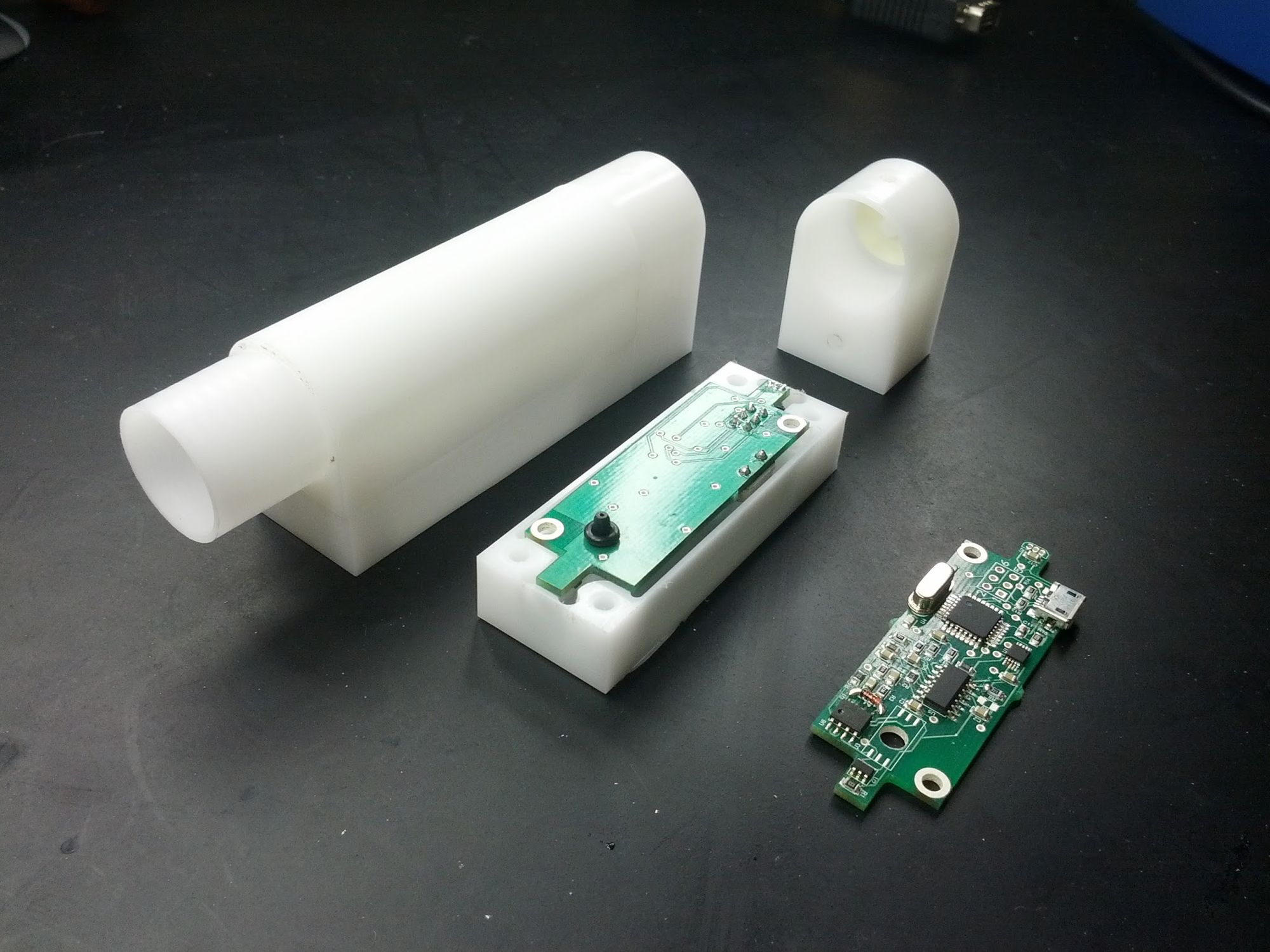
We displayed the project at the final year thesis showcase. Judges awareded us a prize for project with the most commercial potential. That prize included entry to the UQ accelerator program iLab. We took to offer and started on the path from a single hand crafted MVP towards the next phase of development.
### 2013 - iLab and a clinical trial
December 2012 until February 2013 marked the iLab program for us. The startup scene in Brisbane was far less developed than it is today. We had a cohort of six or so other companies, some I knew and others we met in the program. As with most early accelerator programs it was a mix of business basics and building product.

We found faily early in the program that the basic Android App we had made wasn't going to cut it. Kids grew bored of a line on a screen almost as quickly as the plastic pressure meter they were familiar with. I decided to try my hand and becoming a game developer and using the device as a controller. Around the same time we organised with the original clinical team at Mater Children's Hospital[\[2\]](#fn2) to run a small prospective trial. The primary endpoint being compliance.
To run this trial we had to move from the 1 device we had to 25\. We took the opportunity to update the hardware. Somewhere along the way bought an early resin printer to see if we could make use of it for prototyping. The results were sub-par. The printed devices gave us a good idea of form but were too brittle. We ended up using a university CNC to mill the devices from blocks of plastic.

Device and software development continued. We purchased two dozen tablets and got to work. In the end it was almost a year between trial planning and getting the funds and approvals to run the trial. During that year Jeremy and I both also started PhDs full time. Development slowed but we weren't tied to funding which allowed us the freedom to move slowly.
### 2014 to 2015 - Clinical Trials, industrial design, a team and ISO13485
The next couple of years somewhat blurred together. In hindsight, working on a startup and a PhD at once was a recipe for moving slowly. We spent the time between 2014 and mid 2015 iterating on the device as we gained feedback from test users. During this time we added two engineers to our team to help get the product ready for use in the trial.
Around the same time we engaged an industrial design firm to help with design and large scale production. (We also designed a new, friendlier logo).
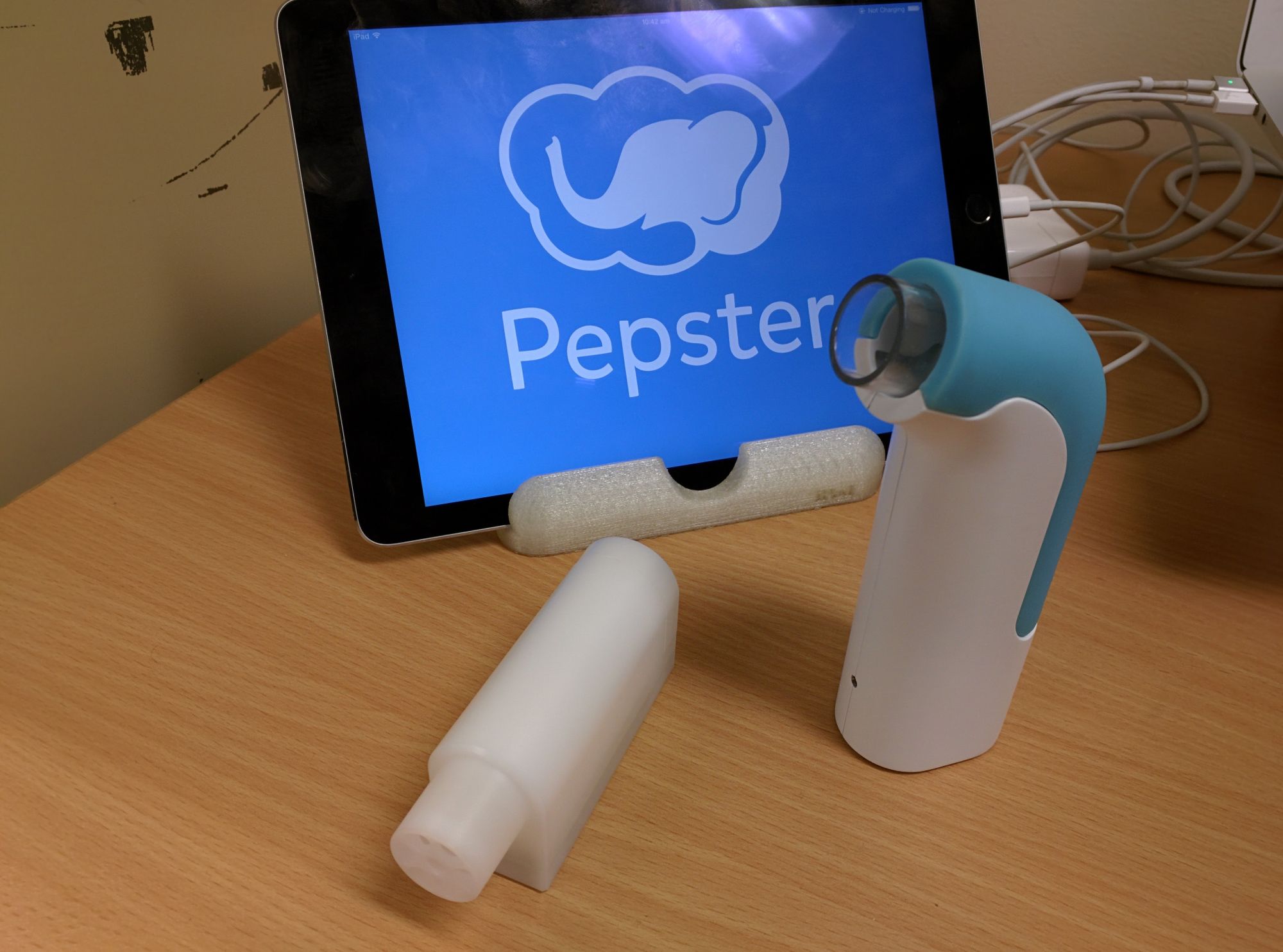
We knew early on that our device was a medical device. Despite advice to attempt to pivot to a wellness product, we felt committed to our mission. We started work on our quality management system and supporting validation documents. Looking back we should have engaged an external partner but learned a lot along the way.
Our trial ran over the course of 12 weeks. Clinicians assigned children device in one of two modes: with feedback or record only. We looked at compliance and how well the recorded pressure matched the target. The participants would randomize into one of the two groups for six weeks and then switch to the other.
Results were positive but due to hardware issues we weren't able to achieve statistical significance. We did uncover useful design changes and understood what sort of repeatability we would need to release the product.
We continued development, design and work on the regulatory approval based on the data we had.
### 2015 - End of an era
Needless to say, Pepster did not make its way to market. We needed to raise capital to finalise approvals and device production. Looking at the market for the device and the funds needed we were unable to find a price point we were comfortable with. Given the device was for at young kids we couldn't add five figures to their cost of treatment.
While the company shut down and the product didn't make it to the market I got a lot from the experience. In many ways it was the first step into a decade of working on medical technology. My PhD and current company are both looking at applying technology to health. The missteps we made allowed me to avoid them the second time around.
---
1. Notably, what experts consider ideal is not a well researched area. We based this on feedback from clinicians that we worked with. [↩︎](#fnref1)
2. This has been renovated and renamed twice since, it's currently the Queensland Children's Hospital [↩︎](#fnref2)
### Prolific
URL: https://www.elliotcsmith.com/prolific/
Last updated: 2021-12-20T04:21:00.000Z
I want to be prolific. There is something inside me that has an almost insatiable need to make things. I have a feeling that if I can grasp that feeling and run with it, I could get there. I have some baggage to shed in that pursuit but it feels within reach.
If you'll indulge me in this I want to write out my thinking. Half journal, half a snapshot of what hopefully marks a turning point.
## Why?
I pondered this a lot. The seemingly arbitrary goal of being prolific seems almost as open ended as wanting to be happy. There are many examples of prolific writers, actors, scientists and thinkers. I don't know which I'll be, likely some mix of many. Regardless I know that for me there is a need to create. To get ideas out and into the world. To build ideas, companies, stories and see how well they hold up outside my brain.
## How?
Reasonable question. Even in writing this I keep coming back to the advice to not share goals publicly. The idea being that announcing ambition gives us enough of a dopamine kick not to bother with the follow through. Perhaps in this goal that doesn't apply. Right now I feel that the biggest barrier for me is two specific worries. Number one, the perpetual worry that I am going to come off looking stupid. Number two, the worry that no matter what I am doing there is always something else that feels like the better use of my time.
The first worry might be some combination of healthy skepticism and an Australian culture of tall poppy syndrome. Worrying that strangers on the internet don't like what you are making is fairly stupid. I can analytically say that my skillset and interests overlap into a pretty small niche. It should come as no surprise to me that of the over eight billion people alive today, some are going to think its bad. Despite that I am going to push on. Make things I love and put them out there. Spend my time worrying if I like what I make not if others like it. That isn't to say I am here for "good vibes only," a lot of my success has come from criticism of my work. It is only to say that nobody gets to be prolific without a bit of time spent looking stupid.
The second worry is no doubt tied into the first. I am sure I am not alone in the following experience:
> It's the weekend. You want to relax and recharge after a big week so you do something fun. Soon you feel guilty for not working so you stop having as much fun. Later you do a bit of work to resolve the guilt and soon find yourself feeling guilty for not relaxing. Repeat until Sunday night.
I end up in this cycle more than just on the weekend. I work too much, feel guilty and spiral into a haze of getting things done slowly but with an ever growing feeling of falling behind.
This past weekend I made a deal with myself. I was going to spend the weekend doing whatever felt like the thing to do in the moment and avoid any guilt for choosing it. In the end, I had a lovely relaxing weekend. I got to spend time doing things I would typically avoid out of guilt and started Monday feeling relaxed and recharged. My plan is to take that experiment and work out how to make that my default mode.
---
If you read this far, thank you for the indulgence. I know that my plans for being prolific are not an attempt to have a popular blog analyzing my own mental blocks. This was a marker. A post to show myself that I can create. Hopefully the start of something wonderful.
### Can we tokenize trust?
URL: https://www.elliotcsmith.com/can-we-tokenize-trust/
Last updated: 2021-10-04T23:13:17.000Z
> What happens when the crowd decides critical matters as easily as following fake news and anonymously criticising people on social media? I assume [#web3](https://twitter.com/hashtag/web3?src=hash&ref%5Fsrc=twsrc%5Etfw&ref=elliotcsmith.com) architects have thought about this? Any recommended reading?
>
> — Phil Morle 🖖🏻 (@philmorle) [October 3, 2021](https://twitter.com/philmorle/status/1444542124821647364?ref%5Fsrc=twsrc%5Etfw&ref=elliotcsmith.com)
It feels like we are in a state of flux right now. Tokenisation and crypto are in their wild west phase. Projects are appearing everywhere trying to make a buck or legitimately move the usefulness of crypto forward. NFTs seem to have reached peak popularity due to how quickly it has become simple to create, mint, and sell NFTs through platforms like OpenSea. On the other hand, the projects seem to be rapidly converging, with most following the same pattern of 10,000 unique combinations of art assets with varying frequency. Much like the wave of trading cards that followed Pokemon in the nineties, one success creates a thousand replicas. Some will succeed. Others won't. Whatever the case, the public understanding of tokens and cryptocurrency is undoubtedly at an all-time high. Beyond art collection, a new phenomenon has begun to appear, the DAO. The decentralised autonomous organisation. They are run by the token holders, at least in theory, but rightly questioned, what happens when a DAO is run by a population susceptible to fake news and hidden behind anonymity?
Keeping in the theme of tokens raises the question of tokenising trust. Can web3, crypto or any other system give us a public, verifiable and trustworthy indication of reliable information? I am currently on the fence. On the one hand, the promise of distributed trust is the foundation of crypto. On the other, a system where reputation and finance are tightly coupled is a hotbed for corruption. Furthermore, do we want to hand over the responsibility of scepticism?
In Neal Stephenson's [Anathem](https://en.wikipedia.org/wiki/Anathem?ref=elliotcsmith.com), there is a moment where the protagonist, a scholarly monk type character, talks with his sister. The conversation centres around a stove that is crudely assembled from simple parts. Erasmas, the protagonist, laments the missed opportunities to optimise and modernise the stove. Citing new technology that could improve efficiency and cost. His sister, Cord, responds that the cost of these improvements is a sacrifice of understanding the technology. The crude stove can be fixed, maintained and improved due to its simplicity. A newer stove would take specialist knowledge to fix and may require tools and parts beyond easy access. All of this is to say that, like the stove, perhaps trust and truth need to be kept crude. To be fixable, understandable and independently verifiable. Tokens, possibly, can assist in this process, but we need to remember the humans even in this technopunk future we are creating.
### Lenses online
URL: https://www.elliotcsmith.com/lenses-online/
Last updated: 2021-07-06T00:31:59.000Z
Focus. Pick an audience. Know your niche. All common advice for creators, but it is advice I am beginning to question. This advice likely originated in the third chapter of a half baked book on startup advice. It is advice repeated across blogs, LinkedIn and youtube about helping people "hustle". If you're cash strapped and building a business or launching a product, it is good advice. If you put yourself out there on the internet, it feeds algorithm-driven self-filtering. Advice that paints a distorted picture of who we are as people and ultimately does more harm than good.
## You're not a business.
In the early days of starting a business, it's tempting to do everything for everyone. You want everyone to be your customer. The advice to focus on a single problem for a single cohort of people keep you sane. It ensures you don't burn through all your funding before getting something to market. I've seen plenty of startups fall over because they tried to do too much for too many people. One I started ended up this way. That doesn't mean it is good advice for individuals. The allure of getting rich as the next rising influencer swapped variety for formula. The weird and wonderful internet of the past has become a drip-feed of AI selected content. Content that would have passed for a black mirror episode a few years ago. I'm hopeful we can find a path back.
Today, everyone is on a path to going viral. To becoming the next influencer on Instagram, TikTok or whatever ends up coming next. The first year on any new platform is a flood of people looking to stake their claim as top talent. Shortly after comes the meta-influencers. They talk 'community' and spout the same tired advice on how to grow your 'personal brand' and rise to the top. Their advice works. It works because platforms are AI-driven filters that someone has learned to trick. They know what gets picked up. More of that content is made, and the algorithms further reinforce the same content and views. When views mean ads and ads means money, there is no incentive to break the cycle. For creators, in most cases, going off piece means a risk of disappearing into obscurity. The algorithm is cold and unforgiving, and a fall is faster than a rise. What this means for many is that your content rarely diverges. As an individual, you pass through a lens, a filter that extracts the AI optimised output of who you are. You're not a business. You're a person, and we shouldn't be filtering out the parts of who we are to help platforms sell more ads.
## The slow decay of the well-rounded person
It's easy to blame ads or AI, but in some ways the change was inevitable. Years ago, everyone had a blog. Forums were on small topics and distributed. Humans, however, are suckers for convenience. Platforms like Facebook and Twitter started to absorb the blogs and forums. Going to one place was easier. Discovery was easier. Everyone else was there. Like a room full of people, a site full of people becomes noisy. To stand out from the noise, people had to change their content. Bob becomes the guy who posts about his dog. Sally posts about her beekeeping. As we scroll through our feeds, we spot the pattern of Bob's familiar puppy post or Sally with her bees. We stop and read and keep scrolling. If Bob posts about surfing and Sally reviews a play, the pattern isn't there. On platforms full of content, a missing pattern means most of us will scroll past.
On platforms driven by engagement, scrolling past is a signal to stop making this content. Team design engagement metrics to be addictive. The AI chose the content, consumers filter for patterns and engage, engagement reinforces. Little by little, conscious or not, this means less variety in content. For some, it may even mean an end to content. Either way, the image of who we are online becoming less and less honest and more a small fraction of who we are. One bent to fit an opening. Despite this loop, there are the mavericks. Those that are happy to be their full and honest self.
## Be your unapologetic, whole self.
My advice is to forget about becoming famous on the internet. Or, if you do plan to do that, make sure you know that is one lens of who you are. Today's platforms mean narrow focus is the path to views, but that doesn't define who you are. You can branch out. You can like bees, surfing, beekeeping and dogs. You can post about a topic for 8 months and then never mention it again. While we are hard-wired for patterns in one part of our mind, there is also a deep desire for human connection. To understand who people are, to empathise with them and to feel connected. We are fast realising that the lens we pass our identities through is a distorting one. That lives online are filtered, edited and crafted to feed the AI and the consumers that play along with it. Write for 10 people. Write for nobody. Make videos that get 100 views from people that love your content.,
Be yourself, your whole weird and wonderful unapologetic self.
### Book Review: Effortless by Greg McKewon
URL: https://www.elliotcsmith.com/book-review-effortless/
Last updated: 2021-06-22T06:42:32.000Z
> Do only as much today as you can recover from before tomorrow
That phrase has haunted me since finishing Effortless by Greg McKeown. If you read that and think, 'Ha, that sounds like weakness', then you are an idiot. I say that with conviction because I myself was an idiot.
I am the kind of person who works too much. I will slog away at things long past diminishing returns because something in the back of my mind says slowing down is going backwards. For most of my early twenties, I was young enough to get away with it too. Energy drinks and excessive calories kept me going long past my body telling me to stop. This year I turn thirty, and I don't bounce back quite as quickly. If I am going to dedicate myself to something for the next decade, I need to be planning on the scale of decades. Burning out in the first year isn't going to get me there.
When I think about exercise, this message is pretty obvious. If I want to run every day or lift weights multiple times a week, then going too hard works against me. My body hurts, I risk injury, and ultimately I fall short of where I want to be. Through this analogy, it's a little easier to think how the same might apply to work. I am not advocating against long hours, deep focus or doing hard things—quite the opposite. I realise that the path to being prolific happens over a decade or more, and in the same way that I can't run for 24 hours once a year to achieve fitness, I can't burn the candle at both ends and expect success.
Effortless had an impact on me because knowing the important things to work on is only step one. Finding a way to work on those things for the rest of my life is just as difficult and ongoing a task as choosing them. The book encourages not waiting for the finish line to enjoy things. That working on hard things can and should be fun. There is no prize for being a moody asshole that spends all his time working.
Anyone who has spent enough time around 'Hustle Culture' and had that bubble pop will probably find this all too familiar. Twitter and Linkedin are plagued with people projecting the idea of working themselves to the bone to outwork everyone else and be successful. I probably bought into this for longer than I should have. In the same way that Instagram is full of doctored photos, these posts are a fantasy. They work because it feels within reach. "If I spend more hours on this, I will win". You won't.
Effortless is a wake-up call. The "How-To Guide" for McKeown's previous book Essentialism. It provides a quick, easy to digest and hard to forget. It's the path to a life of doing the right things and doing them with joy.
Highly recommended.
### On Video Games and Getting Older
URL: https://www.elliotcsmith.com/on-video-games-and-getting-older/
Last updated: 2021-06-15T10:22:37.000Z
When I was a teenager, I played a lot of different video games. I wouldn't say I spent a long time playing video games, but I enjoyed trying new ones. I wanted to be up to date with games, both popular and obscure, and there was a concrete part of who I was wrapped up in that idea. It's been a long time since I was a teenager, but I think that part of my personality was still fighting for its existence until recently.
These days I still play video games. The difference today is I have time for fewer new ones. Life gets busy, and the time I spent reading about new games and trying them out is available less and less. That part of me used to fight hard to exist. As a result, I would become anxious that I was missing out and was less like the 'real me' every day. I'd buy games and never play them. Installing them, then giving myself a reality check, uninstalling them and repeating the process a month later. I became aware of the absurdity of it all and set myself on the task of changing.
What I came to realise is that what I worried about wasn't video games but stagnation. A fear that I would become trapped in routine and feel the years slip by without notice. Keeping on top of everything new meant new experiences, new memories and slowing down the clock. My path to change was coupling acceptance and swapping breadth for depth.
The first step to just about any change is accepting reality. Understanding what was driving my worry meant I could get past it. Much like in [The Tail End](https://waitbutwhy.com/2015/12/the-tail-end.html?ref=elliotcsmith.com), there were really only so many games left that I could commit to if I wanted to see them to the end. Realising that helped me realise that seeing them to the end, or at least until they stopped being fun was more important than playing dozens of new games each year.
Depth became a more important focus. My criteria became "if I had to play this to the end and couldn't expend until I did, would I start?". For many games I had or was looking to buy, the answer was no. It was one question that made all decisions simpler.
If I look at the rest of my life, this pattern exists in many places. I enjoy going deep. I enjoy talking to people who know a tonne of things about single topics. There is just as much to be discovered in-depth and just as much potential to slow down the clock.
### Book Review: Superintelligence by Nick Bostrom
URL: https://www.elliotcsmith.com/book-review-superintelligence-by-nick-bostrom/
Last updated: 2021-06-03T01:34:08.000Z
Nick Bostrom presents a broad and interesting review of the possible futures of superintelligent AI. The book provides an easy to approach summary of threats and potential solutions. Still, the book left me with more of an introduction to vocabulary than a practical approach on what to do about it. As someone working in AI, I felt it was a little too academic in its approach but serves as an excellent general reader overview of the space.
The underlying premise of superintelligence is sound and almost inevitable. Assuming, as we should, that systems and humans continue to become more intelligent over time and that we can create machines to simulate this process, it stands to reason that at some point, we will make a machine that exhibits human-level intelligence. From that moment on, the machine will continue to learn and evolve. Suppose we also assume that learning and evolution can occur faster within a machine environment. In that case, it is a natural conclusion that once a machine is on par with human intelligence, it surpass us with an ever-growing gap between our intelligence and that of AI. Much of the book explores the potential consequences of creating such an AI and how we may limit its existential threat to humanity.
Discussions on the various methods of control and limitations we can apply on a superintelligent AI provide food for thought and an interesting way to look at competition and power within today's human environments. The book focuses mainly on the emergence of a singleton, a single all-powerful AI with no reasonable competitors. This singleton emerges under a wide range of initial conditions based on the idea that an AI with a small head start will grow non linearly in intelligence and quickly become a single powerful force. I have some reservations about this idea. There are genuine hardware restrictions, evident even today, that likely limit the upper ceiling of AIs growth.
Simple things like limitations to available RAM limit even today's AI. While it is reasonable to assume we will continue to produce RAM and other compute resources, these resource constraints lead me to believe that a multi-player scenario is more likely. One in which some several highly capable AIs compete for resources. How we teach them to interact with us and each other is a topic worthy of more exploration.
On a related front, I think in today's political climate, and with most countries driven by capitalist competition, we are even more likely to see a multi-player scenario. This scenario poses its own set of dangers. Any of these groups working on an AI with even a long term goal of superintelligence will be aware of constraints on today's resources. Knowing the power such an AI could give these groups the threat or weaponisation or more subtle AI manipulation is very real. Given that technology, AI or otherwise can be developed and released much faster than new social norms. There is a severe risk of danger in an unregulated AI free-for-all.
I am sure that at a national security level, AI is fast becoming a central discussion point. In a world where AI in some form controls the media we consume, the directions we take to work, and many other facets of day to day life, there is a chance to war on new frontiers. In days gone by, supplying illicit and illegal drugs to a population could be used as a tactic of war. Today, perhaps addiction has become digital, controlling the ideas of the population. While it feels somewhat like a conspiracy theory, it is all very possible. I am optimistic that we will develop new AI aware social norms that counter some of this potential manipulation, intentional or otherwise, but this will take time.
Overall while I enjoyed the book and would recommend it to others, I think there is a need for more discourse on the closer and perhaps just as dangerous threats. I liken it to reading about how the sun will one day engulf the earth whilst ignoring the genuine and present dangers of climate change. All that being said, if this book opens the door to more AI research and brings forward the development of a new AI aware social norm, then it has done its job.
### Book Review: Ultralearning by Scott Young
URL: https://www.elliotcsmith.com/book-review-ultralearning-by-scott-young/
Last updated: 2021-06-03T00:09:11.000Z
Ultralearning by Scott Young is a practical, well-written guide to learning things at speed. It should appeal to anyone who loves productivity hacks, deep work or general self-improvement. The book combines tactics with well-researched examples. This combination provides a clear introduction to some interesting learning techniques without feeling like a textbook.
The book opens with an introduction to the concept of Ultralearning and what separates it from regular learning. Ultralearning is intense, self-directed skill acquisition for a direct outcome. Young intentionally contrasts this with learning for fun, noting that while both can be a valuable use of time, Ultralearning is different. With some insight into the blight of self-help, Young calls out counterexamples where regular learning is enough and Ultralearning can fail.
Chapters 4 through 12 cover a set of principles Young defines as key to Ultralearning. Each chapter begins with a story capturing the principle and showing its application in the real world. These principles are the meat of the book; my reflections on some of these principles will follow. For an excellent introduction to Young’s writings, I highly recommend his post [Do The Real Thing](https://www.scotthyoung.com/blog/2020/05/04/do-the-real-thing/?ref=elliotcsmith.com).
Principle 1 is Meta-learning. I found the most critical part of this chapter to be the emphasis on setting up Ultralearning projects. By their nature, these projects are intense and will take a lot of time. Having both a plan of attack and a good idea of why you’re setting out to learn something new can help keep things on track. I can certainly relate to getting halfway into learning a new skill and wonder why you decided to go down the path in the first place. Another good take away is using courses and textbooks as road maps to the topics you will need to cover.
Principle 2 is Focus. This chapter covers common ideas around time blocking, procrastination and generally getting things done. A comment that stuck with me was that a state of Flow is often incompatible with Ultralearning. Young states that the difficultly associated with Ultralearning projects is at odds with Flow. Roadblocks and not knowing what to do next tend to break the rhythm.
Principle 3 is directness. In the spirit of directness, go read [Do The Real Thing](https://www.scotthyoung.com/blog/2020/05/04/do-the-real-thing/?ref=elliotcsmith.com). It summarises this chapter well.
Principle 4 is Drill. This chapter covers how to continue to attack a problem until your skills improve. The main principles here are finding the areas in which you are weakest and find ways to improve on those areas specifically. This chapter feels quite similar to [How to do hard things](https://www.drmaciver.com/2019/05/how-to-do-hard-things/?ref=elliotcsmith.com).
Principle 5 is Retrieval. The chapter covers ideas, including recall as a method of learning. In several studies, free-recall (i.e. unprompted recall) outperformed other forms of study despite self-reported confidence being lower. The chapter covers several techniques for retrieval practice, including spaced-repetition, post-reading summaries for memory and self-generated testing.
Principle 6 is Feedback. The chapter focuses on three types of feedback. Outcome feedback which is a signal of overall win/loss often at the end of a task. Informational feedback which is more granular and outlines which variables are failing. Finally, corrective feedback which is informational feedback with the addition of some signal on how to correct the problem. Corrective feedback is hard and may require expert input. Noise can come from others, and asking for higher levels of feedback without preparation can lead to problems. People may guess or exhibit some form of ‘white coat’ feedback and tailor responses to what they expect the asker to want to hear. The chapter goes on to discuss different methods of ensuring feedback is of high quality. These methods include filtering noise from the signal, balancing negative and positive feedback, using metrics to get feedback on the rate of learning and to see high-frequency feedback.
Principle 7 is Retention. The chapter talks about why we forget. Some forgetting is linked to decay, the natural process of losing memories with time. Young then counters this idea with anecdotes of memories from childhood that are more vivid than those from more recent times. This likely indicates that there is some factor of importance applied to what gets remembered. Secondly, the forgetting but are rarely quickly accessible enough to serve real-time value.
Principle 8 is Intuition. The chapter covers ways to build intuition and dispel false confidence. One section that stood out was the idea that training yourself to ask a lot of questions is a cure for the [Dunning Kruger Effect](https://en.wikipedia.org/wiki/Dunning%E2%80%93Kruger%5Feffect?ref=elliotcsmith.com). A second technique covered was the “Feynman technique” which involves taking a problem or topic and aiming to explain it to a novice. This method can help to find areas where your explanation is lacking and direct further learning. An extension to this is instead aiming at a general audience; in this case, you’ll often need to use analogies to explain ideas which require a deeper understanding of the subject.
The final principle in the book is Experimentation. The chapter is focused on experiments as they relate to learning. The chapter covers experimentation with resources, technique and style of learning to ensure that you maintain a high rate of knowledge acquisition.
The remainder of the book covers starting an Ultralearning project and instilling these ideas in others, including children. Overall this is an excellent book and one I would recommend. It has inspired me to start an Ultralearning project of my own.
### Planning and Fear
URL: https://www.elliotcsmith.com/planning-and-fear/
Last updated: 2021-06-03T00:12:00.000Z
More of my time has been lost due to fear than poor productivity. I am a sucker for productivity hacks. If there is a tool or system that can squeeze a little more out of my day, I’m willing to try it. For a long time, this leads to a cycle. I would try something new for a while, run into a wall, discard it and repeat. I found myself discarding something and trying something new only to come back to the thing I had discarded. Usually with some renewed vigour that this time it would be different. I did this for a long time. Somewhere through this process, I noticed I was doing it. Why I was caught in this cycle turned out to be simple, in the most frustrating way. I ran in circles because doing fake work is easier than doing real work.
I first began to notice the pattern after reading Cal Newport’s [Deep Work](https://www.calnewport.com/books/deep-work/?ref=elliotcsmith.com). It was some time in 2013, and I was a year or so into my PhD. Newport’s book helped me see that a great deal of the work I had done so far was shallow. Optimising code rather than solving research problems. If you looked into my office at the time, I would have looked productive. Days planned into neat, hourly blocks, a todo list being ticked off, Pomodoro timers ticking away. Day’s flew by, but I wasn’t moving anywhere important. Eventually, I started to notice. My first thought was that my day planning must be wrong. I dropped my daily routines and found new ones. They were fresh, and it felt different. That feeling sustained me until I ended up in the same position. I wish I could say it only happened once before I caught on. I got there in the end but not without wasting more time on the wrong thing.
The reality is that the world is full of things adjacent to real work. These nearby things feel like work. They take time and effort. They’re close enough to the actual work to feel like progress. Newport’s Deep Work was the first hint that maybe not all progress is a good use of time. It was easy to fill my day with shallow work. It felt like an accomplishment, but it wasn’t the real work. I needed to learn to cut through to the actual work. As Scott Young put it in his post, I needed to [Do the Real Thing](https://www.scotthyoung.com/blog/2020/05/04/do-the-real-thing/?ref=elliotcsmith.com).
I took a long time to learn to move past the shallow work. Sitting down and taking an objective look at your output is hard. It likely falls into the category of deep work. A part of me knew. That part of me was happy in the illusion. To create an honest reflection of how I was spending my time was scary. I wrote down everything I wanted to achieve and everything I had done or had planned. I had to stare at the page and realise there wasn’t a clear link between them. Once it was on paper, it was clear. It was scary and demoralising. There were many points where I wanted to stop and find a new ‘hack’ instead. I knew, though, that if I wanted to get something important done, I had to be honest with myself.
Looking back over the time since 2013, I know I have fallen into the same pattern from time to time. Each time I do, I get a little more comfortable facing the hard truths. A little more comfortable admitting to myself when I am wasting time. A little more forgiving as well. I realise that what stops me is usually fear.
Fear is a strong driver or behaviour. It can stop us doing essential things. Several times when writing this, I have thought to myself “Elliot, what are you doing, you don’t need to write this”. From years of that same feeling, I know that it comes from a place of fear. A fear that what I write won’t resonate. A concern that I said something wrong. Pushing past that fear to carry on regardless has taken time to learn. I’m not always perfect at it, but I can look at those feelings and recognise them for what they are. Once I understand them, I can move past them.
These roadblock fears are often the easier ones to push through. They only appear when you are moving towards real work. Eventually, once I learned to spot these signs, I grew to like them. They were a sign that I was heading in the right direction. The same way that I get nervous before a pitch or talk. They’re a small reminder that something good is going to happen. Unfortunately, this is not the only way that fear can block progress. It has a more damaging and more subtle way to keep us from feeling uncomfortable.
The second form of fear shows up when we are planning. It’s the form that leads to cycles of productivity hacks and days full of shallow work. This form of fear doesn’t feel scary. It hides behind the excitement—the excitement of planning and productivity. Things I very much enjoy. It steers me in the wrong direction. It causes me to link a lack of progress to a failure in the system. This process can go on for a long time. Getting past it is not easy. It takes honest reflection—the type of reflection where you take a hard look at yourself. When self-reflection and productivity hacks are the choices at hand, it is no wonder I’ve picked the easy one so many times.
I have become better at this by learning and practising self-reflection. In practice, this is a combination of regular reviews and making choosing the real work simple. To help make choosing the real thing simple, keep a list—a list of things you are avoiding. I have a separate TODO list called ‘The Avoidance List’. I add items to it whenever they cross my mind. Things I know that I should be doing but aren’t. Then, when I come to plan, I make sure that is the first place I look. It is not an instant cure, but it means that when I plan, I’ve already done the hard work of choosing what’s important. Reflection comes in the form of looking back over my day or week and being honest with myself about what got done.
That doesn’t mean I try to spend every day working 24 hours at 100% capacity. Doing essential things and making use of every waking second are different goals. This idea was captured well in the post [How to Be Great? Just Be Good, Repeatably](https://blog.stephsmith.io/how-to-be-great/?ref=elliotcsmith.com). Younger me was obsessed with productivity because I felt it was the path to progress. More than that, I thought it was the only lever I could pull. I know now that it is one piece of a bigger system. Productivity on the wrong things is worse than being unproductive. It drains your energy without moving you forward. My current go-to model for this is from Greg McKewon’s book [Essentialism](https://gregmckeown.com/book/?ref=elliotcsmith.com). McKeown describes it as “The Disciplined Pursuit of Less”. It is easy to overlook the word disciplined in that description, but it is key to success. A single weekend of planning or a late-night productivity revolution isn’t the answer. They may provide a burst of action, but every time I have relied on these bursts, I am back to where I started before too long.
The best path to dispelling fear is putting in the time. In this case, it means making reflection a regular, almost constant activity. Every time I do it, I build an internal filter for fear-driven work. I get a little better at planning for the real things. Day by day, week by week, I learn to spot the important stuff. I learn to spot the cosy distractions and spend more of my time on the things that matter. I am planning for the fear so that fear doesn’t do the planning.
### Leverage
URL: https://www.elliotcsmith.com/leverage/
Last updated: 2021-06-03T00:12:59.000Z
I was listening to an interview between Seth Godin and Tim Ferris. In the interview Seth classified the difference between freelancing and entrepreneurship. In a rough rewording, it came down to leverage. Freelancing is all about swapping your time for money. Entrepreneurship is about finding a need and filling it with a resource that isn’t you. That might be a new person, a new process or some new piece of technology. The key factor is that an hour of your time creates the output of more than one hour of work. This is another one of those things that’s ‘so obvious that it’s easy to ignore’. Things in this category tend to be hard to give clear direction on. There is no step by step to success. There are, plenty of ways to screw it up. This is about one of those ways that hits me in the face.
For me, the hardest part of finding leverage is how exciting it is to be in the trenches. Most times you got into whatever you are doing is that there was a hard valuable problem you felt needed fixing. True enough for me at least. The curse of being a technical founder is that solving that problem by building things is fun. You need to bury that desire for the benefit of the bigger picture. Learning this is one of the harder transitions I’ve had to go through.
In the theme of simple obvious things, there are several things that have helped me with this. One is transparent accountability. Every day, across the company I write down in public what my plans are. The people I work with know I shouldn’t be bug fixing unless it’s dire. Most of the benefit here is not from people calling me out. It’s knowing I need to put it on the wall. Another thing that helps is finding time to step back. It’s hard to find leverage if you are focused on the microscopic details. Make time by booking a slot in your calendar for looking at the bigger picture. The hard thing here is treating a meeting with you like you would a meeting with someone else. Don’t be late, give it your full attention and keep a good list of action items and follow up. Make it a mantra. Every day, ask what is the most important leverage you can generate. High Output Management taught me that leverage is key. Plan your day around that question, be brutally honest with yourself and you’ll be okay.
### Being Comfortable Being Uncomfortable
URL: https://www.elliotcsmith.com/being-comfortable-being-uncomfortable/
Last updated: 2021-06-03T00:13:40.000Z
I’ve come to realise that anything that’s worth doing is located at least one foot outside your comfort zone. The things that matter are there, like starting relationships or ending them, diving into your next startup, learning a new skill. All these things come to people who put in the work and spend time time doing things that are uncomfortable. The tough part is that most of these things aren’t essential. You can live a life inside your comfort zone and do just fine. Just, fine and probably not much else. The way to stop doing ‘just fine’ and start doing well is to become a person who enjoys discomfort. Someone who revels in it. When that happens, it becomes a drip feed of the reward you’re chasing and fuels you to the finish line. The biggest change I made on a personal level was realising the value of discomfort and putting in the work to be a person who likes working there.
Five years ago, discomfort was the fence around my decisions. My limit for doing hard things was about as long as it took to finish an essay the night before it was due. I was anxious, introverted and lacking self confidence. Looking back, there were numerous opportunities I passed up because they were outside my comfort zone. Often I would have dozens of reasons to justify why something was a bad idea but deep down, they were excuses biased by an aversion to discomfort. Worse than passing things up was indecision.
A common sign of the comfort zone dweller is having lots of ‘projects’. Projects aren’t bad but having lots of them means that when one gets tough there are escape routes everywhere. The ‘task management done properly’ project I started in 2011 languishing without a single contribution is an ironic portrayal of my mindset at the time. I would start things, lots of things. Things I’d never finish. The reason they sat unfinished was because when a choice had to be made about which project to focus on, comfort got an extra vote. Why battle through that problem I had last week when I could work on any of these other projects. This happened more than I’d care to admit and extended beyond work and pet projects into my social life as well. I was blind to the problem but a rude awakening was just around the bend.
That rude awakening came in the form of a PhD. I’d finished my undergraduate studies and was offered the opportunity to keep studying. Looking back part of that decision was probably made because it was what I knew. Around 3 months into my PhD I came to the realisation that I’d stepped into something bigger than I could handle at the time. As hard as it is to admit before then I had little need to take initiative and self direct. The anxiety of not knowing how to continue or what to work on built up and I knew I needed to make a change. I turned to the internet for motivation. Life hacks, mind hacks, study hacks and other get productive quick schemes. Almost everyone will see a productivity boost tying some new ‘hack’ for about a week. Almost everybody will see that boost taper away when the shine wears away.
The thing I found consistently was that the true test of almost any method is a shitty day. When things are working out and it’s business as usual it’s easy enough to rack up pomodoros and crosses on the calendar. When things fall apart, the little ticking tomato on your desk becomes a painful reminder that everything is still broken. It’s that moment when the system falls apart. When the stress crosses that threshold of comfort and becomes anger. Eventually I got tired of the hacks and decided I needed something more fundamental. I noticed others around me. There was a subset of people who worked as hard, hit as many problems but didn’t let it slow them down. These people were the high performers, publishing like crazy while keeping their sanity.
I spent time trying to distill the differences between them and me. After a long process of illumination and a dispelling of imposter syndrome, I found the magic bullet. The people I looked up to faced discomfort head on and moved through it. They knew that the hard thing was a barrier to the valuable thing and they wanted that valuable thing bad enough to push through it. Heading back to the books and blogs I found that others knew this secret too. I soaked it in and took the plunge, no more Mr. Easy Street. I was going to embrace discomfort if it was the last thing I did.
All journeys look shorter from the finish line. If I’m being honest becoming someone who enjoyed discomfort was a gradual process. I figured small steps were the way forward seeing how quickly my ‘hacks’ had burned out in the past. I kept a log of my work, knowing that’s what I wanted to improve, and set myself a goal of doing more things just outside my comfort zone. I started with taking cold showers in the morning as I read somewhere online it was a good place to start.
Cold showers suck. Nobody is likely to argue with that, ice cold water is not something many people bound towards. It teaches a valuable lesson though. Cold showers suck, for the first 5 or so seconds. After that the discomfort subsides pretty quickly and it’s just a shower. Most other uncomfortable situations are fairly similar. There is an initial hurdle of resistance and then it’s typically not as bad as it looked from the outside.
Cold showers led to other little challenges. Talking to strangers in lines. Calling for pizza (I hated answering the phone more than just about anything). Forcing myself to work for 5 more minutes before getting angry at a problem. One by one the small steps added up and I noticed myself changing. At the end of the day I had achieved more and didn’t feel quite as overburdened. Tough problems became a challenge I enjoyed facing and I felt the reward of heading to the goal not just reaching it. When there was work to do, I would do the work, comfort be damned.
Taking the easy path is easy, as the term suggests. There are hundreds of options along the easy path, temptations are plentiful. Just like chocolate milk and ice cream are easy to eat, taking the easy road will come back to haunt you. Comfort zone bias is a formidable force. As humans, we are experts in post-rationalisation, but don’t let it fool you. Being uncomfortable is the practice of going against your gut; doing the things that’s hard because something exponential might happen.
In a business context, the ability to be uncomfortable, often referred to as ‘grit’, is a large contributing factor to big success. The Facebooks and Teslas of the world all started doing something outside the norm. Socialising online and driving an electric car were once the habits of a reclusive subculture but have since become (or are becoming) the default. For Mark or Elon to have gotten where they are now as business leaders, there were no doubt moments of discomfort; ones they had to push through despite having a voice in their head telling them they are making a mistake.
These founders have an air about them. You can feel the passion the have for their business and the war stories they tell give the feeling they’re in it for the long haul. When things get tough they don’t move onto a new business, they soldier on and move them selves one space forward on the business board game. This kind of attitude should be seen as a competitive advantage. In an ideal world everyone would work hard and embrace discomfort to build the unicorns of tomorrow. In the world we live in this is far from the case.
So take the plunge. Or rather, take a thousand small plunges. Challenge yourself to do uncomfortable things. Showers, phone calls or just working on hard problems. Do the small things to build the strength to be uncomfortable when it matters. Train for the day that all the voices in your head are shouting stop and you push on anyway. Embrace the discomfort, step outside your comfort zone and find the things worth doing.